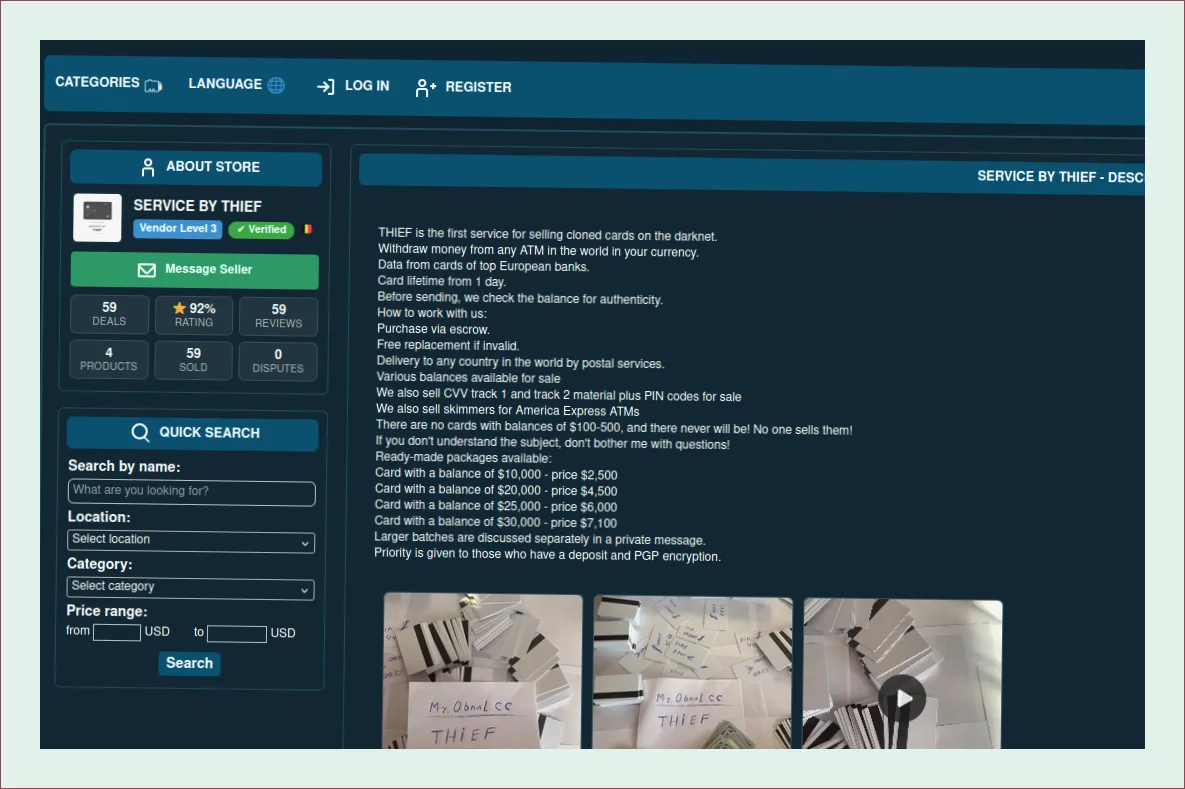
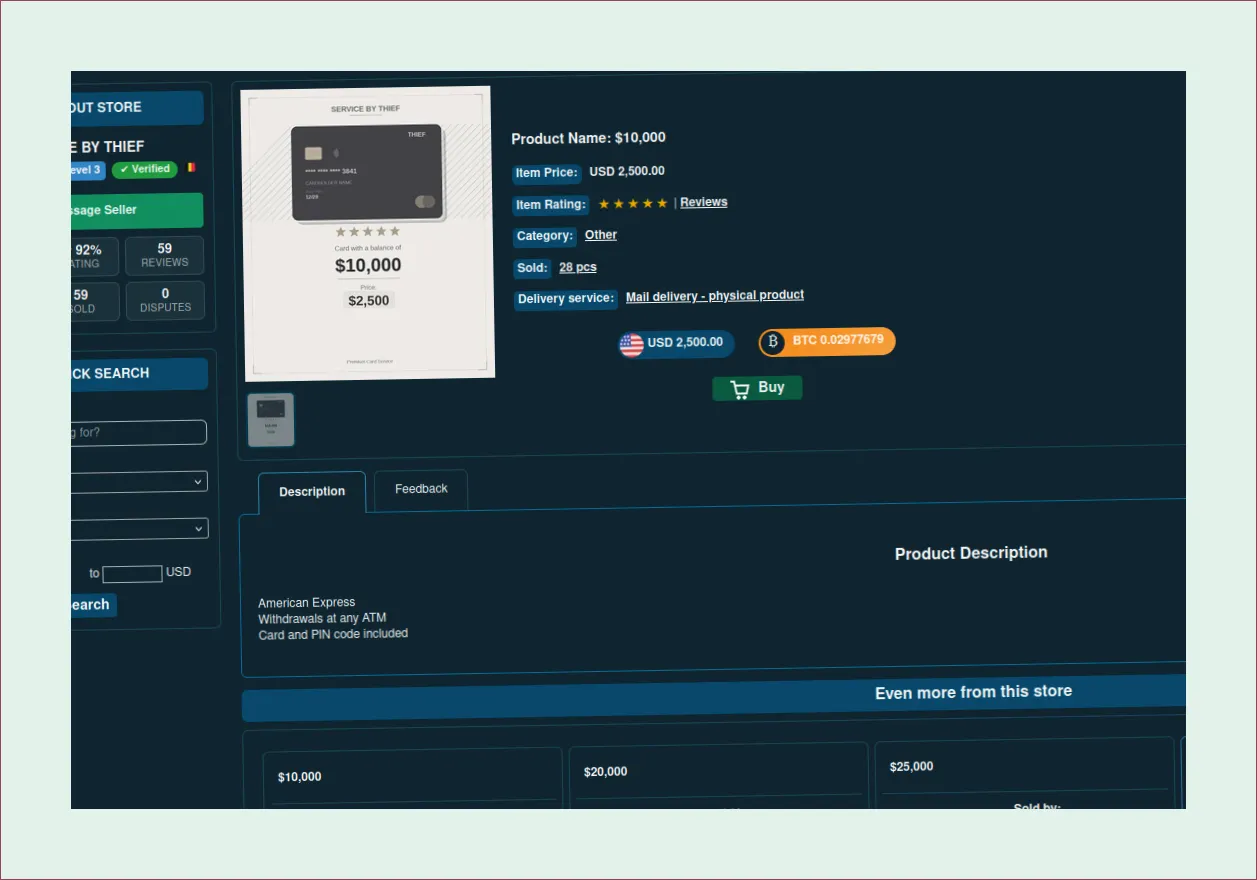
Mark T. was 34 years old and lived in Tampa Bay when he believed he had found an easy path to financial success in November 2024. In November 2024, six counterfeit debit cards, each with a unique PIN, were obtained by him for $480 in cryptocurrency, allowing him to withdraw $4,200 from the first three ATMs he visited. However, his luck took a turn at the fourth ATM, which not only dispensed an additional $700 but also captured vital evidence that ultimately led to his arrest.
This situation highlights a common misconception: many individuals believe their online activities are entirely separate from their real-world identities. In reality, Mark's actions connected him to a cryptocurrency exchange, numerous transactions on various marketplaces, ATM records, surveillance videos, and incriminating evidence found in his home. Just 72 hours after making his withdrawals, he transitioned from being untraceable to being apprehended, with the complete timeline from his initial cashouts to his arrest spanning only 15 days.
1. 1. How the carding chain worked
The operation was relatively simple. Mark's approach was executed in five clear steps:
- Data collection: Offenders acquire track 1 or track 2 details through methods such as ATM skimmers, phishing attempts, or by buying data from illicit online platforms.
- Card fabrication: This information is then encoded onto blank cards, ensuring it appears authentic with a name, card number, and expiration date.
- PIN acquisition: They can capture the PIN using covert devices or hidden cameras at ATMs, enabling the buyer to withdraw cash.
- Funds extraction: The buyer proceeds to take out cash before the victim realises the fraudulent act and notifies the bank to block the card.
- Laundering the cash: The cash is subsequently converted into cryptocurrency, likely to hide its origins.
Mark chose a specific online platform for his cards and decided to use Monero for its privacy advantages. The delivery arrived in plain packaging, creating a false sense of a successful transaction. However, the buyer failed to consider the sophisticated capabilities of the ATM, which not only dispensed money but also collected vital evidence as the online crime transitioned into a physical act.
2. 2. The ATM camera he overlooked
The camera changed everything. Today's ATMs are outfitted with advanced surveillance features, including a camera that records users in striking 1080p quality, often utilising infrared capabilities for low-light situations. Some versions even have an additional camera positioned to provide another perspective. These devices meticulously log transaction specifics, such as the precise time, the sum involved, the card number, the machine's ID, and the outcome of the interaction. Furthermore, they gather geolocation information to pinpoint the machine's location and maintain network logs that monitor requests and metadata sent to the bank's processing system.
During his trip to the fourth ATM located in a Tampa Bay suburb, Mark opted not to conceal his identity with accessories like a mask, hat, or glasses. The camera embedded in the machine captured his image as he withdrew $700, retrieved his card, and departed, resulting in a video clip lasting 23 seconds. This occurrence underscores the fact that the anonymity typically associated with the darknet does not apply to ATMs, where digital crimes become tangible actions.
3. 3. The 15-day investigation
The investigation unfolded rapidly, combining various types of evidence to form a detailed understanding of the situation.
- Day 1, November 2024: Reports came in from three individuals in Florida, Georgia, and North Carolina about withdrawals they did not authorise. Their banks responded quickly, blocking these compromised cards and triggering early fraud alerts.
- On Day 3, a concerning trend of rapid withdrawals was detected by fraud detection algorithms, which were linked to cloned cards originating from a specific group operating across various states. This alarming discovery prompted an immediate alert to the bank's fraud investigation unit.
- Day 5: The situation escalated to the U.S. Secret Service, a federal agency focused on financial crimes. An analyst requested transaction records and video evidence from all relevant ATMs involved in the withdrawals.
- Day 8: The footage from one ATM revealed a clear image of a suspect. This image was cross-referenced with state records, identifying him as Mark T., who had no prior criminal history. Analysis revealed that all withdrawals took place within a 40-mile radius of his home.
- Day 12: Authorities secured permission to investigate Mark’s online activities, including his browsing history, Internet Service Provider logs, and transactions in his cryptocurrency wallet. These records indicated that he accessed Tor exit nodes during the times of the fraudulent transactions, linking his Monero wallet to a darknet marketplace.
- On Day 14, at Mark's residence, items including six blank plastic cards, a magnetic stripe reader/writer, a laptop with evidence of his digital activities, and $3,200 in cash were recovered following the execution of a search warrant.
- On Day 15, after his arrest, Mark confessed to obtaining the cloned cards and cashing out four of them. He mentioned that the remaining two cards had been blocked by the bank before he could attempt to use them.
This timeline illustrates the impressive speed with which contemporary financial crime can be investigated, highlighting how quickly illegal activities are identified and addressed.
4. 4. The figures behind the case
The figures paint a stark picture: Mark’s alleged earnings were small compared with the serious legal consequences he faced.
The money taken came to $4,900, while spending on the cards totaled $480. Mark made 4 withdrawals, and 15 days passed between the withdrawal and his arrest. A sentence of 5 years, or 60 months, was imposed for federal prison. | Total fines and restitution | $22,000 | | Length of supervised release | 3 years |
This instance highlights how swiftly situations can intensify within the realm of financial misconduct.
5. 5. Why Monero did not protect him
Monero did not succeed in adequately concealing Mark's identity. He utilised a centralised exchange that enforced know-your-customer protocols, requiring him to provide his passport and a selfie. As a result, any legal inquiry could easily uncover both his personal details and the specifics of his transactions. Although tracking the subsequent movements of Monero presented difficulties for law enforcement, the exact sum he obtained on that particular day became crucial evidence.
The order of these transactions held notable importance. Mark's acquisition of Monero aligned with a marketplace transaction, postal delivery, and ATM withdrawals, all occurring within a mere fortnight. Additional evidence was gathered from cards discovered in his residence, as their magnetic strips matched the data obtained from actual victims. Ultimately, even though Mark might have executed his plan with great care, no cryptocurrency could eliminate the ATM surveillance footage that clearly captured his presence at the location.
6. 6. The mistakes and defensive lessons
Errors piled up. Situated within a 40-mile radius of his home, the four ATMs he accessed made it easy for anti-fraud systems to detect these transactions. His face was clearly visible in the surveillance footage, and the absence of any disguise made identification through relevant databases straightforward. Furthermore, his Know Your Customer (KYC) exchange account linked his personal information to the acquisition of Monero, further jeopardizing his anonymity. He also kept critical evidence, such as cards, an MSR device, and a laptop, at his residence. Even if he tried to erase his digital footprints, the Tor Browser can leave identifiable traces, and the history of operating system updates might indicate its use.
The $3,200 seized during the investigation corresponded with the denominations dispensed by the ATMs, which was a minor but significant detail reinforcing the case against him. Furthermore, the rapid succession of withdrawals, all completed within a two-week window, triggered automated detection systems. While spreading those transactions out over several months might have delayed alerts, the surveillance cameras would have still captured his image.
For security professionals, this case underscores the importance of continuing to invest in advanced machine-learning anomaly detection methods, geolocation rules, scoring models, and other protective measures against fraud on the banking side. It also highlights the necessity of integrating both physical and digital forensic efforts. While video surveillance provides a face, the transaction logs pinpoint the exact moments that require investigation. Vulnerabilities in KYC processes and physical cash-out locations can challenge claims of anonymity in cryptocurrency transactions. Moreover, encouraging quicker reporting from customers enables banks to block compromised cards more swiftly, which can significantly mitigate potential losses.
If you are curious about identifying a card reader that might have a skimmer, this source does not evaluate inspection methods or consumer products related to that issue. It also refrains from comparing various devices purported to detect or protect against skimmers, meaning we should avoid forming unsupported product recommendations based solely on this case. Before considering any device as a solution for skimming protection, ensure that its claims are verified through independent sources; the evidence discussed here relates to fraud detection and reporting rather than equipment evaluations.
7. 7. The federal verdict
The sentencing occurred after the guilty plea. In March 2025, Mark confessed to charges related to fraud and actions concerning access devices as defined in 18 U.S.C. § 1029, alongside money laundering offences under 18 U.S.C. § 1957. The judgement was delivered by the U.S. District Court located in the Middle District of Florida, imposing a punishment of 60 months in federal prison, followed by a supervised release period of three years. Additionally, Mark was mandated to pay a fine amounting to $22,000, along with restitution to the three victims affected.
It’s important to note that the judge recognised Mark's position as not being the primary instigator of the criminal activity, but merely the final consumer. This fact, however, did not absolve him from facing consequences; individuals who are the last link in such chains take on significant risks and thus incur penalties. The individuals orchestrating these schemes often remain elusive, which continues to pose a challenge for law enforcement agencies.
What the case ultimately shows
We are delving into a case that illustrates how automation, surveillance, and digital transactions can intertwine to reveal significant evidence. In this situation, an automated alert initiated the investigation, while CCTV footage identified a suspect, and transaction records connected him to cryptocurrency purchases. A search of his home uncovered physical proof that reinforced these findings. Court documents linked Mark to the transaction timing and the seized items from his property, establishing a clear connection.
It is a common misconception that complex strategies lead to success; however, in this case, it was the straightforward details that mattered. The combination of a surveillance camera, precise transaction times, a verified exchange account, and the recovered evidence transformed a cash withdrawal of $4,900 into a substantial sentence of 60 months in federal prison.
The court record connected Mark to the website where the purchase was made through timing, exchange records, and evidence seized at his home.
Questions readers ask
How much money did Mark withdraw?
He completed four withdrawals totalling $4,900. The first three produced $4,200, and the fourth added $700.
How was Mark identified?
A fourth ATM recorded 23 seconds of clear footage, and the face matched his Florida driver’s licence record. All withdrawals were also within 40 miles of his home.
Why did using Monero not keep him anonymous?
He bought Monero from a centralised exchange that held his passport, selfie and transaction history through KYC verification. A court order connected that purchase to his identity and the relevant timing.
What sentence did the court impose?
Mark received 60 months in federal prison, three years of supervised release, and $22,000 in fines and restitution. He had pleaded guilty in March 2025.