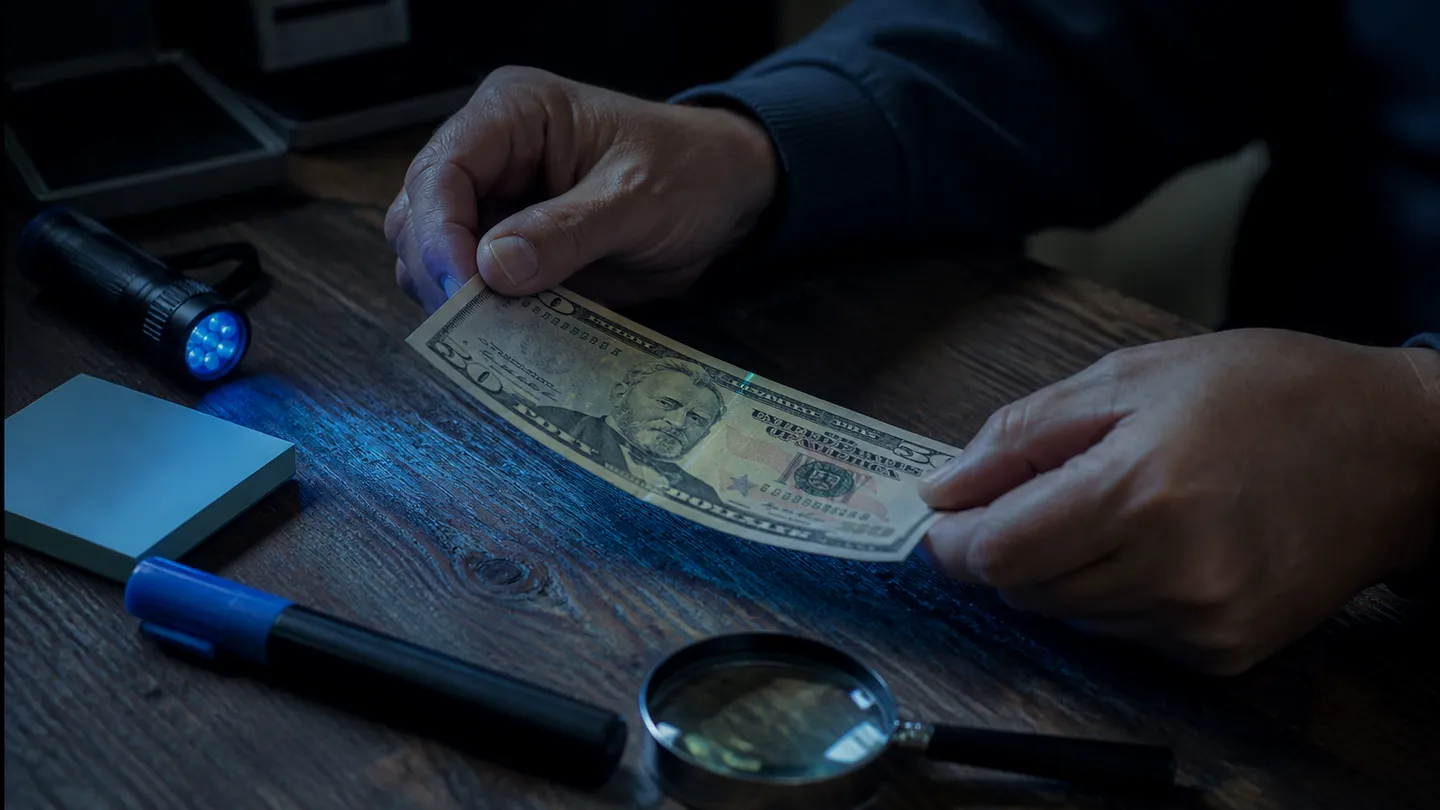
Counterfeit money is advertised and sometimes sold on the dark web—the intentionally hidden part of the broader deep web—but listings do not prove convincing notes will arrive.[1][2][3] Buyers face advance-payment and escrow scams, cryptocurrency tracing, and U.S. penalties of up to 20 years for knowingly possessing or passing counterfeit currency with intent to defraud.[3][4][5][6]
Deep Web vs. Dark Web: What the Terms Actually Mean
The terms "deep web" and "dark web" are often used interchangeably, but they refer to distinct parts of the internet. The deep web encompasses all online content that is not indexed by conventional search engines, which includes a vast array of ordinary private databases, academic resources, medical records, and account pages. In fact, estimates suggest that the deep web is significantly larger than the surface web, comprising about 90% of the total internet content[1].
In contrast, the dark web is a small, intentionally hidden segment of the deep web that requires specific software, such as Tor, to access. This area is often associated with illicit activities, including the sale of counterfeit currency and other illegal goods. However, it is important to note that not all dark web activities are criminal; many users turn to it for legitimate reasons, such as protecting privacy and circumventing censorship[1].
Deep Web vs. Dark Web Comparison
| Feature | Deep Web | Dark Web |
|---|---|---|
| Accessibility | Not indexed by search engines | Requires special software (e.g., Tor) |
| Content Type | Private databases, forums, etc. | Illicit marketplaces, onion services |
| Size | Approximately 90% of the internet | A small subset of the deep web |
| Legal Activities | Mostly legal | Contains both legal and illegal activities |
| Anonymity | Generally not anonymous | Designed for anonymity |
While the dark web contains marketplaces where counterfeit currency is sold, these listings represent only a small fraction of the overall deep web content. For example, a study found that only 243 counterfeit products were advertised across 18 vendors in dark-web shops during a specific period[3]. Moreover, buyers in these marketplaces often face significant risks, such as advance-payment scams and minimal protections against fraud[3][4]. Understanding these distinctions can help individuals navigate the complexities of online transactions and the associated risks.
Is Counterfeit Money Really Sold on the Dark Web?
Counterfeit money is indeed advertised on the dark web, but it's essential to distinguish between listings and actual sales. Research indicates that while counterfeit-currency listings exist, they do not guarantee that buyers will receive convincing notes. A peer-reviewed study covering the period from August 2018 to February 2020 identified 243 counterfeit products across 18 vendors, including 14 dark-web shops and one dark-web cryptomarket[3]. However, these advertisements often overstate the quality of the products, claiming features like watermarks and security threads that may not be present in the actual notes[3].
Moreover, buyers face significant risks when engaging with these dark-web vendors. Most require advance payment, and only a few accept escrow services, leaving customers vulnerable to scams if the promised goods are not delivered[3]. A study highlighted that fraudulent sellers might even operate fake shops and recommend non-existent escrow services, adding another layer to the risks involved[4].
While there have been verified cases of counterfeit money purchases on the dark web, such as the 2026 DOJ case where Jason Christian Evans was sentenced for buying counterfeit U.S. currency, these instances are relatively rare[2]. Additionally, reports suggest that only about 1.5–2.5% of all transactions on dark-web marketplaces involve counterfeit goods, which encompasses a broader category than just currency itself[5].
It's also crucial to understand that the estimated prevalence of counterfeit U.S. notes in circulation is much lower than often assumed, with studies suggesting they account for about one in 40,000 to one in 80,000 notes[7]. This indicates that while counterfeit currency is available, it is not as common as some might believe.
Before considering any transactions, we advise being aware of the legal implications, as knowingly possessing or passing counterfeit currency carries severe penalties, including fines and imprisonment for up to 20 years[6]. Understanding these dynamics can help individuals navigate the complexities and dangers associated with counterfeit money on the dark web.
What Counterfeit Currency Listings Claim—and What the Evidence Shows
Counterfeit currency listings on the dark web often make bold claims about the quality and usability of the notes. Common assertions include that the currency is "undetectable," "passes every test," "ATM-safe," and guaranteed for delivery. These claims can be misleading. A peer-reviewed study revealed that vendors frequently advertise counterfeit notes as reproducing security features such as watermarks, security threads, and intaglio printing. However, these advertised qualities may not reflect the actual products delivered to buyers[3].
Photos and reviews provided by sellers cannot serve as reliable proof of a banknote's authenticity or usability. The study highlighted that advertisements could differ significantly from what vendors actually deliver, leaving buyers with little recourse if the product does not meet expectations[3]. Moreover, many vendors require payment in advance, and only a minority accept escrow services, which typically offer some level of buyer protection[3]. This lack of security can lead to scams where buyers receive nothing in exchange for their money[4].
Claim vs. Evidence Table
| Claim | Evidence Status | Comments |
|---|---|---|
| "Undetectable" | Misleading | Many counterfeit notes can be detected by trained personnel or simple authentication devices. |
| "Passes every test" | Unsupported | Tests vary in effectiveness; no counterfeit note can universally pass all detection methods. |
| "ATM-safe" | Unsupported | ATMs often reject lower-quality counterfeits; nearly 90% of counterfeit notes are easily detectable[8]. |
| "Guaranteed delivery" | Misleading | Vendors often do not fulfil orders, leaving buyers vulnerable to fraud[3]. |
| "Unusually favourable exchange rates" | Contradicted | The prevalence of counterfeit notes is much lower than suggested, with estimates around one in 40,000 to 80,000[7]. |
Understanding these claims and the evidence—or lack thereof—can help potential buyers navigate the complex landscape of counterfeit currency on the dark web. We recommend exercising caution and being aware of the potential legal consequences, as possession or distribution of counterfeit currency can lead to severe penalties, including up to 20 years in prison for intent to defraud[6]. Always verify security features and remain sceptical of offers that seem too good to be true.
Why Many Counterfeit Money Offers Are Scams
Counterfeit money offers on the dark web often turn out to be scams, and there are several non-operational warning signs to watch for. One major red flag is when sellers pressure buyers to move off-platform, which can indicate an attempt to circumvent any buyer protection mechanisms. Additionally, demands for advance payment are common, leaving buyers vulnerable if they do not receive the promised goods. Many listings feature copied images of banknotes, which may not represent the actual products, and inconsistent denominations can suggest a lack of legitimacy. Fabricated reviews are also prevalent, making it difficult for potential buyers to gauge the reliability of a vendor. Requests for identity documents can further raise suspicions as legitimate sellers typically do not require such information.
There are numerous risks associated with these transactions. Non-delivery is a frequent issue, as buyers may find that their payments vanish without receiving any product. The quality of counterfeit notes can be subpar, with many being printed on low-quality paper that is easily detectable. Some scams involve substituted packages, where buyers receive entirely different items instead of the currency they ordered. Phishing attempts and malware are also concerns when engaging with unknown sellers on the dark web, as these can compromise personal information and security.
Even if a vendor offers escrow services or positive ratings, these do not eliminate the inherent risks. Research has shown that only three of the 18 examined vendors accepted escrow, leaving most buyers without significant protection against fraud[3]. Furthermore, some fraudulent sellers may create fake shops that promote escrow services as part of their scam[4].
Understanding these warning signs and potential pitfalls can help individuals avoid falling victim to scams in the dark web's counterfeit money market. Always approach such offers with caution, and consider the legal implications, as engaging in the purchase or distribution of counterfeit currency can lead to severe consequences, including imprisonment for up to 20 years[6].
The Legal, Financial, and Personal Risks
Engaging with counterfeit currency on the dark web carries significant legal, financial, and personal risks. In the United States, knowingly buying, possessing, importing, or passing counterfeit currency is a criminal offense. Under 18 U.S.C. §472, individuals can face penalties including fines and imprisonment for up to 20 years, depending on the severity of the offense[6]. The consequences can vary by jurisdiction, but the potential for severe penalties is consistent across the board.
A notable case highlighting these risks is the May 2026 prosecution by the U.S. Department of Justice, where Jason Christian Evans was sentenced to 32 months in prison for purchasing counterfeit U.S. currency through the dark web marketplace Abacus Market[2]. This case illustrates the serious legal ramifications individuals can face when involved in such activities. On a broader scale, Europol's 2018 operation targeted buyers on the dark web, leading to multiple arrests and the disruption of counterfeit currency networks across Europe.
Financially, buyers risk losing their cryptocurrency investments, as many transactions on the dark web require payment in digital currencies like Bitcoin. The nature of these transactions often means that there is little recourse for buyers if a purchase goes awry. In fact, numerous scams have been documented where buyers never receive the promised counterfeit notes, resulting in a total loss of their funds. Additionally, shipments of counterfeit currency can be seized by law enforcement, leading to further financial loss and legal troubles.
Personal risks include exposure of identity and the potential for malware infections. Engaging with unverified vendors can lead to phishing attempts, where personal information is compromised. Furthermore, if counterfeit notes are used in transactions, individuals may face additional charges, compounding their legal troubles. We recommend that anyone considering involvement in dark web transactions thoroughly assess the legal implications and potential risks involved, as the consequences can be severe and far-reaching.
Can the FBI and Other Agencies Track Dark Web Activity?
Investigative agencies like the FBI and the U.S. Secret Service have developed sophisticated methods to track activities on the dark web. Although many believe that using Tor or cryptocurrency guarantees anonymity, this is a misconception. In reality, law enforcement can connect various activities through several means, including blockchain analytics, postal evidence, undercover purchases, and operational mistakes made by vendors.
Blockchain analytics plays a crucial role in tracing cryptocurrency transactions. Every transaction on a blockchain is publicly visible, enabling investigators to follow the flow of funds. For example, a 2026 operation involving authorities from 23 countries successfully shut down over 373,000 dark-web sites, using cryptocurrency-payment tracing to identify and apprehend individuals involved in illegal activities[5]. This demonstrates that while Tor can obscure a user's location, it does not provide complete anonymity.
Postal evidence is another valuable tool. Law enforcement agencies can track shipments of counterfeit currency through postal services, linking packages to specific individuals or addresses. In some cases, undercover purchases have led to arrests, revealing the identities of vendors who thought they were operating anonymously. For instance, the DOJ successfully prosecuted Jason Christian Evans in 2026 after he admitted to purchasing counterfeit U.S. currency from a dark-web marketplace[2].
Operational mistakes by vendors can also provide leads. Many criminal enterprises underestimate the investigative capabilities of law enforcement, leading to errors that reveal their identities or locations. For instance, vendors may inadvertently disclose personal information or use identifiable payment methods, which can be traced back to them.
Understanding these tracking methods is essential for anyone considering engaging in dark-web transactions. The belief that anonymity is guaranteed can lead to serious legal consequences. Possessing or distributing counterfeit currency is a federal offense in the U.S., punishable by fines and imprisonment for up to 20 years[6]. Therefore, individuals should be aware that the risks involved are not just financial but also legal, making it crucial to approach any dark-web activity with caution.
How to Check a Suspicious Banknote Safely
When you encounter a suspicious banknote, it's crucial to perform specific checks to determine its authenticity. Start by examining the feel of the note; genuine banknotes have a unique texture that can often be felt by touch. Next, tilt the note to see if it features colour-shifting ink, which changes colour at different angles. Checking the note under light can reveal a watermark, a common security feature embedded in genuine currency. Look for a security thread that is woven into the paper, not printed on it, and ensure it is visible when held up to the light.
Microprinting is another important feature; genuine notes often have tiny text that is difficult to replicate accurately. It's worth noting that while counterfeit-detection pens are one tool for identifying fakes, they can produce misleading results. These pens work by reacting to the paper's chemical composition, but some counterfeit notes can be printed on similar paper, leading to false positives.
If you already have a suspicious note, do not attempt to spend or return it. Instead, minimise handling to prevent further complications. Carefully record details about where and how you received the note, including any information about the individual or transaction. We recommend that you notify local police or your bank, as well as the U.S. Secret Service, which provides guidance on counterfeit currency. Remember, counterfeit notes cannot be exchanged for genuine currency, so it's essential to act promptly and follow proper procedures to address the situation responsibly[9].
Common Myths About Counterfeit Money on the Dark Web
Common Myths About Counterfeit Money on the Dark Web
Several myths surround the purchase of counterfeit money on the dark web, and understanding these can help potential buyers make informed decisions. One prevalent belief is that high ratings from vendors guarantee legitimacy. However, research indicates that many counterfeit listings may include fabricated reviews, making it difficult to assess a vendor's reliability[3]. Furthermore, while some platforms may feature positive ratings, they do not eliminate the inherent risks associated with dark web transactions.
Another common misconception is that Bitcoin payments cannot be traced. In reality, law enforcement agencies have developed sophisticated methods for tracking cryptocurrency transactions through blockchain analytics. A significant operation in 2026 involved authorities from 23 countries shutting down over 373,000 dark web sites using these tracing techniques, demonstrating that anonymity is not guaranteed even when using Tor and Bitcoin[5].
Many believe that passing a simple pen test proves a note's authenticity. However, the Federal Reserve warns that counterfeit-detection pens can produce false results, and they cannot definitively confirm that a note is genuine. Instead, the best approach is to inspect security features such as watermarks and embedded security threads[9].
Finally, some people think that browsing and purchasing on the dark web carries the same legal risk. This view oversimplifies the issue, as engaging in transactions with counterfeit currency can lead to severe penalties, including imprisonment for up to 20 years under U.S. law[6]. The legal implications vary by jurisdiction, but the potential for significant consequences is consistent across the board.
By understanding these myths and the realities behind them, individuals can better navigate the complexities of counterfeit currency on the dark web and avoid falling victim to scams or legal troubles. Always verify claims and remain cautious, as the risks involved can be substantial and far-reaching.
Frequently Asked Questions
Counterfeit currency on the dark web often involves various national currencies, with the U.S. dollar and euro being the most advertised. Research indicates that 25.5% of counterfeit listings feature U.S. dollars, while 23.9% pertain to euros, with Bitcoin being the primary payment method[3]. This reliance on cryptocurrency raises concerns about the anonymity of transactions.
Many people wonder whether merely browsing the dark web is illegal. Accessing dark web content itself is not a crime, as it can have legitimate uses such as privacy and censorship circumvention[1]. However, engaging in illegal activities, such as purchasing counterfeit currency, is punishable under U.S. law, specifically 18 U.S.C. §472, which can result in fines and imprisonment for up to 20 years[6].
Law enforcement agencies, including the FBI and U.S. Secret Service, have developed methods to track activities on the dark web, disproving the notion that using Tor and cryptocurrency guarantees anonymity. These agencies employ blockchain analytics and other investigative techniques to trace transactions and identify individuals involved in illegal activities[5].
When it comes to assessing a suspicious banknote, we recommend inspecting its security features. Genuine banknotes possess characteristics such as watermarks, embedded security threads, and microprinting that are difficult to replicate accurately. The Federal Reserve advises against relying solely on counterfeit-detection pens, as they can yield false results[9]. If you do receive a suspicious note, keep it separate from genuine currency, document details about the transaction, and notify local authorities promptly, as counterfeit notes cannot be exchanged for legitimate currency[9].
Understanding the legal landscape and potential risks is crucial for anyone considering involvement in the dark web's counterfeit currency market. Always approach such activities with caution, as the consequences can be severe and far-reaching.
Counterfeit Money Deep Web Claim-Verification Matrix
| Claim | Research Evidence | Official Guidance | Enforcement Cases |
|---|---|---|---|
| High vendor ratings guarantee legitimacy | Many reviews may be fabricated [3] | No guarantee of reliability | Jason Christian Evans case [2] |
| Counterfeit notes pass simple pen tests | Pens can yield false results [9] | Inspect security features instead | N/A |
| Bitcoin payments are untraceable | Law enforcement tracks transactions [5] | Cryptocurrency does not ensure anonymity | N/A |
| Counterfeit listings reproduce security features | Advertisements may differ from actual products [3] | Check for watermarks and threads [9] | N/A |
| Purchasing counterfeit is low risk | Legal consequences can be severe [6] | Engaging in transactions is illegal | Jason Christian Evans case [2] |
Common Mistakes and Misconceptions
The categories matter.
Treating the deep web and dark web as the same thing
People often use both terms interchangeably because hidden marketplaces receive more attention than ordinary unindexed content. The deep web covers content that conventional search engines do not index, while the dark web is an intentionally hidden segment generally accessed through software such as Tor[1]. We recommend separating the technology from the activity: anonymising services also support privacy, censorship circumvention, and sensitive communications[1].
Applying counterfeit-goods statistics to fake currency
Large marketplace figures can sound persuasive, but they often combine counterfeit banknotes with fake clothing, documents, electronics, and other goods. One currency-specific study found 243 advertised products across 18 vendors, including 14 dark-web shops and one cryptomarket, rather than measuring the entire counterfeit economy[3]. Before treating any figure as evidence about fake banknotes, make sure it counts:
- banknote listings rather than counterfeit goods generally;
- completed transactions rather than advertisements;
- independently examined notes rather than seller descriptions.
Assuming a listing proves that genuine-looking notes exist
A polished listing is evidence of an advertisement, not proof that money was produced, shipped, received, or successfully passed. Sellers claimed features including watermarks, security threads, intaglio printing, holograms, colour-shifting elements, and resistance to UV or iodine-pen tests, but researchers warned that advertisements could differ substantially from actual products and practices[3]. We suggest labelling evidence carefully as a seller claim, reported transaction, enforcement-confirmed purchase, or independently assessed banknote.
Believing escrow makes the transaction safe
Buyers may assume escrow prevents fraud because payment appears to be held by a neutral service. Yet only three of the 18 vendors examined in one study said they accepted escrow, and separate research found fake shops recommending supposed escrow services that added another layer to the scam[3][4]. Even an established marketplace can disappear: documented exit scams involved more than €11 million in 2015 and more than €36 million in 2013[10].
Mistaking dramatic claims for evidence of widespread circulation
Sensational descriptions can make counterfeit U.S. currency appear far more common than official estimates support. A Federal Reserve study estimated at most about one counterfeit among 40,000 notes in circulation, with the probable level closer to one among 80,000[7]. For a Seattle reader, that national estimate does not predict what will appear in a particular shop, but it does provide better context than marketplace advertising.
Assuming low-quality counterfeits are easy to spend
Some people interpret poor print quality as a buyer problem rather than a detection risk. Federal Reserve data indicate that nearly 90% of counterfeit consumer-denomination notes worth $20 or less were low-quality examples detectable by a minimally trained person or simple authentication device[8]. We would not confuse "cheap to produce" with "likely to pass": lower quality makes detection and financial loss more likely, not less.
Conclusions
- Do not buy counterfeit currency.
- Treat dark-web offers as unverified sales pitches: ratings, photographs and escrow branding do not prove that usable notes exist[3][4].
- Assume neither Tor nor cryptocurrency prevents identification; investigators can connect online activity and blockchain payments to individuals[5].
- If a dollar looks suspicious in Seattle, check several built-in security features rather than relying on a detection pen alone[9].
- Keep the note separate, record how you received it, and contact your bank, local police or the U.S. Secret Service instead of spending it[9].
Next, use Fake US Dollars: How to Spot Them to organise a safer visual check.
Straight answers
Is counterfeit money really sold on the dark web?
Yes, although a listing alone does not prove that any notes exist. In a DOJ case dated May 7, 2026, Jason Christian Evans admitted buying counterfeit U.S. currency through Abacus Market and received 32 months in prison plus three years of supervised release[2].
Are counterfeit money listings on the dark web usually scams?
There is not enough evidence to claim that most listings are scams, but buyers have little protection against non-delivery. Customers in one study generally paid before shipment, while only three of 18 examined vendors claimed to accept escrow—and even a recommended escrow service may itself be fraudulent[3][4].
What is the #1 way to detect counterfeit money?
We recommend checking the denomination-specific security features built into the note, especially its watermark and embedded security thread. The Federal Reserve identifies this as the best authentication approach; a counterfeit-detection pen can give false results and cannot prove that a bill is genuine[9].
Can a counterfeit-detection pen prove that a bill is genuine?
No. A pen may provide a quick warning, but it can produce false results and cannot establish authenticity, so we advise checking the note's watermark and embedded security thread as well[9].

Links and references
- 1. Dark Web
- 2. Maryland Man Sentenced for Orchestrating Counterfeit Money Scheme
- 3. Assessing the Practices of Online Counterfeit Currency Vendors
- 4. Dynamics of Dark Web Financial Marketplaces: An Exploratory Study of Underground Fraud and Scam Business
- 5. Global cybercrime crackdown: over 373 000 dark web sites shut down – Authorities from 23 countries participate in the operation
- 6. 18 USC 472: Uttering counterfeit obligations or securities
- 7. Estimating the Volume of Counterfeit U.S. Currency in Circulation
- 8. Estimating the Volume of Counterfeit U.S. Currency in Circulation
- 9. How do I determine if a banknote is genuine? What should I do if I think I have a counterfeit note?
- 10. IOCTA 2015 – Darknets