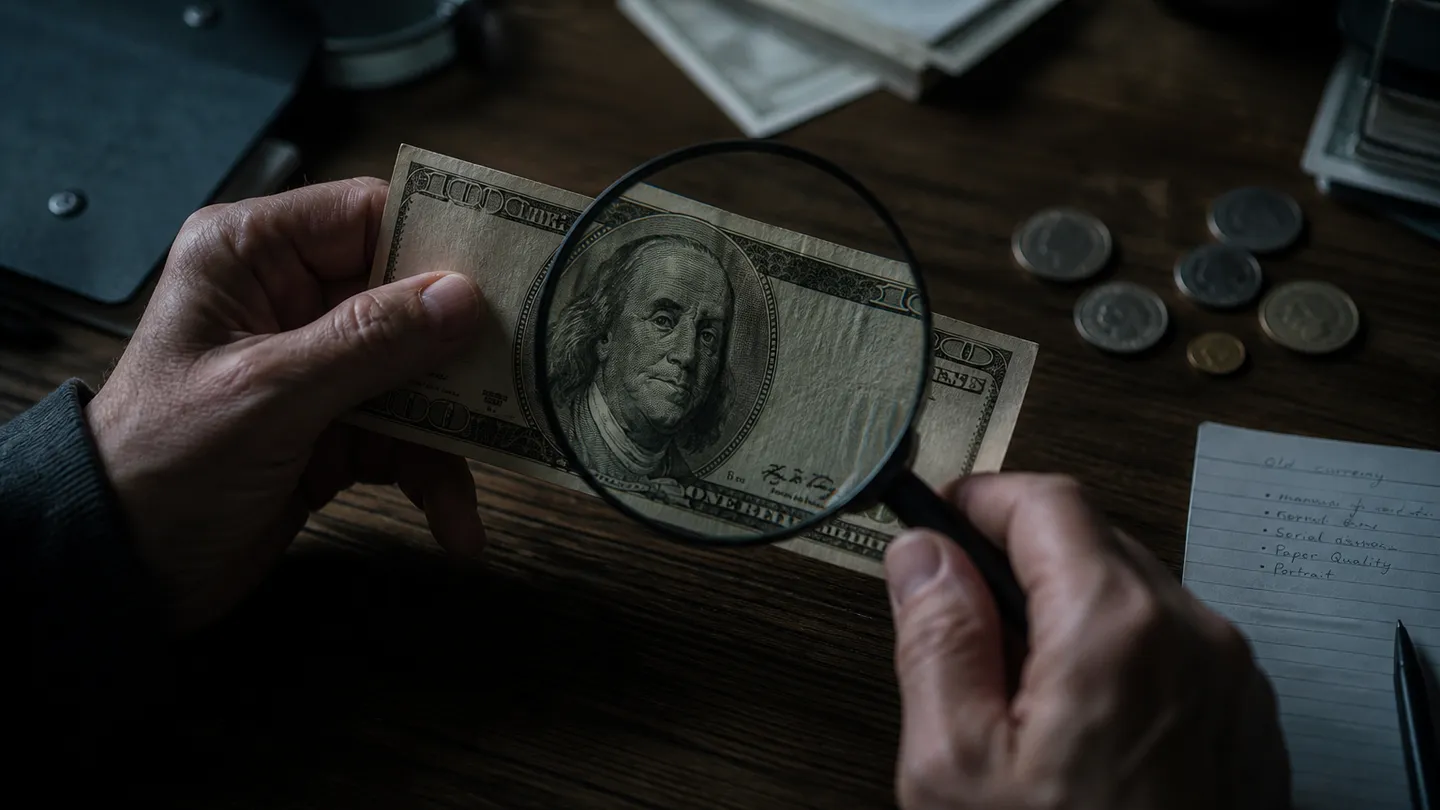
Counterfeit dollar bills are fake or altered U.S. notes made to resemble genuine currency; to check one, feel for raised printing and hold denominations of $5 and higher to light to confirm the watermark and security thread match the printed value.[1][2][3] If a bill seems suspicious, keep it separate from genuine cash, do not pass it on, and notify local police immediately.[4]
How to Check a Dollar Bill: Feel, Tilt, Light, and Compare
To effectively determine if a dollar bill is genuine, we recommend a quick four-step process: feel, tilt, light, and compare. Each step focuses on specific features of the note that can help identify counterfeits.
First, feel the texture of the bill. Genuine Federal Reserve notes are made from a unique blend of 75% cotton and 25% linen, giving them a slightly rough texture due to raised printing. You can run your finger across the bill to check for this tactile characteristic, which is absent in most counterfeit notes[1].
Next, tilt the bill. For denominations of $5 and higher, there is a security thread that is embedded in the note and becomes visible when tilted. On a current-design $100 note, for example, the blue 3-D Security Ribbon is woven into the paper, creating a visual effect that shifts as you move it[5].
Then, hold the bill up to the light. This will help you confirm the presence of a watermark and security thread. On $5 notes and higher, the watermark will show the same denomination as the bill, while $1 and $2 notes do not feature these security elements[2]. If you see a different image in the watermark, the note is likely counterfeit[6].
Finally, compare the bill to a known genuine note of the same denomination and series year. Look closely at the details, such as microprinting and colour-shifting ink, which should match perfectly with the authentic bill[7].
Quick Checklist for Authenticating a Dollar Bill (30–60 seconds)
- Feel: Check for raised printing and rough texture.
- Tilt: Look for the embedded security thread and shifting effects.
- Light: Hold to light to verify the watermark and security thread.
- Compare: Match with a known genuine bill for details.
Remember, it’s crucial not to rely on just one of these checks. A combination of features should be assessed to make a more accurate determination of authenticity. If you suspect a note is counterfeit, keep it separate from genuine currency and notify local authorities immediately[4].
Security Features by Denomination
Security Features by Denomination
Understanding the security features of U.S. dollar bills is essential for identifying counterfeits. Each denomination has unique elements designed to prevent forgery. Below is a table summarising the security features for various denominations, including watermarks, security threads, colour-shifting ink, microprinting, and special design elements.
| Denomination | Watermark | Security Thread | Colour-Shifting Ink | Microprinting | Special Design Elements |
|---|---|---|---|---|---|
| $1 | None | None | None | None | None |
| $2 | None | None | None | None | None |
| $5 | Portrait of Lincoln | Blue, glows under UV light | None | Present | Raised printing |
| $10 | Portrait of Hamilton | Orange, glows under UV light | Yes (green to black) | Present | Raised printing |
| $20 | Portrait of Jackson | Green, glows under UV light | Yes (green to black) | Present | Raised printing |
| $50 | Portrait of Grant | Yellow, glows under UV light | Yes (green to black) | Present | Raised printing |
| $100 | Portrait of Franklin | Pink, glows under UV light | Yes (copper to green) | Present | 3-D Security Ribbon, raised printing |
It is important to note that the positions and colours of the security threads under ultraviolet light vary by denomination, so we advise verifying these details against current materials provided by the U.S. Currency Education Program.
The $1 and $2 notes are particularly notable for lacking several protective features found in higher denominations. They do not have watermarks or security threads, making them more susceptible to counterfeiting. For any suspicious bills, we recommend using the checks we've previously outlined, as well as consulting reliable resources for the latest information on currency security features.
Fake $100 Bill vs. Real $100 Bill
Identifying a counterfeit $100 bill requires a keen eye for specific security features. Modern $100 notes incorporate several advanced elements designed to deter forgery, including the blue 3-D Security Ribbon, a colour-shifting Bell in the Inkwell, the Benjamin Franklin watermark, and an embedded security thread.
The 3-D Security Ribbon is woven into the paper, not merely printed on the surface. When you tilt the note, the bells and numeral "100" appear to move, creating an eye-catching effect[5]. Additionally, the Bell in the Inkwell shifts colour from copper to green, providing another layer of security[5]. The Benjamin Franklin watermark is visible when held to the light, confirming the authenticity of the note[5].
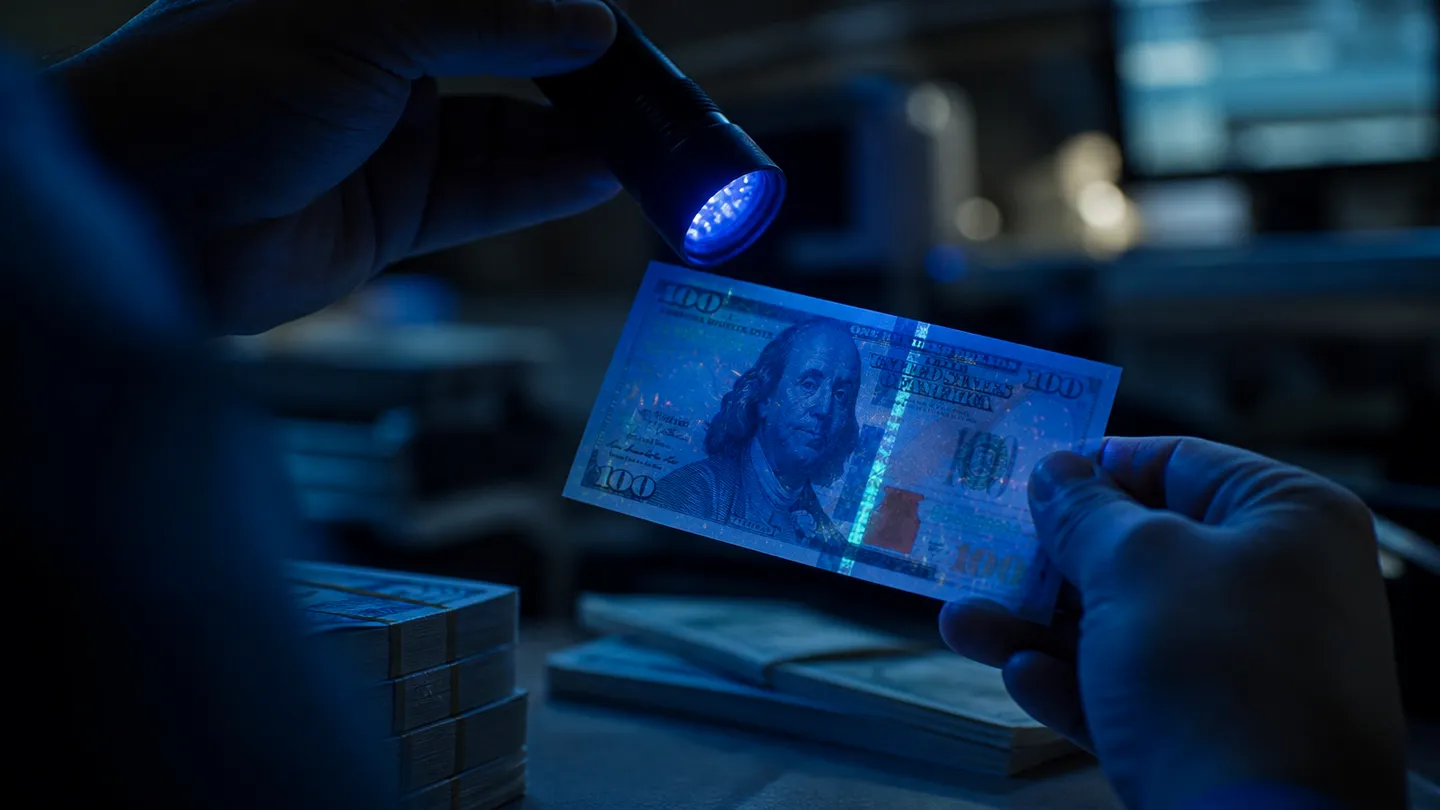
Another crucial feature is the security thread. This thread is embedded within the bill and marked with "USA" and "100," glowing pink under ultraviolet light[5]. These elements work together to ensure that genuine notes are difficult to replicate.
Comparison with Older Designs
It's important to note that the current-design $100 bill was introduced on October 8, 2013; therefore, older bills, which lack the blue ribbon, are not automatically counterfeit[8]. For example, $100 notes issued between 1996 and 2013 feature a lower-right "100" that shifts from green to black and have other security features like raised printing and a Franklin watermark[7].
If you encounter an older $100 bill, check for the following features: raised printing, microprinting, and embedded security threads. The absence of the blue ribbon does not definitively indicate that the bill is fake.
Quick Checklist for Identifying a Genuine $100 Bill
- 3-D Security Ribbon: Check for the woven ribbon that shifts as you tilt the bill.
- Colour-Shifting Ink: Ensure the Bell in the Inkwell changes from copper to green.
- Watermark: Look for the Benjamin Franklin watermark when held to light.
- Security Thread: Verify the embedded thread glows pink under UV light.
By familiarising ourselves with these characteristics, we can become more adept at spotting counterfeit $100 bills and ensuring that we handle only authentic currency. Always remember to compare any suspicious notes with a genuine bill to verify their authenticity.
How to Check Older-Series Dollar Bills
How to Check Older-Series Dollar Bills
Older designs of U.S. dollar bills remain legal tender, even though they may lack some of the advanced security features found in newer notes. It's essential to understand the specific characteristics of each series and denomination when verifying the authenticity of these older bills. For example, an older $100 bill might not have the blue 3-D Security Ribbon introduced in the Series 2009 design, but that does not automatically mean it's counterfeit[8].
When checking an older bill, start by examining the portrait. Each denomination features a specific historical figure, and the quality of the portrait can be a telltale sign of authenticity. Additionally, check the series year printed on the bill; older notes will have a different series year compared to current designs. For instance, a genuine $100 bill issued between 1996 and 2013 includes a lower-right "100" that shifts from green to black, along with other identifiable features, such as raised printing and a Franklin watermark[7].
Key Features to Examine
Here are some specific security features to look for in older-series notes:
- Raised Printing: Genuine bills have a slightly rough texture due to raised printing. You can feel this by running your finger across the surface[1].
- Watermark: Older $100 bills should display a Benjamin Franklin watermark when held up to the light, confirming its authenticity[6].
- Security Thread: Many older notes, including the $100 bill, include an embedded security thread that matches the denomination. This thread may not glow under UV light as with newer notes, but it should be present[7].
- Microprinting: Check for clear microprinting, which is difficult to replicate and can serve as a verification point[7].
Example of an Older $100 Bill
Consider an older $100 note that does not feature the blue ribbon. This bill could still be authentic if it meets the criteria outlined above. For instance, a $100 bill from the Series 2006 would not have the latest security features but should still include the raised printing, watermark, and security thread. If you encounter an older bill, it's crucial not to dismiss it outright based on the absence of modern elements. Instead, verify its authenticity by checking the features that correspond to the specific series and denomination.
By familiarising ourselves with these characteristics, we can better navigate the complexities of older-series dollar bills and ensure we are handling genuine currency. Always remember to consult reliable resources or documentation from the U.S. Currency Education Program for the most accurate and up-to-date information on currency security features.
Altered Genuine Bills: When the Paper Is Real but the Value Is Fake
An alarming scenario arises when genuine but lower-denomination bills, such as $5 or $1 notes, are altered to appear as higher denominations like $50 or $100. This method often involves bleaching the ink from a genuine $5 note and printing a false $100 design on the same paper. Since the paper remains authentic, a counterfeit detection pen may fail to identify it as fake, leading to potential financial loss for unsuspecting individuals or businesses[3].
To effectively spot these altered notes, we need to compare several key features. First, examine the printed denomination against the watermark and security thread. For instance, a genuine $100 note will have a Benjamin Franklin watermark, while an altered bill that features Abraham Lincoln in its watermark is immediately suspicious[6]. Furthermore, the security thread embedded in the bill should match the denomination; a genuine $100 note has a pink security thread that glows under ultraviolet light, while a $5 note has a blue thread[5].
Key Features to Compare
- Watermark: Always check that the watermark corresponds with the bill's printed denomination. An altered $100 note will not display the correct watermark.
- Security Thread: Verify that the security thread matches the denomination. For a $100 bill, it should glow pink under UV light and be marked with "USA" and "100"[5].
- Printed Denomination: The printed value must match the security features. If you notice discrepancies, such as a $1 bill altered to look like a $100, it is likely counterfeit.
Example of an Alteration
Consider a $1 bill that has been bleached and printed over to resemble a $100 bill. The alterations may make it visually convincing at first glance, but upon close inspection, the discrepancies become apparent. For instance, the absence of a proper watermark that displays Benjamin Franklin or an incorrect security thread can quickly reveal the truth behind the note.
To safeguard against receiving these altered bills, it's essential to familiarise ourselves with the security features of genuine currency. Always remember to cross-check against a known authentic bill, paying close attention to the watermark, security thread, and printed denomination. If you suspect a bill is altered, isolate it from genuine currency and report it to local authorities promptly[4]. By staying vigilant and informed, we can protect ourselves from falling victim to these sophisticated scams.
Do Counterfeit Pens and UV Lights Really Work?
Counterfeit detection pens and ultraviolet (UV) lights are tools often used to verify the authenticity of dollar bills, but their effectiveness varies significantly. Counterfeit pens function based on a reaction between iodine and starch. When the pen is applied to ordinary paper, it can leave a dark mark, indicating the presence of starch. However, this test is not foolproof. If the bill is printed on processed paper or is an older note that has become dirty, the pen may produce misleading results[9].
It's essential to understand the limitations of counterfeit pens. For instance, if a pen does not leave a dark mark, it does not automatically confirm that the bill is genuine. There are many factors at play, such as the type of paper used. Genuine Federal Reserve note paper consists of 75% cotton and 25% linen, which does not contain starch and would not react with the pen[1]. Thus, relying solely on this method can lead to false confidence in a bill's authenticity.
When it comes to UV lights, their utility lies in the ability to reveal certain security features embedded in the bills. For example, genuine security threads glow in specific colours when exposed to UV light: blue for $5 notes, orange for $10 notes, green for $20 notes, yellow for $50 notes, and pink for $100 notes[10]. However, it's crucial to know the correct position and colour of these threads for effective verification. If you shine a UV light on a bill without understanding these features, you may misinterpret the results.
In summary, while counterfeit pens and UV lights can be useful tools in the verification process, they should not be the only methods we rely on. We should always consider additional security features, such as watermarks and microprinting, as primary indicators of authenticity. The myth that a bill is genuine if a counterfeit pen does not leave a mark is simply not true. To ensure accuracy, we recommend cross-referencing multiple security features alongside these tools[4].
Common Signs of Counterfeit U.S. Currency
Identifying counterfeit U.S. currency requires careful observation of specific features. Here are some common signs that might indicate a bill is fake:
First, examine the paper. Genuine Federal Reserve note paper is composed of 75% cotton and 25% linen, which gives it a slightly rough texture. If the bill feels smooth or waxy, it’s a red flag[1]. Look for clear, sharp lines; counterfeit bills often have blurry or smudged printing. Additionally, if the print appears unusually flat, this could suggest a fake note.
Next, check the colours. Genuine U.S. currency has precise colour schemes that are difficult to replicate. If you notice any mismatched or incorrect colours, this could indicate counterfeiting. Pay attention to the watermark as well; while current notes have a visible watermark when held to the light, counterfeit bills may only imitate this feature on the surface without proper detailing[2].
Another important feature is the security thread, which is embedded in denominations of $5 and higher. This thread should match the denomination of the bill and glow under ultraviolet light. Be cautious if the security thread appears printed rather than embedded, as this is a common method used in counterfeiting[10].
When it comes to serial numbers, ensure they match the series year of the bill. Counterfeit notes often have mismatched or nonsensical serial numbers. Checking for the presence of microprinting can also be useful; genuine bills feature tiny text that is hard to replicate and often overlooked.
While unusual characteristics can indicate a counterfeit bill, it is essential to remember that wear and tear or dirt can alter a bill's appearance. Therefore, we recommend confirming the authenticity of a note through at least two or three independent security features. For example, if a bill feels smooth but has a correct watermark and security thread, it may still be genuine, albeit damaged.
If you suspect a bill is counterfeit, avoid accepting it and report it to local authorities immediately[4]. By familiarising ourselves with these signs, we can better protect ourselves against counterfeit currency.
What to Do If You Receive a Suspected Counterfeit Bill
If you suspect that you have received a counterfeit bill, it's crucial not to attempt to return it to circulation or use it for purchases. Doing so could lead to legal repercussions, as knowingly passing counterfeit money is a federal crime that can result in a fine or imprisonment for up to 20 years[11]. Instead, ensure your safety and take the following steps.
First, remember as many details as possible about the circumstances under which you received the bill. Note the description of the person who passed it to you, their vehicle, and the location and time of the transaction. This information can be valuable for law enforcement, so keep it in mind without putting yourself at risk.
Next, report the incident to your local police department. You can also contact your bank or the U.S. Secret Service, which is responsible for investigating counterfeit currency. When you report it, be prepared to surrender the suspected bill, as authorities may need to examine it for verification[4].
It's important to understand that accidentally receiving a counterfeit bill is not the same as intentionally trying to pass one. However, counterfeit currency typically has no monetary value, meaning you cannot expect reimbursement for the loss[4]. This situation highlights the importance of vigilance when handling cash, as counterfeit bills can circulate widely and often go unnoticed by the average person.
To summarise, if you receive a suspected counterfeit bill, do not attempt to use it. Instead, safely record the details surrounding the transaction and report it to local authorities. By taking these actions, we can help combat the issue of counterfeit currency and protect ourselves from potential financial loss.
Counterfeit Dollar Bills: Key Features Matrix
| Denomination | Series | Security Element | Verification Method |
|---|---|---|---|
| $1 | All | None | Feel texture, check for clarity |
| $5 | Current | Blue security thread, watermark | UV light, feel texture |
| $10 | Current | Orange security thread, watermark | UV light, feel texture |
| $20 | Current | Green security thread, watermark | UV light, feel texture |
| $50 | Current | Yellow security thread, watermark | UV light, feel texture |
| $100 | Current | Pink security thread, 3-D ribbon, watermark | UV light, tilt, compare |
| $100 | 1996-2013 | Embedded security thread, watermark | Feel texture, check features |
| $100 | Before 1996 | None or older features | Feel texture, check for clarity |
Common Mistakes and Misconceptions
Most errors come from using the wrong test. Before deciding, we suggest this quick checklist:
- Identify the denomination and design series.
- Check features that belong to that specific note.
- Keep a suspicious bill separate rather than trying to spend it.
Expecting Every Denomination to Have the Same Security Features
Features vary by denomination. Current-design notes worth $5 or more have a watermark and embedded security thread, while $1 and $2 notes have neither feature nor colour-shifting ink[2]. We should identify the denomination before checking it, or a genuine low-value note may appear suspicious simply because we expected features it was never designed to have.
Treating a Detector-Pen Result as a Verdict
A pen is only a paper test. It reacts to starch rather than confirming that the portrait, denomination, watermark, and other design elements belong together[9]. Because altered genuine note paper may escape this test, we should treat the result as supporting information and rely mainly on denomination-specific security features[3][4].
Rejecting an Older $100 Bill Because It Lacks a Blue Ribbon
Age is not proof of counterfeiting. The current-design $100 entered circulation on October 8, 2013, and earlier Federal Reserve note designs remain legal tender at face value[8][7]. For a $100 issued between 1996 and 2013, we should check its raised printing, Franklin watermark, embedded thread, microprinting, fibres, and green-to-black colour-shifting numeral instead of expecting modern features[7].
Assuming Legal Tender Must Be Accepted Everywhere
Legal tender status does not force every private business to accept every bill. A Seattle café or shop may establish its own cash-acceptance policy unless state or local law says otherwise[7]. We should separate an older note's validity from a business decision to decline it, then apply that policy consistently rather than labelling the customer’s cash counterfeit.
Trying to Spend a Suspicious Bill to Avoid the Loss
Receiving a counterfeit unknowingly is different from passing it after recognising the risk. Knowingly passing, attempting to pass, possessing, or concealing counterfeit or altered U.S. obligations with intent to defraud can lead to a fine, imprisonment for up to 20 years, or both[11]. We should keep the note apart, record relevant details safely, notify local police, and surrender it promptly rather than transferring the potential loss to someone else[4].
Conclusions
Keep these priorities clear.
- Begin by identifying the denomination and design series, since legitimate security elements differ between newer, older, and low-value notes[2][7].
- Examine several independent features, including print quality, watermark, embedded thread, microprinting, texture, and any denomination-specific colour changes[4].
- Use detector pens and ultraviolet lamps only as supporting checks; neither tool can establish authenticity by itself[9][4].
- If concerns remain, isolate the note, avoid further transactions, record the circumstances safely, and contact local police or the U.S. Secret Service[4].
- Remember that an unusual or worn bill may still be genuine, while knowingly passing a counterfeit can carry serious federal penalties[11].
For a practical denomination-by-denomination review, continue with Fake US Dollars: How to Spot Them.
Straight answers
How can you tell a fake $100 bill from a real one?
On a current-design $100 bill, tilt the note: bells and 100s on the woven blue ribbon should appear to move, while the Bell in the Inkwell shifts from copper to green[5]. Hold it to light and confirm that the watermark depicts Benjamin Franklin and the embedded thread reads "USA 100"; under UV light, that thread should glow pink[5]. A Lincoln watermark or a thread identifying another denomination indicates a counterfeit or altered note[3][6].
How can you tell if an old $100 bill is real or fake?
Start by identifying its series, because an older $100 bill should not be judged by features introduced with the current design on October 8, 2013[8]. For a note issued between 1996 and 2013, check for raised printing, a Franklin watermark, an embedded security thread, red and blue fibres, clear microprinting, and a lower-right 100 that shifts from green to black[7]. Older Federal Reserve note designs remain legal tender, so age or the absence of a blue ribbon does not by itself indicate a fake[7].
What color does a counterfeit marker turn on a fake $100 bill?
On ordinary starch-containing paper, a detector-pen mark changes from yellow to dark purple or black[9]. However, there is no dependable colour result for every fake $100 bill because counterfeiters may print over bleached genuine currency paper, and the Federal Reserve warns that pens can produce false results[3][4]. We suggest checking the Franklin watermark and the denomination on the embedded thread instead of treating the pen mark as a verdict[5][4].
Do counterfeit dollar bills have any value?
No: a counterfeit note has no redeemable face value and cannot be exchanged for genuine currency, so whoever accepted it normally bears the loss[4]. We should not try to recover that loss by spending the note; knowingly passing counterfeit currency with intent to defraud can bring a fine, imprisonment for up to 20 years, or both[11].
Links and references
- 1. Decoding Dollars: The $100
- 2. Estimating the Volume of Counterfeit U.S. Currency in Circulation
- 3. New $5 Bill Debuts During “Wi-5” Event
- 4. How Do I Determine If a Banknote Is Genuine?
- 5. $100 Note
- 6. Training Course - Exam
- 7. Acceptance and Use of Older-Design Federal Reserve Notes
- 8. The Seven Denominations
- 9. Starch Search
- 10. How to Check Your Money Training Presentation
- 11. 18 U.S.C. §472 — Uttering Counterfeit Obligations or Securities