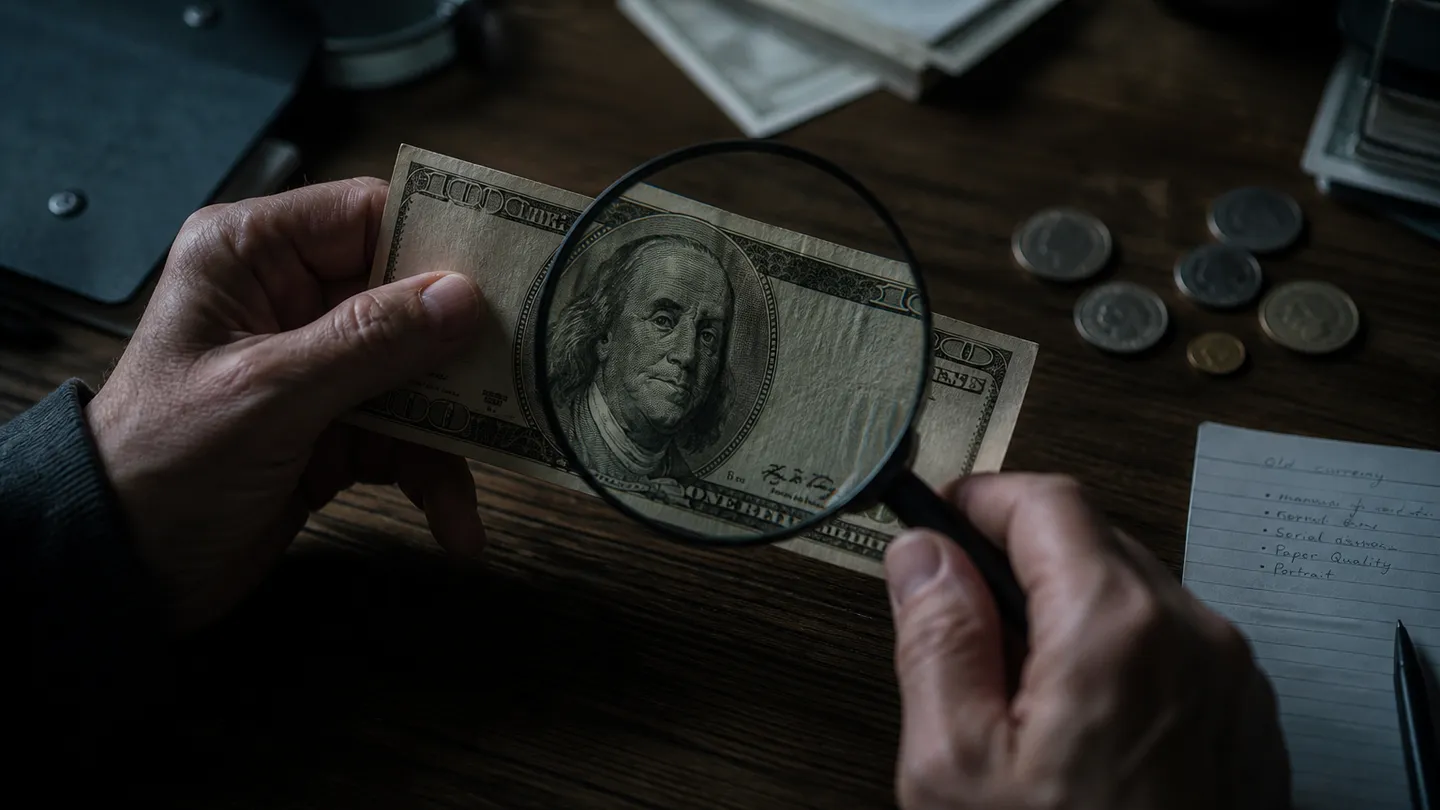
An old $100 bill is not fake merely because it lacks modern security features.[1] Check the series year, which identifies the approved design rather than the printing date:[2] Series 1981 should have raised printing and embedded red and blue fibres but no security thread, while Series 1990 and 1993 should include a left-side "USA 100" thread and microprinting.[3][4]
Identify the $100 Bill’s Series Before Checking Its Security Features
To effectively assess an older $100 note, we must first identify its series year, which is located on the front of the bill, just below the portrait of Benjamin Franklin. This series year does not indicate when the note was printed; instead, it marks when the design was approved or when a new Treasury secretary or treasurer's signature was introduced. If there is a letter following the series year, it signifies a major change in appearance. For example, a Series 1981 note will not contain security features introduced in later series, such as those from 1990, 1996, or 2013[2].
Understanding the evolution of the $100 note is crucial, so here is a timeline of the different designs:
| Series Year | Design Era | Key Features |
|---|---|---|
| Pre-1990 | 1914–1990 | Raised printing, cotton-linen paper, two serial numbers, appropriate seals and portraits[3]. |
| Series 1990–1995 | 1990–1996 | First appearance of the security thread and microprinting[1]. |
| Series 1996–2006A | 1996–2013 | Franklin watermark, left-side "USA 100" security thread, and colour-shifting ink[5]. |
| Series 2009 | Current Design | Enhanced security features like the 3-D Security Ribbon[5]. |
It's essential to remember that an authentic Series 1981 note will not display features such as the security thread or microprinting that debuted in the 1990 series. For instance, if you are checking a Series 1990 $100 bill, you should see the embedded thread that reads "USA 100" on the left side of Franklin’s portrait, which glows pink under ultraviolet light[4]. In contrast, a Series 1981 note will lack this feature, and its absence should not be a cause for alarm[3].
By knowing the series year and its associated features, we can better determine the authenticity of the note in hand and avoid misjudging older currency.
How to Check an Old $100 Bill: Feel, Tilt, Light, and Magnify
To verify the authenticity of an old $100 bill without causing damage, we recommend a four-step checklist: feel, tilt, light, and magnify. Each step reveals unique security features that can help determine if the bill is genuine.
Feel the Paper and Raised Printing
Start by feeling the texture of the bill. Genuine U.S. currency is made from a special paper that is 75 percent cotton and 25 percent linen, giving it a slightly rough feel compared to regular paper. You should also check for raised printing, especially on the portrait of Benjamin Franklin and the denomination. If the printing feels smooth or lacks texture, this could indicate a counterfeit[6].
Tilt the Note
Next, tilt the note to observe the colour-shifting ink. For Series 1996 and later notes, the lower-right corner should show a numeral "100" that shifts from green to black when tilted. If this colour change is absent or inconsistent, the bill may be counterfeit[5]. For older Series 1981 notes, this feature will not be present, which is acceptable given its design era[3].
Hold it to Light
Hold the bill up to the light to inspect for a watermark and security thread. A genuine Series 1990 or later note should display a left-side "USA 100" security thread that is visible from both sides and glows pink under ultraviolet light[4]. Be aware that older Series 1981 notes will not have this security thread, so its absence is not a definitive sign of counterfeiting[1].
Inspect Fine Details Under Magnification
Finally, use a magnifying glass to examine microprinting. Genuine notes contain microprinted text, such as "THE UNITED STATES OF AMERICA" around Franklin's portrait frame, which may require magnification to see clearly[4]. If the letters merge, blur, or are unreadable, this is a strong indication of a counterfeit[7].
No single test can definitively prove authenticity. Instead, it’s essential to combine these methods for a thorough assessment. By following this checklist, we can more confidently identify genuine old $100 bills while preserving their condition.
Security Features by Series and Design Era
Security Features by Series and Design Era
Understanding the security features of the $100 note is vital for verifying its authenticity. Each series year corresponds to a specific design era, which dictates the presence or absence of various security features. Below is a matrix that outlines the security features associated with different series and design eras of the $100 bill, allowing us to quickly identify what to expect.
| Series Year | Security Thread | Microprinting | Portrait Watermark | Colour-Shifting Ink | 3-D Security Ribbon | Bell in the Inkwell |
|---|---|---|---|---|---|---|
| Pre-1990 | None | None | None | None | None | None |
| Series 1981 | None | None | None | None | None | None |
| Series 1990 | Yes (reads "USA 100") | Yes | Yes (Franklin) | None | None | None |
| Series 1993 | Yes (reads "USA 100") | Yes | Yes (Franklin) | None | None | None |
| Series 1996 | Yes (reads "USA 100") | Yes | Yes (Franklin) | Yes (lower right 100) | None | None |
| Series 2006 | Yes (glows pink UV) | Yes | Yes (Franklin) | Yes (lower right 100) | None | None |
| Series 2009 | Yes (glows pink UV) | Yes | Yes (Franklin) | Yes (lower right 100) | Yes | Yes |
The security thread on Series 1990 and later notes is embedded in the paper, located to the left of Franklin's portrait, and reads "USA 100" in an alternating pattern. This thread is visible from both sides and glows pink under ultraviolet light[4]. Older series, such as Series 1981, do not possess this feature, which is perfectly acceptable given its design era[1].
Microprinting first appeared on the Series 1990 and later notes, featuring the text "THE UNITED STATES OF AMERICA" around Franklin's portrait frame. This detail may require magnification to see clearly, and if it is absent or unclear, it could indicate a counterfeit[4][7].
For Series 1996 and onward, we also see the introduction of colour-shifting ink, where the numeral "100" in the lower right corner changes from green to black when tilted[5]. The 3-D security ribbon and the Bell in the Inkwell are exclusive to the current design issued from 2013 onwards, enhancing the bill's security further[5].
By familiarising ourselves with these features, we can better evaluate the authenticity of older $100 notes, ensuring we make informed assessments without damaging the currency in the process.
Real vs. Fake Old $100 Bills: Warning Signs to Compare
Real vs. Fake Old $100 Bills: Warning Signs to Compare
When assessing the authenticity of an old $100 bill, we should carefully examine several key features: the paper quality, portrait detail, borders, seals, serial numbers, ink, and alignment. Each of these elements can provide critical clues about whether a note is genuine or potentially counterfeit.
A genuine bill is printed on a special cotton-linen paper, which has a distinct texture and includes embedded red and blue fibres. If the bill feels smooth or lacks texture, it may be counterfeit[6]. Look closely at the portrait of Benjamin Franklin; a genuine note will have sharp and clear details, while a counterfeit might display a flat or fuzzy appearance. For instance, if you notice a lack of definition in Franklin's facial features, this could indicate a fake note.
The borders and seals are also important indicators. Genuine old $100 bills will have precise and clean borders, while counterfeit notes often exhibit uneven or poorly defined edges. Additionally, the serial numbers should be evenly spaced and correctly aligned; mismatched or misaligned serial numbers can be a sign of counterfeiting.
Microprinting is another feature to inspect. On Series 1990 and later notes, you should see tiny text that reads "THE UNITED STATES OF AMERICA" around Franklin's portrait frame. This microprinting should be clear and readable under magnification. If the letters merge, blur, or are indistinguishable, this is a warning sign of a possible counterfeit[7].
Watermarks are crucial as well. A genuine $100 bill will display a portrait watermark of Benjamin Franklin, not a different president. If the watermark appears to be of a different individual, it may indicate that a lower-denomination note has been altered and reprinted as a $100 bill[7].
Be cautious of the security thread. For Series 1990 and later notes, the embedded thread should be visible from both sides and glow pink under ultraviolet light. If the thread is printed on the surface instead of embedded, it is likely counterfeit[4].
It's essential to remember that normal wear, fading, folds, and ink transfer do not automatically indicate counterfeiting. An old note may show signs of age without being fake. By comparing these features with known genuine notes, we can more confidently identify authentic old $100 bills.
How to Check 1981 and 2006 Series $100 Bills
Verifying the authenticity of older $100 bills, particularly the Series 1981 and 2006, requires a keen understanding of their unique features. Each series has distinct characteristics that help differentiate genuine notes from counterfeits, and knowing what to look for is essential.
For a Series 1981 note, one must focus on the engraving, paper quality, seals, and serial number rather than expecting features like the watermark or security thread, which were not introduced until later. This series falls within the 1914–1990 design era, so it will not display the security thread or microprinting that first appeared on the Series 1990 notes[3][1]. The bill should be made from cotton-linen paper, which contains embedded red and blue fibers, and the raised printing should be noticeable, particularly on Benjamin Franklin's portrait. If these features are present, you can be more confident in the note's authenticity.
On the other hand, the Series 2006 and 2006A notes incorporate features from the 1996–2013 design. When checking these bills, it’s important to look for the Franklin watermark, which should be visible when held up to the light, and a left-side security thread that glows pink under ultraviolet light[5]. Additionally, the lower-right corner should display a colour-shifting numeral "100," shifting from green to black when tilted. Be mindful that neither the Series 1981 nor the Series 2006 notes will feature the current 3-D Security Ribbon, which is exclusive to the latest designs[5].
Summary of Key Features
| Feature | Series 1981 | Series 2006 |
|---|---|---|
| Security Thread | Absent | Present (glows pink under UV) |
| Watermark | Absent | Present (Franklin portrait) |
| Microprinting | Absent | Present (requires magnification) |
| Colour-Shifting Ink | Absent | Present (shifts from green to black) |
| Raised Printing | Present | Present |
| Paper Type | Cotton-linen with red and blue fibers | Cotton-linen with red and blue fibers |
By understanding these distinctions, we can avoid misjudging the authenticity of a note based on features that were not applicable during its era. This knowledge allows us to make informed decisions when handling older currency.
Counterfeit Detector Pens, UV Lights, and Other Tests: What They Can and Cannot Prove
Counterfeit Detector Pens, UV Lights, and Other Tests: What They Can and Cannot Prove
Counterfeit detector pens and ultraviolet (UV) lights are popular tools for assessing the authenticity of currency, including old $100 bills. However, while these methods can provide useful information, they are not foolproof and should be used in conjunction with other verification techniques.
Iodine-based pens react with starch, which is commonly found in ordinary paper. When applied to a genuine $100 bill, the pen should remain pale or amber, whereas it will react darkly with starch-containing paper. Despite this, results can be inconclusive; some genuine notes, especially those that have been bleached, may pass the pen test while still featuring counterfeit printing. Therefore, it’s crucial that we do not rely solely on this test. Instead, we must ensure that the portrait, denomination, watermark, and security thread all align correctly for a more accurate assessment[8].
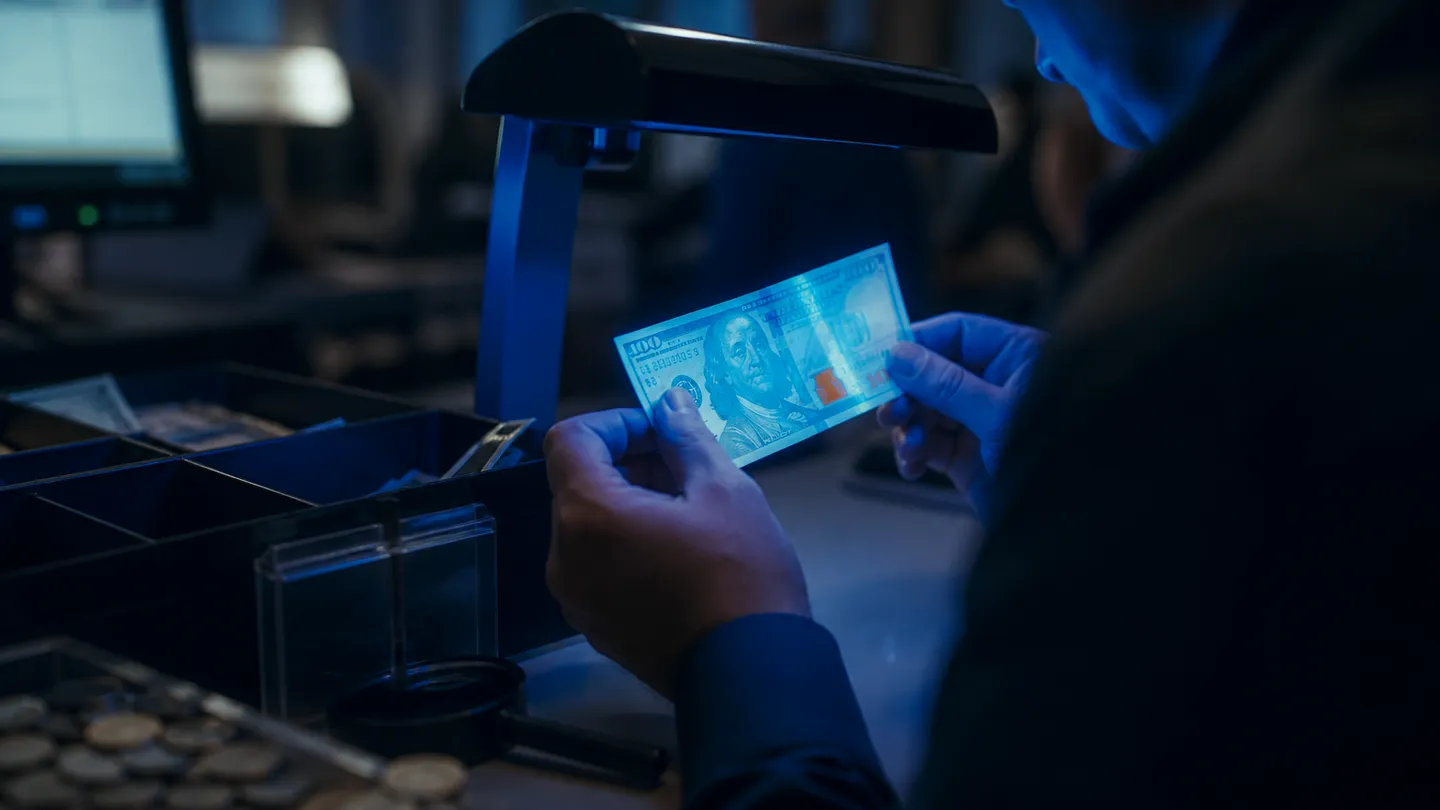
UV light inspection serves as a supportive test rather than a standalone method for authentication. For instance, Series 1990 and later $100 notes have an embedded security thread that glows pink under UV light, whereas the Series 1981 notes do not possess this feature at all. If a Series 1990 or 2006 note lacks a glowing thread, this absence is suspicious, but it's normal for older designs[3]. This highlights the importance of understanding the specific features associated with each series year.
Utilising these tools can enhance our ability to detect counterfeit notes, but we must remember that they are not definitive proof of authenticity. A comprehensive approach, combining multiple verification methods, is essential for confidently identifying genuine old $100 bills.
Common Myths About Fake Old $100 Notes
Common Myths About Fake Old $100 Notes
Several common misconceptions surround old $100 notes that can lead to confusion when determining their authenticity. One prevalent myth is that "every real $100 has a watermark." While modern notes do feature a watermark of Benjamin Franklin, older Series 1981 notes do not include this feature, as watermarks were introduced with the Series 1990 notes[1]. Therefore, the absence of a watermark on a Series 1981 note does not indicate it is counterfeit.
Another claim is that "a pen result is definitive" for authenticity checks. Counterfeit detector pens use iodine to identify starch in paper, which can indicate a fake if it reacts darkly. However, this test is not foolproof, as some genuine notes may also show a reaction due to bleaching processes. Thus, we should not rely solely on pen results; a thorough examination of the note's features is essential[8].
The assertion that "old notes are no longer legal tender" is misleading. All Federal Reserve notes issued from 1914 onward, including older $100 bills, remain legal tender[5]. While businesses may choose not to accept cash, this does not invalidate the currency.
Lastly, the belief that "all counterfeit bills feel like printer paper" is an oversimplification. Genuine notes are made from a special cotton-linen blend, which gives them a distinctive texture[6]. While some counterfeit bills may mimic this feel, others may not, making it crucial to assess various features, such as raised printing and microprinting, rather than relying solely on texture.
By understanding these myths and the specific design features of different series, we can better navigate the complexities of identifying genuine old $100 notes.
Are Old or Fake $100 Bills Worth Anything, and What Should You Do Next?
Genuine older U.S. $100 notes remain legal tender, meaning they can still be used for transactions, regardless of their age. However, their collector value varies based on several factors, including the series year, type of seal, condition, rarity, and serial number—not just age alone. For example, a Series 1981 note may be worth more to collectors than a later series if it is in excellent condition and has a low serial number[2][3]. Conversely, an ordinary counterfeit bill has no face value and should never be knowingly spent or sold as genuine. If you suspect you have an unusual historical counterfeit, it’s crucial to seek lawful specialist assessment.
If you've come across an old or potentially fake $100 bill, we recommend taking several safe steps. First, stop handling the note unnecessarily to avoid any further wear or damage. Next, document how you received the note, including any relevant details about the transaction or the person who gave it to you. Keep the note separate from other currency to avoid confusion, and store it in a safe place. Finally, contact a local bank or the appropriate law enforcement agency or the U.S. Secret Service to report your findings and get advice on what to do next.
It’s also vital to remember that knowingly passing, selling, concealing, or possessing counterfeit currency can lead to serious legal consequences, including up to 20 years in prison[9]. Therefore, handling such situations with care and seeking professional guidance is always the best course of action. By following these steps, we can ensure that we navigate the complexities of old and counterfeit currency responsibly and safely.
Old $100 Bill Authentication Matrix
| Design Era | Security Thread | Watermark | Microprinting | Colour-Shifting Ink | Key Features |
|---|---|---|---|---|---|
| Pre-1990 | Absent | Absent | Absent | Absent | Cotton-linen paper, raised printing, red and blue fibers |
| 1990–1995 | Present (glows pink under UV) | Present (Franklin portrait) | Present (requires magnification) | Absent | Cotton-linen paper, raised printing, embedded thread |
| 1996–2006A | Present (glows pink under UV) | Present (Franklin portrait) | Present (requires magnification) | Present (shifts from green to black) | Cotton-linen paper, raised printing, embedded thread |
| Current Design | Present (glows pink under UV) | Present (Franklin portrait) | Present (requires magnification) | Present (shifts from green to black) | Cotton-linen paper, raised printing, embedded thread |
Common Mistakes and Misconceptions
Most errors come from using the wrong test. Before judging an older note, we suggest checking:
- the series designation;
- only the security features expected for that design;
- whether the watermark, portrait, and denomination agree;
- authenticity separately from spending or collector value.
Reading the series year as the printing date
People often assume the printed series year tells them exactly when the note was produced. It actually identifies a design approval or signature change, while a following capital letter marks a significant appearance change[2]. We should use the series to select the correct authentication features, not to estimate the note’s precise age.
Applying one feature checklist to every old note
Older designs are often checked against whichever security guide is easiest to find, but this can produce both false rejections and false confidence. For example, the thread and microprinting on Series 1990 and 1993 notes have defined wording and placement, while Series 2006 and 2006A notes also require a Franklin watermark and colour-shifting ink[4][5]. We should match every feature to the stated series rather than treating "old $100 bill" as a single design.
Treating a detector pen as proof of denomination
A detector pen reacts to starch in wood-based paper, so it tests paper chemistry rather than whether the printed denomination is genuine[8]. A counterfeit printed over altered genuine currency may avoid the expected reaction, yet its watermark can reveal the original lower denomination[7]. We advise checking that the watermark depicts Benjamin Franklin and agrees with the portrait and printed value.
Accepting any UV glow as a pass
People may look only for a coloured glow without checking where it comes from or whether that series should contain a thread. On Series 1990 and 1993 notes, the thread sits left of Franklin, reads "USA 100" in an alternating pattern, appears from both sides, and glows pink under ultraviolet light[4]. The correct approach is to verify the thread’s position, wording, visibility, and colour together rather than accepting an unexplained glow.
Confusing refusal, face value, and collector value
A seller’s refusal does not prove that an old note is counterfeit, because genuine Federal Reserve note designs issued from 1914 onward remain legal tender even though private businesses may decline cash[5]. Face value concerns a genuine note’s use as currency, while collector value is a separate assessment based on the specific note rather than merely its age. If authorities identify the note as counterfeit, it is neither returned nor reimbursed, so it should not be treated as having legitimate face value[9].
Conclusions
- Start with the series. It determines which security features belong on the note and prevents a genuine older design from being rejected unfairly[2].
- Do not expect every old note to have a watermark, security thread, microprinting, or colour-shifting ink; pre-1990 designs lack these later protections[1].
- Compare several features without damaging the paper: portrait quality, raised printing, fibres, watermark, thread placement, microprinting, and ink behaviour where applicable[4][5][6].
- Treat detector pens and UV lights as supporting checks, not final proof[8][3]. If concerns remain, separate the note, record where it came from, and consult a bank or the U.S. Secret Service rather than attempting to spend it[9].
Next, use Fake US Dollars: How to Spot Them to check other U.S. denominations safely.
Links and references
- 1. $100 Note | U.S. Currency Education Program
- 2. Identifying Banknotes | U.S. Currency Education Program
- 3. $100 Note Issued 1914 to 1990
- 4. $100 Note Issued 1990 to 1996
- 5. Use of Older-Design Notes | U.S. Currency Education Program
- 6. Decoding Dollars: The $100 | U.S. Currency Education Program
- 7. U.S. Currency Education Program Training Course Answer Key
- 8. Trial Court Financial Policies and Procedures Manual — Cash Handling
- 9. 18 U.S.C. § 472 — Uttering Counterfeit Obligations or Securities