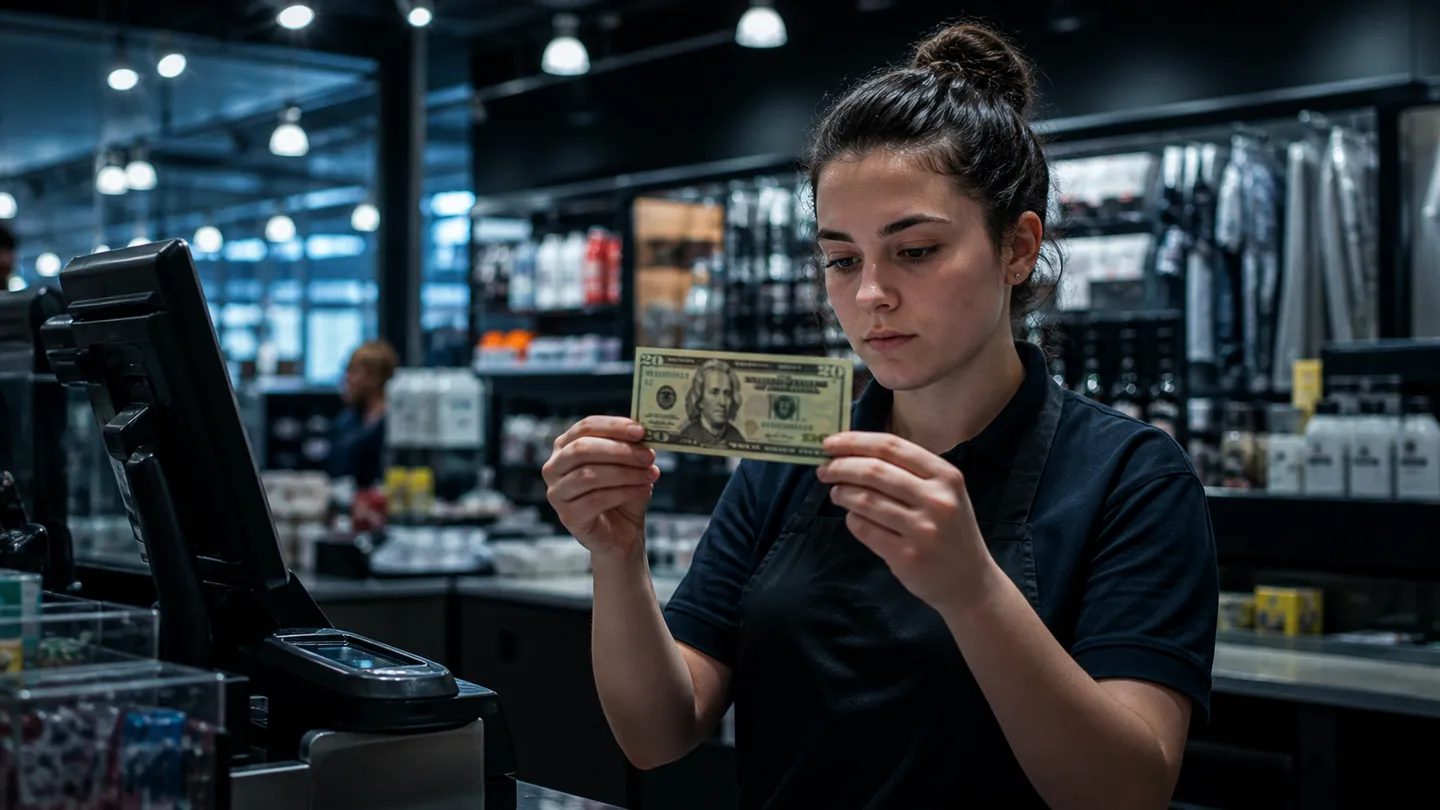
Fake US dollars are counterfeit notes made to pass as genuine currency. To check a bill, feel for slightly rough raised printing, tilt it for moving or colour-shifting features, then hold it to light to inspect the watermark and security thread[1]; if it still seems suspicious, separate it from genuine cash and notify local police[2].
How to Check a U.S. Bill in 60 Seconds
To quickly determine if a U.S. bill is genuine, we can follow a simple four-step process: Feel, Tilt, Check with Light, and Compare. This routine helps us identify key security features without needing advanced tools.
Feel
First, take a moment to feel the texture of the bill. Genuine Federal Reserve notes are made from a blend of 75 percent cotton and 25 percent linen, which gives them a distinct texture. The surface should feel slightly rough due to the raised intaglio printing, unlike the smooth feel of regular printer paper[1].
Tilt
Next, tilt the bill to observe any moving or colour-shifting features. For example, on the current-design $100 note, the blue 3-D Security Ribbon reveals bells and numerals that shift as the bill is angled[1]. Watching these features can help us confirm authenticity.
Check with Light
After tilting, hold the bill up to the light. We should look for the watermark and security thread. A genuine $5 note, for instance, features a vertical pattern of small 5s beside the portrait, while its security thread glows blue under ultraviolet light[3]. Checking these elements is crucial, as they are hard to replicate in counterfeit bills.
Compare
Finally, if we still have doubts, compare the bill with a known genuine note of the same denomination. This allows us to spot differences in colour, design, and security features. Remember that we should not rely on a single characteristic to make our decision; instead, we should consider all aspects collectively.
Quick Checklist
- Feel: Check for a rough texture from raised printing.
- Tilt: Look for moving or colour-shifting elements.
- Check with Light: Examine the watermark and security thread.
- Compare: Use a genuine note for side-by-side comparison.
By following these steps, we can effectively assess the authenticity of a U.S. bill in just 60 seconds. Always keep in mind that a single sign of a counterfeit may not be definitive; it's the combination of features that gives us a clearer picture of the bill's authenticity.
Security Features That Genuine U.S. Currency Uses
To effectively identify genuine U.S. currency, we should focus on several key security features. Genuine Federal Reserve notes are composed of a unique paper blend made from 75 percent cotton and 25 percent linen, giving them a distinctive texture. This paper is not smooth; the raised intaglio printing creates a slightly rough surface, distinguishing it from regular printer paper[1].
Among the most important features to check are the embedded red and blue security fibres, which are woven throughout the paper. These fibres are not easily replicable and are a reliable indicator of authenticity. Additionally, the watermark is a significant feature; for instance, a genuine $5 note displays a vertical pattern of small 5s next to the portrait, while a larger 5 appears on the opposite side[3].
When inspecting a bill, we can employ several techniques. First, we should feel the texture of the bill to confirm the raised printing. Next, tilting the note can reveal colour-shifting ink; for example, on the current-design $100 note, the blue 3-D Security Ribbon shows moving bells and numerals as the bill is angled[1]. Moreover, holding the note up to the light allows us to check for the security thread, which is designed to glow in different colours under ultraviolet light, depending on the denomination—blue for $5, orange for $10, green for $20, yellow for $50, and pink for $100[3].
It's crucial to remember that the arrangement and presence of these features can vary based on the denomination and the year of design. For instance, the current-design $100 note, issued on October 8, 2013, includes specific elements like the blue ribbon, while older versions may lack this feature[3]. Therefore, when checking a bill, we should always consider its specific design characteristics.
In summary, by focusing on these tactile, visual, and light-based checks, we can significantly increase our chances of identifying genuine currency. Always bear in mind that a combination of features, rather than a single characteristic, should guide our assessment of authenticity.
Security Features by Denomination
Security Features by Denomination
To effectively identify counterfeit U.S. dollars, it is essential to understand the specific security features associated with each denomination. Below is a table summarising these features for the $1, $2, $5, $10, $20, $50, and $100 notes.
| Denomination | Watermark | Security Thread | UV Thread Colour | Colour-Shifting Elements |
|---|---|---|---|---|
| $1 | None | None | None | None |
| $2 | None | None | None | None |
| $5 | Small 5s pattern | Yes | Blue | Yes |
| $10 | Large 10 | Yes | Orange | Yes |
| $20 | Large 20 | Yes | Green | Yes |
| $50 | Large 50 | Yes | Yellow | Yes |
| $100 | Franklin watermark | Yes | Pink | Yes |
It's important to highlight that the $1 and $2 bills do not include a watermark or security thread. Therefore, their absence does not automatically indicate that these notes are counterfeit.
For the current-design notes, the security thread embedded in the paper glows in different colours under ultraviolet light. For example, the $5 bill glows blue, the $10 bill glows orange, the $20 bill glows green, the $50 bill glows yellow, and the $100 bill glows pink[3]. These colours are vital for identification, but it is crucial to remember that variations may exist between different series of the same denomination.
In addition to these features, we recommend checking for raised printing and colour-shifting elements. Genuine notes will have a slightly rough texture due to the raised intaglio printing, which is distinct from the smooth feel of regular paper[1]. By familiarising ourselves with these security features, we can better protect ourselves from accepting counterfeit currency.
What a Fake $100 Bill May Look Like
There is no universal appearance for counterfeit $100 bills, making it essential to understand the typical signs of a fake. Common indicators include a flat or waxy surface, blurred microprinting, printed instead of embedded security thread, non-moving ink, and mismatched details. These features can help us identify a counterfeit note before it becomes a problem.
Focusing on the design of the $100 Series 2009, which has been in circulation since 2013, we can identify several key security features. The blue 3-D Security Ribbon is woven into the paper and displays shifting bells and numerals when tilted[1]. Additionally, there is a Bell in the Inkwell feature that changes colour from copper to green, a numeral 100 that shifts colour, and a Franklin watermark visible from both sides of the note[1]. When examining a $100 bill, it's crucial to look for these characteristics, as they are difficult to replicate in counterfeit notes.
It's important to note that older genuine $100 bills may not feature the blue ribbon or other elements introduced in the 2009 series. This means that comparing notes should always be done within the same series. For example, if you have a 2009 series note, it should be compared to another note from the same series to accurately identify any discrepancies. Older notes may lack modern security features, which does not automatically indicate they are counterfeit[3].
When checking a $100 bill, we can use a straightforward approach. We should feel the texture for raised printing, tilt the note to observe the 3-D Security Ribbon, and hold it to the light to inspect the watermark and security thread. This method is effective and can provide a clearer picture of the note's authenticity[1]. Remember, relying on a single characteristic can lead to mistakes; instead, we should assess the bill based on a combination of features for a more accurate evaluation.
Do Counterfeit Pens, UV Lights, Apps, and Online Detectors Work?
Counterfeit pens are commonly used for quick checks, but they have significant limitations. These pens react to starch, which is found in many types of paper, including some legitimate notes. As a result, they can produce false positives, indicating a bill is counterfeit when it is not. Conversely, they may fail to detect counterfeit notes that do not react to the pen's ink[2]. Therefore, we advise that these pens should not be relied upon exclusively; instead, focus on denomination-specific security features such as watermarks and threads.
Using ultraviolet (UV) lights can be helpful, but only as part of a broader assessment. Under UV light, the security thread embedded in genuine notes will glow in specific colours, such as blue for $5 bills and pink for $100 bills[3]. However, UV light does not provide a complete picture of authenticity. It is essential to combine this method with tactile checks, like feeling the raised printing and inspecting the watermark against light[1]. Relying solely on UV light can lead to missed counterfeit notes, as it does not account for other critical security features.
While technology has advanced, using a smartphone camera, apps, or online detectors to verify the authenticity of a bill is not reliable. These tools cannot accurately authenticate a physical banknote based solely on photographs. For instance, the Cash Assist app can help identify a bill's denomination and suggest security features to inspect, but it cannot confirm whether a note is counterfeit[4]. The best approach is to perform a physical inspection, focusing on the feel, tilt, and light checks of the bill.
In summary, while counterfeit pens, UV lights, and apps can assist in the verification process, they should not be the sole methods used for detecting counterfeit currency. We recommend a multi-faceted approach that combines tactile, visual, and light-based inspections to ensure the authenticity of U.S. dollars.
Old-Series Bills, Worn Notes, and Common False Alarms
Old designs of U.S. dollars remain legal tender, meaning they can still be used for transactions despite lacking the security features found in newer series. For instance, the current-design $100 bill, issued on October 8, 2013, includes modern features like the blue 3-D Security Ribbon, while older notes may not have this element[3]. It's important to remember that age alone does not indicate a bill is counterfeit; all Federal Reserve notes issued from 1914 to the present are valid currency[3].
When assessing potential counterfeit bills, we should be aware of common false alarms. Worn or dirty notes can sometimes be mistaken for counterfeits. Genuine currency can become soiled or damaged over time, and these notes can typically be exchanged at a bank[5]. However, if a bill is significantly damaged or has less than half of its original size remaining, it may be considered mutilated currency, which has different redemption processes[5].
Other false indicators include a damaged security thread or a weak ultraviolet (UV) reaction. For example, a genuine $20 note has a security thread that glows green under UV light; if it does not, this may raise suspicions[3]. Additionally, counterfeit detector pens, often used for quick assessments, can yield inaccurate results. They may indicate that a legitimate bill is counterfeit due to the ink's reaction to the paper, which can be misleading[2].
To accurately verify the authenticity of a bill, we recommend checking the series and features through official resources such as the U.S. Currency Education Program. This program provides comprehensive information on the characteristics of each series, allowing us to compare notes effectively. Relying solely on images found online can lead to errors, as they may not capture the nuances of different series[2].
In summary, while older bills and worn notes can create confusion, understanding the legal status of currency and common false alarms can help us navigate these challenges. Always verify authenticity using official materials and remember that a combination of features should guide our assessment.
What to Do If You Receive a Suspected Counterfeit Bill
If you suspect that you have received a counterfeit bill, the first step is to avoid spending, passing, or trying to return the note to anyone else. This can create unnecessary risks, so it is best to handle the bill as little as possible and keep it separate from your other cash.
For safe options, we recommend contacting your local police department immediately. You can also visit the nearest U.S. Secret Service office or a bank for verification. Keep in mind that if the note is confirmed as counterfeit, it may be confiscated without reimbursement, as banks and law enforcement do not compensate individuals for counterfeit currency[2].
In the event that you received the counterfeit bill by mistake, it is important to understand that a genuine error does not equate to intent to defraud. If you discover that you have unknowingly used a counterfeit bill, stop using it immediately and cooperate with any inquiries from law enforcement or financial institutions. However, this information does not serve as personal legal advice; if you find yourself in a complicated situation, it may be wise to consult a legal professional.
By following these steps, we can ensure our safety and comply with legal obligations when faced with suspected counterfeit currency.
Counterfeit Money vs. Legal Prop Money
Counterfeit currency and prop money serve distinct purposes, and understanding their differences is crucial. Counterfeit money is created or used to deceive others into thinking it is genuine, which is illegal. In contrast, prop money is designed with clear markings and a design that indicates it is not intended for real transactions. This distinction is essential for anyone handling money in various contexts, from film production to educational demonstrations.
While possessing prop money is generally not illegal, attempting to use it as real currency can lead to severe legal consequences. Under federal law, specifically 18 U.S.C. § 473, anyone who buys, sells, or transfers false U.S. obligations with the intent to use them as genuine can face up to 20 years in prison. It's essential to ensure that prop money is clearly marked as fake and cannot be mistaken for real currency to avoid potential legal issues.
When it comes to reproducing currency, there are strict federal regulations that must be followed. For instance, 18 U.S.C. § 504 and 31 CFR § 411.1 dictate that any reproduction of U.S. currency must meet specific criteria to avoid being classified as counterfeit. These regulations encompass size, colour, and design specifications, ensuring that replicas are not used maliciously.
Before purchasing or using prop money, we should verify that it complies with these legal requirements. This ensures that we are not inadvertently participating in unlawful activities. Always look for clear markings that indicate the money is not real, and remember that while prop money can be useful for various purposes, using it as actual currency is a crime.
Signs of Authentic US Dollars and Verification Methods
| Denomination | Feel | Tilt | Light | Counterfeit Pen | UV Light | App |
|---|---|---|---|---|---|---|
| $5 | Rough texture | Small 5s watermark | Glows blue | Inaccurate results | Glows blue | Not reliable |
| $10 | Rough texture | Color-shifting elements | Glows orange | Inaccurate results | Glows orange | Not reliable |
| $20 | Rough texture | Color-shifting elements | Glows green | Inaccurate results | Glows green | Not reliable |
| $50 | Rough texture | Color-shifting elements | Glows yellow | Inaccurate results | Glows yellow | Not reliable |
| $100 | Rough texture | 3-D Security Ribbon | Glows pink | Inaccurate results | Glows pink | Not reliable |
| $1 | Smooth texture | No significant features | No glow | Inaccurate results | No glow | Not reliable |
| $2 | Smooth texture | No significant features | No glow | Inaccurate results | No glow | Not reliable |
Common Mistakes and Misconceptions
Before accepting or rejecting a note, make sure we have checked:
- the correct denomination and series;
- more than one independent security feature;
- what to do if suspicion remains.
Treating a Rough Texture as Proof
A rough surface is not a verdict. Genuine Federal Reserve note paper contains 75 percent cotton and 25 percent linen, while raised intaglio printing should feel slightly rough[1]. We advise confirming that first impression by tilting the note and checking its watermark and security thread against light[1].
Assuming Any UV Glow Means the Note Is Genuine
People often look for a glowing thread without checking its colour. On current-design notes, the expected colours are blue for $5, orange for $10, green for $20, yellow for $50, and pink for $100[3]. Match the glow to the denomination, then complete the feel, tilt, and light checks rather than treating UV as a final answer[1].
Looking for a Portrait Watermark on Every Denomination
The $5 note is a common trap. A genuine current-design $5 has three small 5s to the portrait's left and one large 5 to its right, not a portrait watermark[3]. Before calling the note fake, we should compare its watermark with the features assigned to that denomination and design.
Mistaking the $100 Security Ribbon for Surface Printing
The blue ribbon is not simply printed onto a current-design $100 bill. It is woven into the paper, and its bells and 100s appear to move from side to side or up and down when the note is tilted[1]. We should inspect both the ribbon's placement and movement instead of deciding from its colour alone.
Returning a Suspicious Note to the Person Who Passed It
Trying to resolve the matter directly can interfere with the safer reporting process. In Seattle or elsewhere in the USA, we should separate the note from genuine cash, contact local police promptly, and record the passer's description and vehicle details when possible[2]. The suspected note should then be surrendered to law enforcement rather than placed back in the till or circulation[2].
Spending the Note to Avoid a Loss
Receiving a suspicious bill unknowingly does not make it safe to pass onwards after doubts arise. Counterfeit currency cannot be exchanged for genuine money, so neither a bank nor the government will reimburse the holder merely because it was accepted by mistake[2]. Federal law ties the offence of passing counterfeit US obligations to intent to defraud and permits a fine, imprisonment for up to 20 years, or both, so we advise stopping and reporting the note instead[6].
Conclusions
Start with the note itself.
- We should pause the transaction and inspect the denomination's expected details rather than judging from appearance or wear alone.
- Use touch, movement, transmitted light, and denomination-specific UV colour together; a detector pen or app cannot settle the question by itself.
- An unfamiliar older design may still be spendable, since Federal Reserve notes issued from 1914 onwards remain valid currency[3].
- If doubts remain, keep the bill apart from other cash and contact local police, a bank, or the U.S. Secret Service; confirmed counterfeits are not reimbursed[2].
- Never pass a suspicious note onwards, because doing so with intent to defraud can carry serious federal penalties[6].
For a denomination-focused check, continue with Fake 20 Dollar Bill: Identifying Counterfeits.
Straight answers
How to identify a fake dollar?
We advise using three checks: feel the paper and raised printing, tilt the note for moving or colour-shifting details, then hold it to light for the watermark and security thread[1]. Compare those features with the correct denomination and series, because an unfamiliar design or older note is not automatically counterfeit[3].
What happens if you accidentally pay with counterfeit money?
Accidental use is not the same as deliberately passing counterfeit currency, because the federal offence requires intent to defraud[6]. Once we suspect the note is fake, we should stop using it, keep any related information, and cooperate with the bank or police rather than trying to pass another suspicious bill.
What does a fake $100 bill look like?
There is no single appearance, so we look for missing or incorrect security features rather than one visual flaw. On a genuine current-design $100 note, the blue ribbon is woven into the paper, the bell and numeral shift from copper to green, the Franklin watermark appears from both sides, and the "USA 100" thread glows pink under UV light[1]. Older genuine $100 notes may lack the ribbon and bell, since the current design was issued on October 8, 2013[3].
Can a phone app or online detector verify a bill?
No phone app should be treated as proof that a banknote is genuine. The official Cash Assist app identifies the denomination and explains which security features to inspect, but it explicitly does not identify counterfeits[4]. We advise using it as a guide, then checking the physical feel, tilt, watermark, and security thread on the actual note[1].

Links and references
- 1. Decoding Dollars: The $100
- 2. The Fed - How do I determine if a banknote is genuine? What should I do if I think I have a counterfeit note?
- 3. The Seven Denominations | U.S. Currency Education Program
- 4. Cash Assist Mobile App | U.S. Currency Education Program
- 5. The Fed - What should I do if I have damaged or mutilated currency?
- 6. 18 U.S.C. §472 - Uttering counterfeit obligations or securities