Start with official sources, not sellers. We recommend Federal Reserve currency checks and local police or a Secret Service field office for reporting; avoid websites offering counterfeit notes for use as genuine, because buying or selling them with that intent can bring up to 20 years in prison[1], and a "prop money" label does not excuse fraud[2].
What Does “Counterfeit Money Website” Mean?
A "counterfeit money website" typically serves three primary intents: educating on how to identify counterfeit currency, providing a platform for reporting suspected counterfeit notes, and offering prop or novelty money for purchase. Understanding these distinctions is vital for navigating the complexities of counterfeit money.
Counterfeit legal tender refers to fake currency that is intended to be passed off as genuine. Under U.S. law, specifically 18 U.S.C. § 472, knowingly selling or using counterfeit currency with intent to defraud can result in severe penalties, including imprisonment for up to 20 years[3]. It's important to note that no legitimate source can sell "real counterfeit money" for use as currency, as this constitutes a criminal activity that can lead to significant legal repercussions[1].
Prop money, on the other hand, is designed for use in film, theatre, or as a novelty item. It is crucial to distinguish prop money from counterfeit currency; while prop money may look realistic, it is not intended for actual transactions. Federal regulations permit the production of prop money as long as it adheres to certain guidelines. For instance, colour illustrations of U.S. currency must be one-sided and either less than 75% or more than 150% of the original size[2]. However, if prop money is produced or used with the intent to defraud, it can also be classified as a federal felony under 18 U.S.C. § 514[2].
When encountering a suspected counterfeit note, individuals should take immediate action. The U.S. Secret Service advises that anyone who receives a suspected counterfeit should report it to local law enforcement and keep the note separate from genuine cash[4]. This is crucial as accepting counterfeit currency generally results in a financial loss since it cannot be exchanged for genuine money[4].
In summary, understanding the differences between counterfeit currency and prop money is essential for making informed decisions and protecting oneself from legal issues related to counterfeit activities.
Can a Website Selling Counterfeit Money Ever Be Legitimate?
Claiming that counterfeit money is "spendable," "ATM-ready," or "passes every test" often indicates unlawful intent. Such descriptions suggest that the seller is offering currency meant to be used as genuine, which is a violation of U.S. law. Under 18 U.S.C. § 472, knowingly selling or using counterfeit currency with intent to defraud can lead to imprisonment for up to 20 years[3]. Therefore, any website making these claims should be approached with extreme caution, as they may be engaging in illegal activities.
It's important to distinguish between counterfeit money and prop money, which is legally produced for theatrical or educational purposes. For example, prop money that is clearly marked as such and adheres to federal guidelines can be used without legal repercussions. According to the U.S. Currency Education Program, prop money must be one-sided and either less than 75% or more than 150% of the original size[2]. However, if prop money is marketed or used with the intention to defraud, it is classified as a federal felony under 18 U.S.C. § 514[2].
To illustrate the contrast, consider two hypothetical scenarios. In the first, a website advertises "realistic $100 bills that can be used in stores" — a clear red flag indicating a high-risk product. In contrast, another site might offer "theatrical prop money for film production," clearly stating its intended use and adhering to regulatory guidelines. The latter example reflects a compliant-looking offer, while the former could lead to legal consequences.
Always verify the legitimacy of any site before making a purchase. We advise checking for clear indications that products are not intended for actual transactions and ensuring compliance with federal regulations. If you suspect you have received counterfeit currency, report it to local law enforcement immediately[4].
Is It Illegal to Buy Fake Money Online?
Purchasing fake money online can lead to serious legal consequences under U.S. law. Specifically, 18 U.S.C. §§ 471–474 and § 504 outline the legal framework surrounding counterfeit currency and related activities. The key factors affecting liability include intent, design, possession, and use of the items in question. For example, under 18 U.S.C. § 473, engaging in the sale or distribution of counterfeit U.S. obligations with the intent to use them as genuine can result in a fine or imprisonment for up to 20 years[1].
The legality of possessing or using counterfeit currency hinges significantly on intent. If someone knowingly sells or passes counterfeit U.S. currency to defraud others, they can face imprisonment for up to 20 years under 18 U.S.C. § 472[3]. It is crucial to understand that labels such as "novelty" or "for entertainment only" do not automatically provide legal protection. If these items are produced or used with the intent to deceive, they can be classified as a federal felony under 18 U.S.C. § 514[2].
Before considering a purchase of fake money online, we advise verifying current federal, state, and local regulations. Laws can vary significantly, and what may seem permissible at first glance could lead to unintended legal issues. For example, even prop money, which is designed for theatrical use, must adhere to specific guidelines, such as being one-sided and not exceeding certain size limits[2].
Additionally, if someone inadvertently accepts counterfeit currency, they generally bear the financial loss, as counterfeit notes cannot be exchanged for real money[4]. If you suspect you have received counterfeit currency, it is essential to report it to local law enforcement immediately and to keep the note separate from genuine cash[4].
In summary, purchasing fake money online carries significant risks, and understanding the legal implications is vital for anyone considering such actions. Always consult current laws and seek reliable information to avoid potential legal troubles.
How to Evaluate an Information Source or Lawful Prop-Money Website
We can assess the reliability of an information source or a prop-money website using two main checklists: authority signals for educational sources and legitimacy signals for prop sellers. These criteria help ensure that you are accessing trustworthy information and purchasing from legitimate vendors.
Authority Signals for Educational Sources
- Domain Ownership: Look for domains ending in .gov, .edu, or .org, which typically indicate reputable organisations.
- Verifiable Business Details: Check for contact information, including a physical address and phone number, to verify the legitimacy of the source.
- Links to Applicable Rules: Educational sites should reference relevant laws or guidelines, such as those from the U.S. Currency Education Program or U.S. Secret Service.
Legitimacy Signals for Prop Sellers
- Clear Non-Currency Product Images: The website should display images of prop money that clearly indicate they are not intended for actual transactions.
- Refund Policy: A transparent refund policy indicates a trustworthy seller.
- Privacy Policy: Ensure the site has a privacy policy that protects your personal information during transactions.
- Transparent Payment Methods: Look for secure payment options like credit cards or PayPal, which offer buyer protection.
- Compliance with Federal Regulations: Check if the prop money adheres to federal guidelines, such as being one-sided and not exceeding size limits[2].
Scoring Table
| Check Item | Red (0) | Amber (1) | Green (2) |
|---|---|---|---|
| Domain Ownership | |||
| Verifiable Business Details | |||
| Links to Applicable Rules | |||
| Clear Non-Currency Product Images | |||
| Refund Policy | |||
| Privacy Policy | |||
| Transparent Payment Methods | |||
| Compliance with Federal Regulations |
A total score can help you gauge the reliability of the source. A score of 12-16 (Green) indicates a trustworthy source, while 8-11 (Amber) suggests caution. A score below 8 (Red) is a clear warning to avoid the site. Always remember that engaging with illegitimate sources can lead to serious legal consequences, as outlined in U.S. law[1][3].
Red Flags That Signal a Scam or Illegal Offer
Identifying a scam or illegal offer when searching for counterfeit money websites is crucial. Several red flags can help you spot potential fraud.
One major warning sign is the use of lookalike government domains. Legitimate sites typically utilise official domains, whereas scammers may create websites with similar names to trick users. Additionally, if a site features copied seals or logos from government agencies, this is a clear indication of illegitimacy.
Unverifiable testimonials can also hint at deceitful practices. If a website showcases customer reviews that cannot be independently verified, it’s best to be cautious. Legitimate vendors usually provide detailed information about their products, including compliance with federal regulations.
Another concerning practice is the requirement for crypto-only payments. While cryptocurrencies can be used for legitimate transactions, many scams prefer this method due to the difficulty of tracing such payments. If a site insists on this payment option, it’s worth reconsidering your purchase.
Pressure tactics, such as limited-time offers or aggressive marketing, are commonly used by scammers to rush decisions. A legitimate business will provide ample time for you to make an informed choice without high-pressure sales tactics.
Communication methods can also signal a scam. If a site only offers encrypted messaging for contact, it may be trying to evade accountability. Legitimate businesses typically provide multiple contact methods, including phone numbers and email addresses.
Lastly, any guarantee that notes will pass bank tests, UV checks, or cash machines should raise alarm bells. Claims suggesting that a product is foolproof against detection are often misleading. Remember, just because a website uses HTTPS, has a polished design, or ranks high in search results does not guarantee its legitimacy. Always conduct thorough research before making any purchases.
By being aware of these red flags, we can better protect ourselves from scams and ensure that we engage with legitimate sources when dealing with counterfeit money websites.
How to Check Whether a U.S. Banknote Is Genuine
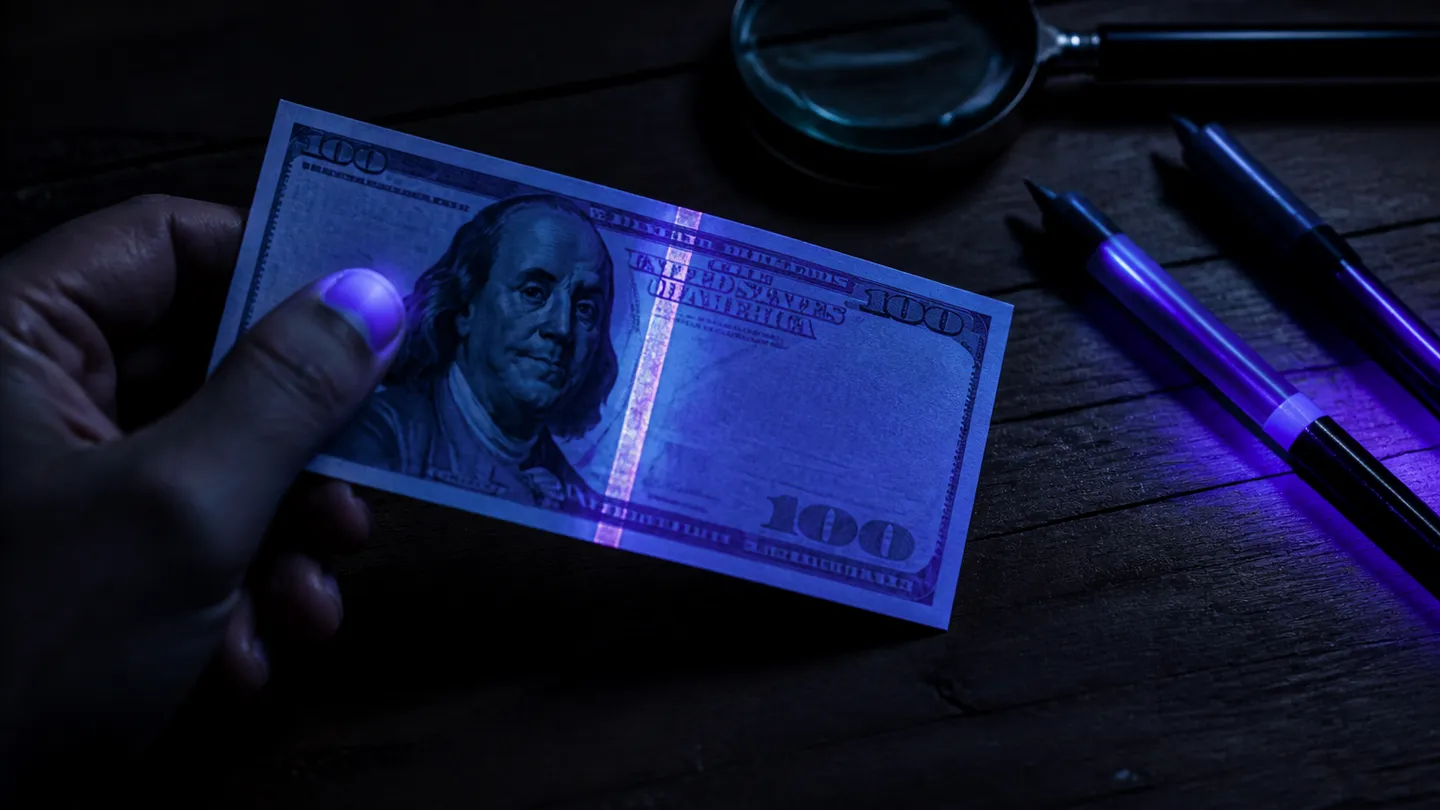
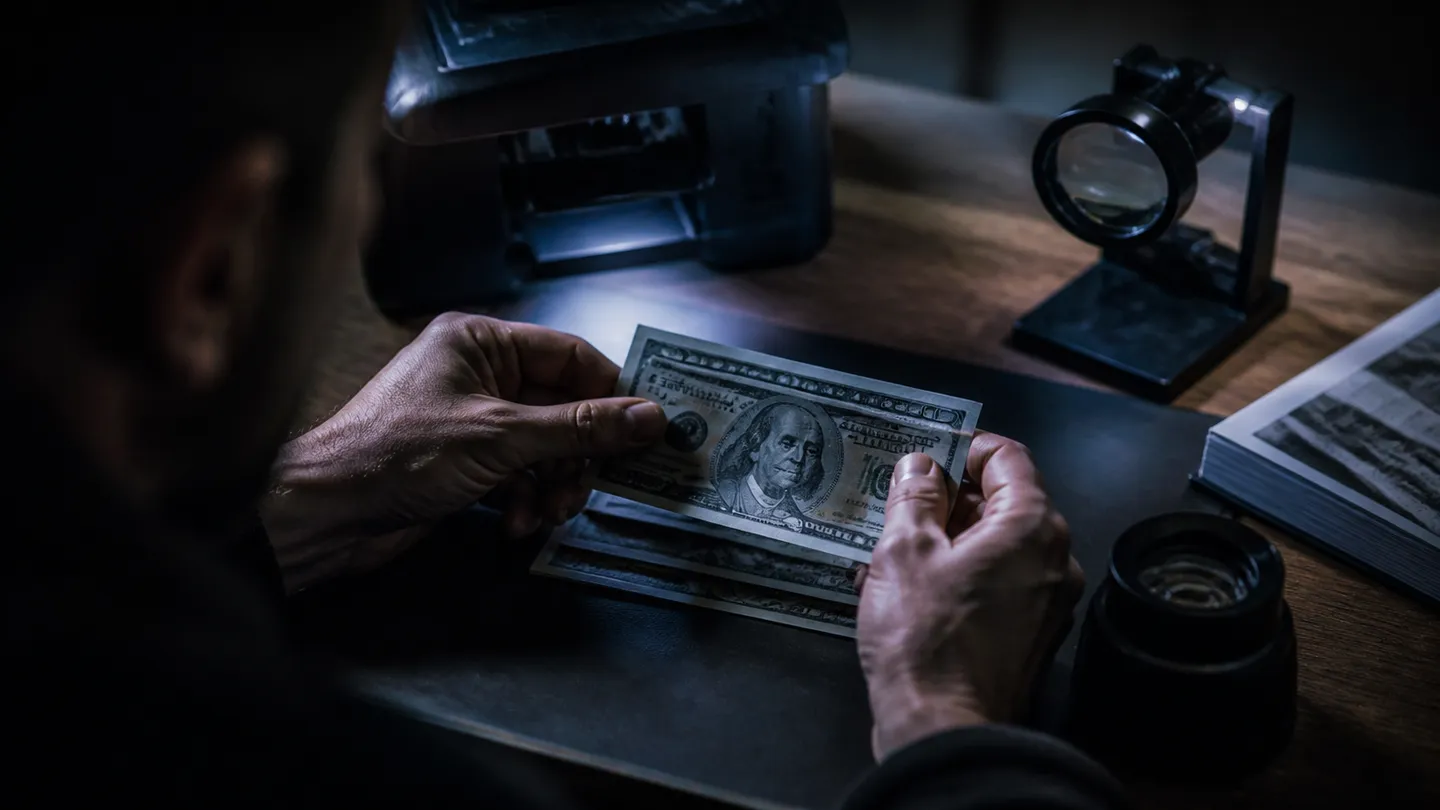
To verify the authenticity of a U.S. banknote, we can employ the official “feel, tilt, check” method. This approach focuses on several key features that are embedded into the design of genuine currency. These include raised printing, watermarks, security threads, colour-shifting ink, and microprinting, all of which help to distinguish real notes from counterfeits.
For instance, let’s examine the current $100 note. When we tilt the note, we should notice a shift in the colour of the numeral and the bell in the inkwell from copper to green. Additionally, the note features a blue 3-D Security Ribbon that displays images of bells and 100s that move when the note is tilted. This is a critical aspect of its design that enhances security[5].
Next, we should hold the note up to the light. This will reveal a watermark of Benjamin Franklin, which is visible from both sides of the note. Also, a security thread marked “USA 100” is embedded in the note and glows pink under ultraviolet light, providing another layer of security[5].
The texture of the paper is also a giveaway; genuine U.S. banknotes are made from a special blend of 75% cotton and 25% linen, giving them a slightly rough feel due to the raised printing[5]. It's important to note that older designs of Federal Reserve notes remain legal tender, so a banknote that appears old is not necessarily counterfeit[6].
We advise that before making a transaction, especially if large sums are involved, you should ensure that the banknote features these characteristics. An understanding of these elements can significantly reduce the risk of accepting counterfeit currency. If you suspect you have received a counterfeit note, it is essential to report it to local authorities immediately and keep the note separate from genuine cash[4].
Trusted Official Sources for Currency Information
For anyone seeking reliable information about U.S. currency, several trusted official sources provide valuable insights. We recommend visiting the U.S. Currency Education Program, the U.S. Department of the Treasury, the Federal Reserve, and the U.S. Secret Service. Each of these organisations has a distinct role in educating the public about currency authentication, policy, and security features.
The U.S. Currency Education Program offers extensive resources on how to identify genuine banknotes, including details about security features such as watermarks and security threads. The Federal Reserve focuses on currency policy and provides guidance on detecting counterfeits, warning that counterfeit-detection pens are not always reliable[4]. The U.S. Secret Service, while known for its law enforcement role, also plays a part in educating the public about counterfeit currency and how to report it.
Here’s a compact table summarising what each source provides:
| Source | Purpose |
|---|---|
| U.S. Currency Education Program | Authentication education, security features |
| U.S. Department of the Treasury | Currency policy, legal tender information |
| Federal Reserve | Reporting counterfeit notes, detection tips |
| U.S. Secret Service | Reporting suspected counterfeit currency |
It’s essential to note that the USDollars system from the U.S. Secret Service is primarily aimed at law enforcement agencies, banks, and cash processors, not the general public[7]. This distinction helps clarify the appropriate channels for reporting counterfeit currency and seeking assistance.
If you suspect you have received counterfeit currency, immediate action is necessary. Report it to local law enforcement, ensuring to keep the note separate from genuine cash[4]. Understanding these resources equips us with the knowledge to navigate the complexities of currency authentication and stay informed about potential counterfeit threats.
What to Do If You Receive Suspected Counterfeit Money
If you suspect that you have received counterfeit money, it is crucial to act responsibly. Do not attempt to spend, return, or pass the note to someone else. Handling the note should be minimised to avoid any potential legal issues. Instead, keep the note separate from genuine cash and record any identifying details about where it came from. This includes noting the time, place, and any information about the person who gave it to you if applicable[4].
Contact local police immediately if you receive a suspected counterfeit note. They can provide guidance on the next steps and help you understand the situation better. If you have further concerns, you can also reach out to your bank or the U.S. Secret Service. It is worth noting that the Secret Service has shifted its reporting process, directing individuals to local law enforcement for cases without investigative leads[7].
Keep in mind that surrendering a counterfeit note generally has no redemption value, meaning you will not receive any compensation for it. The law is quite strict regarding counterfeit currency; knowingly passing or possessing counterfeit notes can lead to severe penalties, including imprisonment for up to 20 years[3].
To protect yourself further, ensure that you report the incident promptly and accurately. This will not only aid your case but also help authorities track down counterfeit operations. Remember, even if you believe you have received a low-quality counterfeit, the legal implications can still apply. Always prioritise your safety and legal standing when dealing with suspected counterfeit currency.
Common Claims About Counterfeit-Money Websites: Fact Check
When navigating counterfeit-money websites, several common claims can mislead consumers. We’ve compiled a myth-versus-fact table to clarify these misconceptions, helping you make informed decisions.
| Claim | Fact |
|---|---|
| Counterfeit-detection pens are definitive. | The Federal Reserve warns that these pens can produce false results, making them unreliable. Authenticating currency should rely on built-in features like watermarks and security threads[4]. |
| All older notes are invalid. | All designs of Federal Reserve notes issued from 1914 to the present remain legal tender. An old-looking banknote is not automatically counterfeit[6]. |
| A “prop money” label guarantees legality. | Labeling an item as “prop money” does not protect its maker or user from legal repercussions if it is produced with intent to defraud[2]. |
| HTTPS proves a seller is trustworthy. | While HTTPS offers some security, it does not guarantee legitimacy. Always investigate further before engaging with any seller[4]. |
| “Undetectable counterfeit” is a legitimate product category. | Claims of “undetectable counterfeit” are often misleading and illegal. Engaging with such products can lead to severe penalties under U.S. law[1][3]. |
Understanding these claims is crucial. We advise that before making any purchase, especially involving significant amounts, verify the legitimacy of the source. Engaging with counterfeit currency or illegal prop money can lead to serious legal consequences, as outlined in U.S. law[1][3]. Always refer to trusted official sources like the U.S. Currency Education Program or the U.S. Secret Service for accurate information and guidance on currency authenticity.
Counterfeit Money Website Evaluation Scorecard
| Website Name | Information Authority (1-5) | Transaction Legitimacy (1-5) | Notes |
|---|---|---|---|
| ExampleSite.com | 4 | 2 | Claims to sell prop money but lacks transparency. |
| LegitCurrency.com | 5 | 5 | Official source with clear policies and contact methods. |
| ScamMoneyMarket.com | 1 | 1 | High-pressure tactics and no contact information. |
| TrustedProps.com | 3 | 4 | Offers lawful prop money but limited verification. |
| CounterfeitAlert.com | 2 | 3 | Provides information but lacks reliable sources. |
Common Mistakes and Misconceptions
Treating Every Search Result as the Same Type of Website
Intent matters. The phrase "counterfeit money website" can lead us to educational resources, official reporting guidance, theatrical-prop shops, scams, or sellers offering illegal currency. Before relying on a result, we should identify whether its purpose is education, entertainment production, document illustration, or passing imitation notes as genuine money.
Confusing Currency Illustrations with Physical Prop Money
The categories are not interchangeable. Federal law permits colour illustrations of U.S. currency only when they are one-sided, smaller than 75% or larger than 150% of the original linear size, with production files and materials erased or destroyed after final use[2]. For physical props or replicas, we should examine the design, marketing and intended use rather than assuming that an entertainment-related label settles the legal question[2].
Trusting a Government-Looking Domain
Official-looking branding can mislead. Readers may assume that an agency name, seal or formal layout establishes government ownership, when the publisher’s identity and exact web address still require verification. We advise starting from an agency’s established public listing and navigating from there, rather than trusting a button or contact supplied by a currency seller.
Assuming the Payment Method Makes the Seller Safe
Payment is not due diligence. A familiar checkout, marketplace account or escrow logo cannot establish that the seller exists, will deliver the stated product, or is offering something lawful. Before paying, we suggest checking:
- The merchant’s legal name, physical location and reachable contact details.
- The refund and dispute terms for the exact payment method.
- Whether the product description promotes theatrical use or use in shops, ATMs and private sales.
Taking "ATM-Ready" or "Undetectable" as a Quality Claim
Technical language can disguise intent. Terms such as "ATM-ready" describe proposed use as genuine currency rather than a legitimate standard for theatrical props, and buying counterfeit obligations with that intent falls within federal counterfeiting law[1][3]. A January 2025 case involved motion-picture prop money used to defraud at least 13 online sellers, causing documented losses of $229,200[8]. When arranging a Seattle marketplace sale, we would reject any buyer or seller who presents machine acceptance as evidence that imitation notes are legitimate.
Conclusions
- Start with purpose. We should distinguish educational resources and lawful prop suppliers from sites offering notes intended to circulate as genuine currency.
- Verify the publisher before trusting its advice. A polished design, secure checkout or government-style branding does not establish authority, ownership or legality.
- Review the product language closely. Claims such as "undetectable" or "ATM-ready" indicate intended misuse rather than a legitimate theatrical application[1][3].
- Before paying, confirm the seller’s legal identity, contact details, refund terms and clear restrictions on use. For a Seattle sale, we should also reject requests involving cash-machine testing or passing replicas to third parties.
- If a banknote seems suspicious, isolate it, preserve the transaction details and contact local police rather than spending it.
Next, use Fake US Dollars: How to Spot Them to check a questionable note safely.
Straight answers
Where can I buy the realest fake money?
We cannot recommend a seller of imitation notes designed to pass as genuine currency. Buying or receiving counterfeit U.S. obligations with that intent can bring a fine, imprisonment for up to 20 years, or both under 18 U.S.C. § 473[1]. For production use, choose an identifiable prop supplier whose products are visibly fictional and never marketed as "undetectable", "ATM-ready", or suitable for shops.
Who is the largest counterfeiter of U.S. currency?
The supplied official sources do not identify a single person, group, or country as the largest counterfeiter of U.S. currency. We would treat any website making that claim cautiously unless it defines the measurement period and links the ranking to an identifiable government report or court record.
How to detect counterfeit money $100?
Tilt a current-design $100 note and look for the copper-to-green numeral and bell, plus movement in the woven blue 3-D security ribbon[5]. Hold it to light to find the Benjamin Franklin watermark and the thread marked "USA 100"; that thread should glow pink under ultraviolet light[5]. We advise checking several features rather than relying on a detection pen, because the Federal Reserve warns that pens can produce false results[4].
What is the difference between counterfeit money and prop money?
Counterfeit money is made or handled with the intention that someone accept it as genuine currency, while prop money is intended for controlled uses such as film, theatre, or photography. The words "prop money" or "replica money" do not make an item lawful when it is produced, possessed, offered, or transmitted with intent to defraud[2]. Before buying a prop, we suggest checking that its design is conspicuously fictional and that the seller never promotes real-world payment or machine acceptance.
Links and references
- 1. 18 USC 473: Dealing in counterfeit obligations or securities
- 2. Currency Image Use | U.S. Currency Education Program
- 3. 18 USC 472: Uttering counterfeit obligations or securities
- 4. How do I determine if a banknote is genuine? What should I do if I think I have a counterfeit note?
- 5. Decoding Dollars $100 | U.S. Currency Education Program
- 6. Circulating Currency | Bureau of Engraving and Printing
- 7. Reporting Suspected Counterfeit Currency to the United States Secret Service
- 8. St. Louis County Man Admits Defrauding Online Sellers with Prop Money