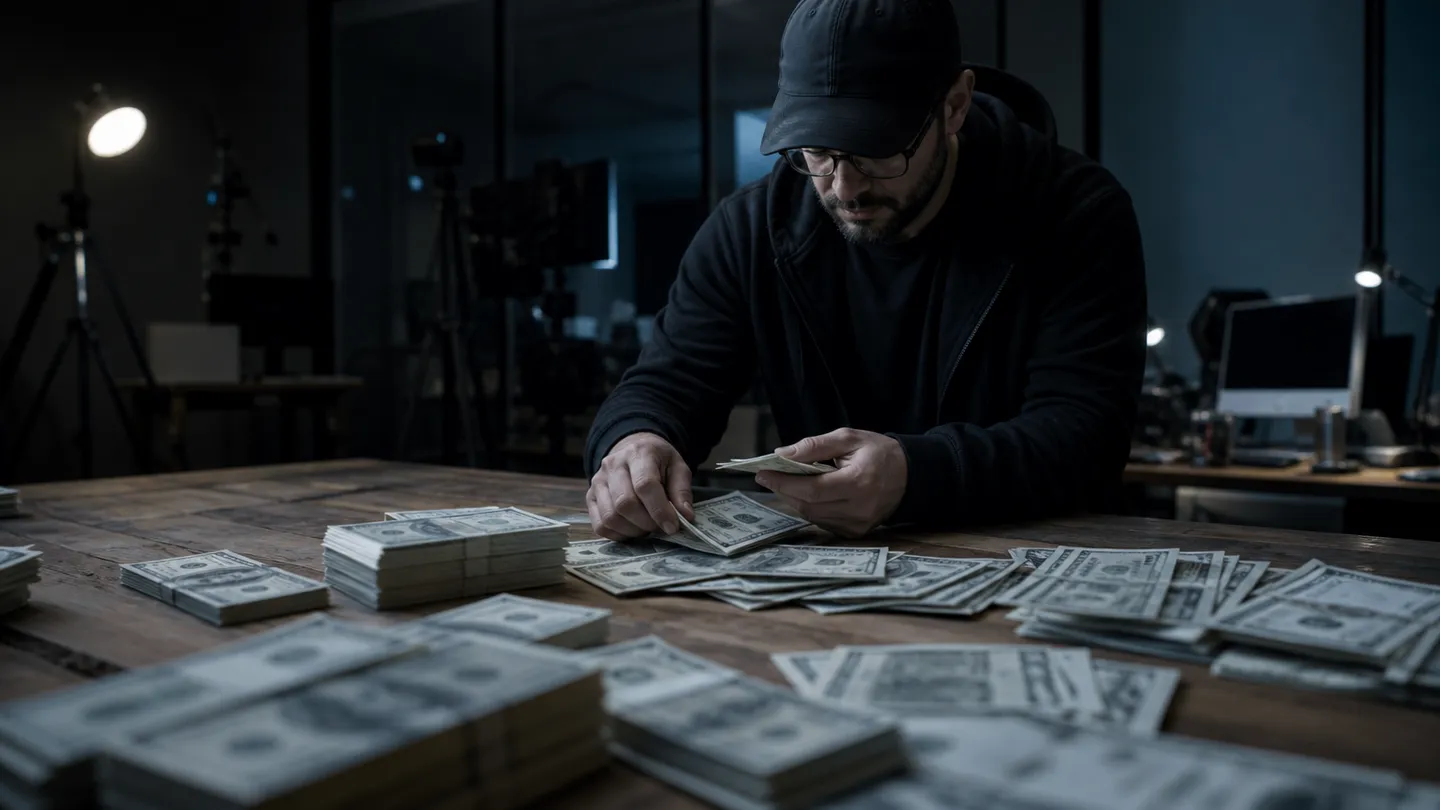
A fake $100 bill is an imitation, counterfeit, or prop note rather than genuine U.S. currency. We recommend feeling the paper, tilting the bill, and holding it to light for design-appropriate security features instead of trusting a detection pen alone; a missing blue ribbon does not prove fraud, because genuine older designs remain legal tender.[1][2][3][4]
How to Check a $100 Bill in 30 Seconds
To quickly determine if a $100 bill is genuine, we recommend a straightforward Look–Feel–Tilt checklist. This method takes only about 30 seconds and involves five essential checks:
Paper Texture and Raised Printing: Genuine bills are made of a unique cotton-linen blend. The paper feels distinctively rough, especially on Benjamin Franklin's shoulder, due to enhanced intaglio printing[5][2].
Franklin Watermark: When held to the light, you should see a watermark of Benjamin Franklin to the right of the portrait. This should be visible from both sides of the note[6].
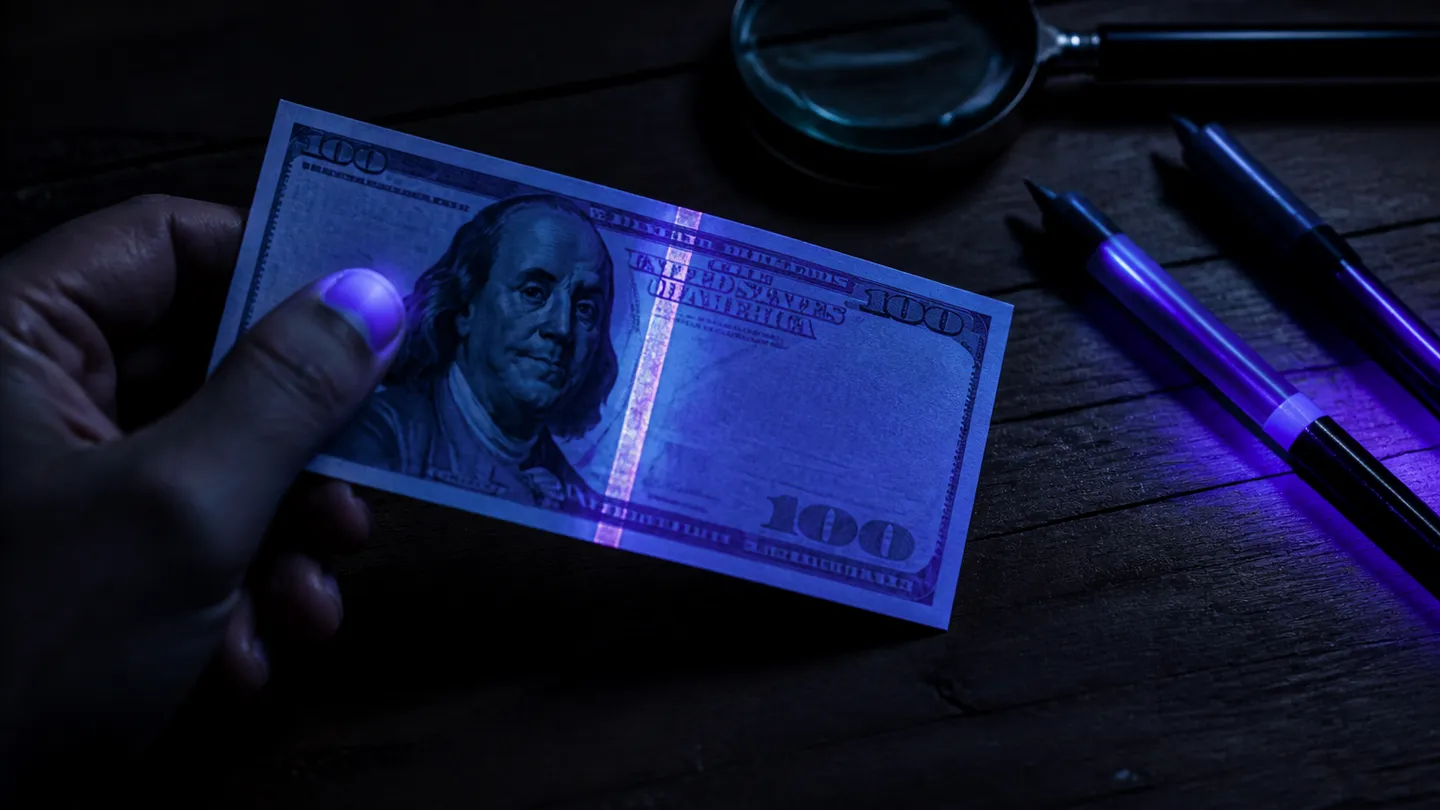
Embedded Security Thread: A genuine $100 bill contains a security thread that is embedded in the paper. When held up to light, it should read "USA 100" in an alternating pattern and glow pink under ultraviolet light[2].
Color-Shifting Ink: The lower-right numeral "100" contains color-shifting ink that changes from copper to green when tilted. This feature is present only on the current design, which entered circulation on October 8, 2013[6].
3-D Security Ribbon: The current design includes a blue 3-D security ribbon woven into the note. When tilted, the bells on the ribbon change to "100s", creating a dynamic visual effect[3].
No single test is conclusive on its own, so it's crucial to perform all five checks. If any of these features seem off, it's wise to be cautious. Remember, counterfeit detection pens can sometimes produce false results, so relying solely on them is not advisable[4]. Always trust multiple security features for the most accurate assessment.
First, Identify Which $100 Bill Design You Have
To determine if your $100 bill is genuine, start by identifying which design you have. The current-design $100 note was introduced on October 8, 2013. However, earlier designs dating back to 1914 are still considered legal tender, meaning a genuine $100 bill may not necessarily feature the blue security ribbon that is characteristic of the current design[1].
The blue 3-D security ribbon is a key feature of the current design, and it is important to note that this ribbon appears only on notes issued from 2013 onwards. Older bills do not have this feature, which can lead to confusion. The U.S. Currency Education Program outlines four distinct design periods for the $100 note: 2013-present, 1996-2013, 1990-1996, and 1914-1990[2].
Design Comparison Table
| Design Generation | Approximate Issue Period | Blue Ribbon Presence | Notable Security Features |
|---|---|---|---|
| Current Design | 2013-present | Yes | 3-D security ribbon, color-shifting ink, embedded thread |
| 1996 Design | 1996-2013 | No | Franklin watermark, embedded thread, microprinting |
| 1990 Design | 1990-1996 | No | Franklin watermark, security thread |
| 1914-1990 | 1914-1990 | No | Basic security features, no advanced technology |
For the current design, several security features can help you confirm its authenticity. When held to light, the embedded security thread should read "USA 100" in an alternating pattern and glow pink under ultraviolet light[2]. Additionally, the Franklin watermark must be visible from both the front and back of the note when held up to light[6].
We advise using a multi-faceted approach to authentication. The U.S. Currency Education Program recommends feeling the paper, tilting the note, and checking it with light as part of a quick three-part authentication routine[3]. Always ensure you are familiar with these features to avoid accepting counterfeit or prop money.
Feel the Paper and Raised Printing
To identify a genuine $100 bill, the texture of the paper and the presence of raised printing are crucial indicators. Genuine U.S. currency paper is composed of approximately 75% cotton and 25% linen, which contributes to its unique feel. Instead of printed fibers, authentic bills contain red and blue security fibers embedded throughout the paper, making them more difficult to replicate[5]. When you hold a genuine bill, you should notice a rough texture, particularly on Benjamin Franklin's shoulder and various parts of the lettering due to enhanced intaglio printing. This tactile feature can help you distinguish authentic currency from counterfeit or prop money[2].
It's important to understand that while feeling the texture is a significant step, it is not foolproof. Heavily worn bills may lose some of their distinctive texture, which can make it challenging to authenticate them based solely on feel. Therefore, we recommend combining this tactile check with other authentication methods, such as tilting the note and examining it under light, as part of a more comprehensive approach[3].
Raised Printing Locations
- Franklin's Shoulder: The most notable area where you can feel raised printing.
- Lettering: Parts of the text on the bill should also have a distinct texture.
Always remember, no single test can confirm authenticity. For the best results, we advise using a combination of methods to verify a bill's legitimacy. If something seems off during your checks, it may be wise to seek further confirmation or consult with local authorities, as counterfeit detection pens are not always reliable[4].
Look for the Watermark, Security Thread, and Microprinting
To verify the authenticity of a $100 bill, examining the watermark, security thread, and microprinting is essential. Start by holding the note up to a light source. You should see the Benjamin Franklin watermark to the right of his portrait, which must be visible from both sides of the bill[6]. This is a reliable indicator of authenticity, as counterfeit notes often lack this feature or do not replicate it accurately.
Next, focus on the embedded security thread, which is positioned to the left of Franklin. This thread should read "USA 100" in an alternating pattern and be visible from both sides of the note[2]. An additional verification step is to check under ultraviolet light; the security thread will glow pink, a characteristic that is difficult for counterfeiters to reproduce effectively.
Microprinting Locations
Microprinting can also serve as a crucial verification tool. Genuine $100 bills feature microprinted text in various locations, including:
- "THE UNITED STATES OF AMERICA" on Franklin's collar.
- "USA 100" around the watermark area.
- "ONE HUNDRED USA" along the golden quill.
- Small "100s" in the borders of the bill[2].
To ensure you are comparing these features correctly, we recommend consulting images from the U.S. Currency Education Program to see the specific design elements of the bill you are examining.
While these features are important, it's crucial to remember that no single test should be relied upon alone. The Federal Reserve suggests using a combination of methods—feeling the paper's texture, tilting the note, and checking for visible features under light—to authenticate the bill effectively[3]. By employing this multi-faceted approach, you will have a much better chance of accurately identifying whether a $100 bill is genuine, counterfeit, or even prop money.
Tilt the Bill to Test Its Motion and Color-Shifting Features
To effectively determine the authenticity of a $100 bill, tilting it can reveal important features. The current design, which has been in circulation since October 8, 2013, includes a woven blue 3-D security ribbon. This ribbon is not merely a flat printed stripe; instead, it has depth, and when tilted, it creates a dynamic effect where images of bells transform into "100s" as they move side-to-side or up-and-down depending on the angle[3]. This distinctive motion is a key indicator of a genuine note.
Another critical feature to observe is the colour-shifting ink used in the lower-right numeral "100" and the Bell in the Inkwell. When tilted, the colour of the Bell shifts from copper to green, which is a hallmark of the current design. In contrast, older designs, such as the 1996-style bill, show the numeral changing from green to black, making this a straightforward comparison point for identification[6].
Several warning signs can indicate a counterfeit or prop note. If the ribbon appears flat, lacks movement, or is simply printed on the surface, these are strong indicators of a fake. Similarly, if the graphics seem static or if the edges appear blurry, it is likely that the bill is not genuine. Always be cautious if you notice these features, as they are common in counterfeit notes[4].
Quick Tips for Tilting the Bill
- Observe the Ribbon: Ensure it moves and changes from bells to "100s" when tilted.
- Check Colour-Shifting Features: Look for the copper-to-green transition in both the Bell and the numeral.
- Watch for Warning Signs: Blurry edges, static graphics, or a flat ribbon are red flags.
By combining the tilt test with other verification methods, we can enhance our chances of identifying a genuine $100 bill. Remember to rely on multiple security features rather than a single test, as counterfeit detection pens can sometimes yield inaccurate results[4].
Detection Pens, UV Lights, and Magnifiers: What They Can and Cannot Prove
Detection Pens, UV Lights, and Magnifiers: What They Can and Cannot Prove
Detection pens, ultraviolet (UV) lights, and magnifiers are popular tools for assessing the authenticity of a $100 bill, but they each have limitations. Understanding what these tools can and cannot prove is crucial for effective verification.
Detection pens are commonly used to identify counterfeit notes, but they primarily detect starch in ordinary commercial paper. This means they can produce false positives, especially if a counterfeit note has been printed on bleached paper or if a genuine lower-denomination note has been altered[7]. Thus, relying solely on a detection pen can lead to a false sense of security, as it may not accurately indicate whether a bill is genuine or counterfeit.
UV lights can be more informative. When using a UV light on a current-design $100 bill, the embedded security thread should glow pink and be visible from both sides of the note[2]. Additionally, the thread's position is a critical factor; it should read "USA 100" in an alternating pattern when viewed under light. However, while UV lights can help verify the thread's authenticity, they cannot confirm other essential features, such as the quality of microprinting or the presence of the Benjamin Franklin watermark.
Magnifiers are particularly useful for examining microprinting, which is a hallmark of genuine currency. On a current-design $100 bill, you can find microprinted text in various locations, including "THE UNITED STATES OF AMERICA" on Franklin's collar and small "100s" along the borders[2]. By using a magnifier, we can assess the quality of these details, but again, this tool should not be used in isolation. It is essential to compare findings with a known genuine bill to ensure accuracy.
To effectively verify a $100 bill, we recommend using a combination of these tools alongside multiple independent features. For instance, after checking the UV light response and examining microprinting under magnification, ensure to also assess the tactile features of the bill, such as the raised printing and the overall texture of the cotton-linen paper[5]. This multi-faceted approach will provide a more reliable assessment and help distinguish between genuine currency, counterfeit notes, and prop money.
Real $100 Bill vs. Prop Money, Play Money, and Chinese Training Notes
Identifying the differences between a genuine $100 bill and items like prop money, play money, or Chinese training notes is crucial. These items are often designed to resemble real currency but are not legal tender. Prop money is typically marked with phrases like "For Motion Picture Use Only" or "Replica," while training notes may have foreign-language text indicating they are not for circulation. Understanding these distinctions can help prevent accepting non-genuine notes.
Genuine $100 bills, particularly the current design introduced on October 8, 2013, feature specific security elements that are absent in prop or training money. For example, the current design includes a blue 3-D security ribbon woven into the paper, which cannot be replicated in prop money[2]. In contrast, prop money may have similar colours and designs but lacks the tactile features and security elements found in authentic currency, such as the raised intaglio printing that makes Benjamin Franklin's shoulder feel rough[2].
Key Differences to Note
- Security Features: Genuine bills have an embedded security thread that reads "USA 100" when held to light, while prop money does not include this feature[2].
- Watermark: The Franklin portrait watermark must be visible from both sides when held up to light, a characteristic often missing in replicas[6].
- Material Composition: Authentic bills are made from a cotton-linen blend, which gives them a unique texture; prop money is usually made from different materials that do not replicate this feel[5].
It's important to remember that a close resemblance to real currency does not make a note legal tender. Prop and training notes have no redeemable face value. For instance, Chinese training notes are explicitly marked as "for practice only" and are not valid for transactions[8].
When distinguishing lawful, clearly marked props from replicas intended to deceive, we should focus on the authenticity indicators. Always look for the security features mentioned above and verify them against a known genuine bill. If you suspect a note is not genuine, it's advisable to handle it carefully and report it to local authorities, as counterfeits cannot be exchanged for real money[4].
By familiarising ourselves with these differences, we can better protect ourselves from inadvertently accepting counterfeit or non-genuine currency.
What to Do If You Think a $100 Bill Is Fake
If you suspect that a $100 bill is counterfeit, it's essential to take immediate and careful action to protect yourself and others. Follow this official safety sequence to ensure your safety and to handle the situation appropriately.
First, do not put yourself at risk. Avoid confronting the person who gave you the bill or attempting to pass it to someone else. Instead, limit your handling of the note. This helps prevent any potential legal issues and keeps you safe from inadvertently participating in the circulation of counterfeit money.
Next, record relevant details about the transaction. If possible, note the appearance of the person who passed you the bill and any vehicle information, including the license plate number. This information can be helpful for law enforcement.
After documenting these details, place the suspect bill in a protective envelope to avoid further handling. This step is crucial because counterfeit currency is considered evidence, and proper handling can help preserve it for investigation.
Once these steps are complete, contact your local police department or the nearest U.S. Secret Service office. The Secret Service is the federal agency responsible for investigating counterfeiting. Be prepared to surrender the bill to law enforcement, as counterfeits cannot be exchanged for genuine currency by the U.S. government. It's important to understand that if you do possess a counterfeit note, you will not be reimbursed for it[4].
For official guidance on reporting counterfeit currency, refer to resources from the U.S. Currency Education Program or the Federal Reserve[4]. By following these steps, we can help maintain the integrity of our currency system and assist in the fight against counterfeiting. Remember, it's always better to be cautious and report any suspicions to the authorities.
Common $100 Bill Myths and Identification Mistakes
Several myths surround the identification of genuine $100 bills that can lead to costly mistakes. One common misconception is that every real $100 bill features a blue stripe. In reality, the blue 3-D security ribbon is only present on the current design, which has been in circulation since October 8, 2013. Earlier designs, issued from 1914 onward, remain legal tender and do not include this feature[1][2]. Thus, a genuine bill without a blue ribbon can still be authentic.
Another frequent error is relying solely on counterfeit detection pens to verify authenticity. These pens test for starch in regular paper and are not always reliable. Counterfeiters can easily defeat these tests by using bleached genuine currency paper or coating a fake note[7]. The Federal Reserve advises that security features such as the watermark and embedded thread are far more reliable indicators of authenticity[4].
Many people also believe that all serial numbers on U.S. currency must be unique worldwide. While it is true that each note has a unique serial number, there can be multiple notes with the same serial number in different denominations or designs. This misunderstanding can lead to confusion when assessing a bill's authenticity.
Lastly, there is a misconception that a bill must feature a hologram to be genuine. While modern bills do include numerous security features, the blue ribbon is woven into the paper rather than being a conventional hologram[3]. Older designs, which lack this ribbon, are still valid and should not be dismissed based solely on this characteristic.
To effectively authenticate a $100 bill, we should employ a multi-faceted approach that examines several security features, including the raised printing, tactile feel, and visible elements when held to light[3]. By understanding these myths and verifying multiple features, we can significantly improve our ability to distinguish genuine currency from counterfeit or prop money.
$100 Bill Verification Table
| Design Period | Key Features | Security Tests | Notes |
|---|---|---|---|
| 2013-present | Blue 3-D Security Ribbon | Feel, Tilt, Light | Only current design has blue ribbon. |
| 1996-2013 | Watermark, Security Thread | Feel, Tilt, Light | No blue ribbon; check for USA 100. |
| 1990-1996 | Watermark, Microprinting | Feel, Tilt, Light | No blue ribbon; check for microprinting. |
| 1914-1990 | Watermark, Security Fibers | Feel, Tilt, Light | No blue ribbon; older notes valid. |
Common Mistakes and Misconceptions
Avoid these shortcuts. Before accepting a suspicious bill in Seattle, make sure you can:
- identify its design period before comparing security features[2];
- perform the official "feel, tilt, and check with light" routine[3];
- separate the note from genuine cash if doubts remain[4].
Using replica listings as authentication guides
Replica and prop-money sales pages describe products, not a complete authentication process, so their comparisons may omit decisive security features. We advise using the official design-period guide, then checking the bill by touch, movement, and transmitted light[2][3].
Rejecting every note without a blue ribbon
People often compare an older bill with the newest design and assume that a missing ribbon proves counterfeiting. The ribbon belongs only to the current design; earlier Federal Reserve notes issued from 1914 onward can still be legal tender[1][2]. Identify the design period before deciding which features should be present.
Treating a pen mark as a verdict
A counterfeit pen feels conclusive because it gives an immediate result, but it only tests for starch and can be defeated[7]. A "pass" may create false confidence, while a "fail" does not replace examination of the watermark, security thread, and other design-appropriate features[4].
Calling every non-genuine note a counterfeit
Marked prop money, play money, and training notes are not valid currency, but visible wording may reveal their intended category immediately. Chinese-text training notes can carry phrases such as "training coupon", "sample", or "for practice only", and have no redeemable face value[8]. Read both sides before inspection, refuse the item, and reserve counterfeit reporting procedures for a note suspected of being passed as genuine.
Assuming a "prop" label makes a reproduction acceptable
A printed disclaimer does not by itself show that a colour currency reproduction follows federal requirements. Permitted colour illustrations must be one-sided, meet specified size limits, and have their reproduction materials erased or destroyed after final use[9]. For payment purposes, the practical answer is simpler: do not accept any item labelled as a prop, sample, training coupon, or play money.
Giving the suspect bill back or trying to spend it
Someone may return the note to avoid losing $100, but passing it onwards leaves another person with the same problem. Keep it apart from genuine cash, note available details about the passer and vehicle, contact Seattle police, and surrender the bill promptly; suspected counterfeits cannot be exchanged for genuine money[4].
Conclusions
Stay methodical.
- We should identify the note’s design period before judging it, since older genuine bills may lack the current blue ribbon[1][2].
- Check several independent features together, including texture, print quality, light-visible elements, and details that change when tilted[3][4].
- Use a detection pen only as supporting evidence; its result cannot establish whether the bill is authentic[7].
- Reject anything marked "prop", "sample", or "training", because it has no monetary value[8].
- If doubts remain in Seattle, separate the note, record the transaction details, and contact local police rather than returning or spending it[4].
Next, review Fake US Dollars: How to Spot Them for the same practical checks across other denominations.
Straight answers
How much is a Chinese $100 bill worth?
If you mean a Chinese-text training note resembling U.S. currency, it has no redeemable $100 face value and cannot be spent as legal tender[8]. We advise checking both sides for wording such as "training coupon", "sample", "for practice only", or "not for circulation"[8].
What is the #1 way to detect counterfeit money?
There is no reliable single test; we advise using the official combined routine: feel the paper, tilt the note, and check it with light[3]. Give particular weight to the watermark and embedded security thread, which the Federal Reserve identifies as better authentication evidence than a detection pen[4].
How can you tell a fake $100 dollar bill from a real one?
First identify the design period, then check only the features appropriate to that version[2]. On the current design, feel for rough printing on Franklin's shoulder, tilt the woven blue ribbon to watch its images move, and hold the note to light to find the watermark and embedded thread[2][6][3].
What is the difference between prop money and a counterfeit $100 bill?
A clearly identified prop or training note presents itself as non-currency, often through wording such as "sample" or "for practice only"; it has no redeemable face value[8]. A suspected counterfeit instead imitates genuine currency closely enough to be passed as real, so we should separate it from genuine cash and surrender it to law enforcement rather than spend or return it[4].
Does the security thread on a real $100 bill glow under UV light?
On current-design and 1996-style notes, the embedded thread glows pink under ultraviolet light[2]. It should sit to the left of Franklin, display an alternating "USA 100" pattern, and remain visible from both sides when the bill is held to light[2].
Links and references
- 1. The Seven Denominations | U.S. Currency Education Program
- 2. $100 Note | U.S. Currency Education Program
- 3. Decoding Dollars: The $100 | U.S. Currency Education Program
- 4. How Do I Determine If a Banknote Is Genuine? What Should I Do If I Think I Have a Counterfeit Note? | Federal Reserve Board
- 5. The Buck Starts Here: How Money Is Made | Bureau of Engraving and Printing
- 6. Training Course - Exam | U.S. Currency Education Program
- 7. U.S. Currency Education Program Training Presentation
- 8. Anchorage Man Found Guilty of Attempting to Spend Counterfeit Money at Anchorage International Airport | U.S. Department of Justice
- 9. Currency Image Use | Bureau of Engraving and Printing