We cannot recommend buying counterfeit money in the UK: knowingly possessing it without lawful authority or excuse is an offence, while overseas orders can also create an illegal importation issue[1]. No lawful price or delivery terms are provided, and adverts are often deceptive scams[2]. We suggest reporting the advert to its hosting platform rather than attempting a purchase[2].
Buy Counterfeit Money UK: What to Know
| Options/Tariffs/Methods | Price | Timeframes | Requirements | Restrictions |
|---|---|---|---|---|
| Counterfeit Notes | Varies; often illegal | Immediate; varies by seller | None; illegal to possess without authority | Possession can lead to up to 10 years' imprisonment |
| Prop Money | Typically £10-£50 per note | Immediate; varies by seller | Must comply with Bank of England's reproduction conditions | Must be one-sided and 25% larger or smaller than genuine notes |
| Online Purchases | Varies; often scams | Immediate; varies by seller | None; illegal to import without Treasury consent | Possession can lead to up to 2 years' imprisonment |
| Reproductions with disclaimers | Varies; often illegal | Immediate; varies by seller | Must meet Bank of England's reproduction conditions | Adding disclaimers does not make it lawful if conditions are not met |
How to Obtain a Lawful Banknote Prop
- 1. Decide whether you need a prop or genuine currency
Choose the lawful route. A counterfeit is an item resembling a currency note closely enough to be reasonably capable of passing as genuine; even a one-sided reproduction may qualify.[1] Knowing possession without lawful authority or excuse is an offence, including where the note is unfinished or unfit to be passed.[1] Before looking at sellers, confirm that your intended item is a clearly compliant prop rather than realistic fake money intended for payment.
- 2. Reject counterfeit adverts and overseas offers
Do not attempt a counterfeit purchase. The Bank of England says online accounts advertising counterfeit notes are often scams, even when photographs or videos appear convincing, and advises reporting the advert to its hosting platform.[2] An overseas order also creates an importation issue because importing, landing or unloading counterfeit notes without Treasury consent is prohibited.[1] The source guidance provides no standard delivery period, so a promise of fast or discreet shipping should not influence your decision.
- 3. Request the prop's specifications before paying
Ask for measurable details. A physical Bank of England note reproduction covered by the Bank's consent conditions must be one-sided and at least 25% smaller or 25% larger than the genuine note, rather than matching its size.[3] Compare the seller's stated measurements with these genuine dimensions:
- £5: 125 × 65 mm
- £10: 132 × 69 mm
- £20: 139 × 73 mm
- £50: 146 × 77 mm[3]
Before paying, make sure the listing shows both sides, exact dimensions and any required marking; photographs alone do not establish compliance.
- 4. Check the design and issuing bank
Read every label carefully. A reproduction showing more than 50% of one side generally needs a central, bold grey "SPECIMEN" marking placed at a 45-degree angle, unless it is slanted by more than 20 degrees or meets the separate-material condition.[3] Words such as "Movie", "Prop" or "Training" do not make a copy lawful when the Bank of England's reproduction conditions are not met.[2] For Scottish or Northern Ireland note designs, check the relevant issuing bank's requirements separately because the Bank of England's consent applies only to its own notes.[3]
- 5. Inspect the item when it arrives
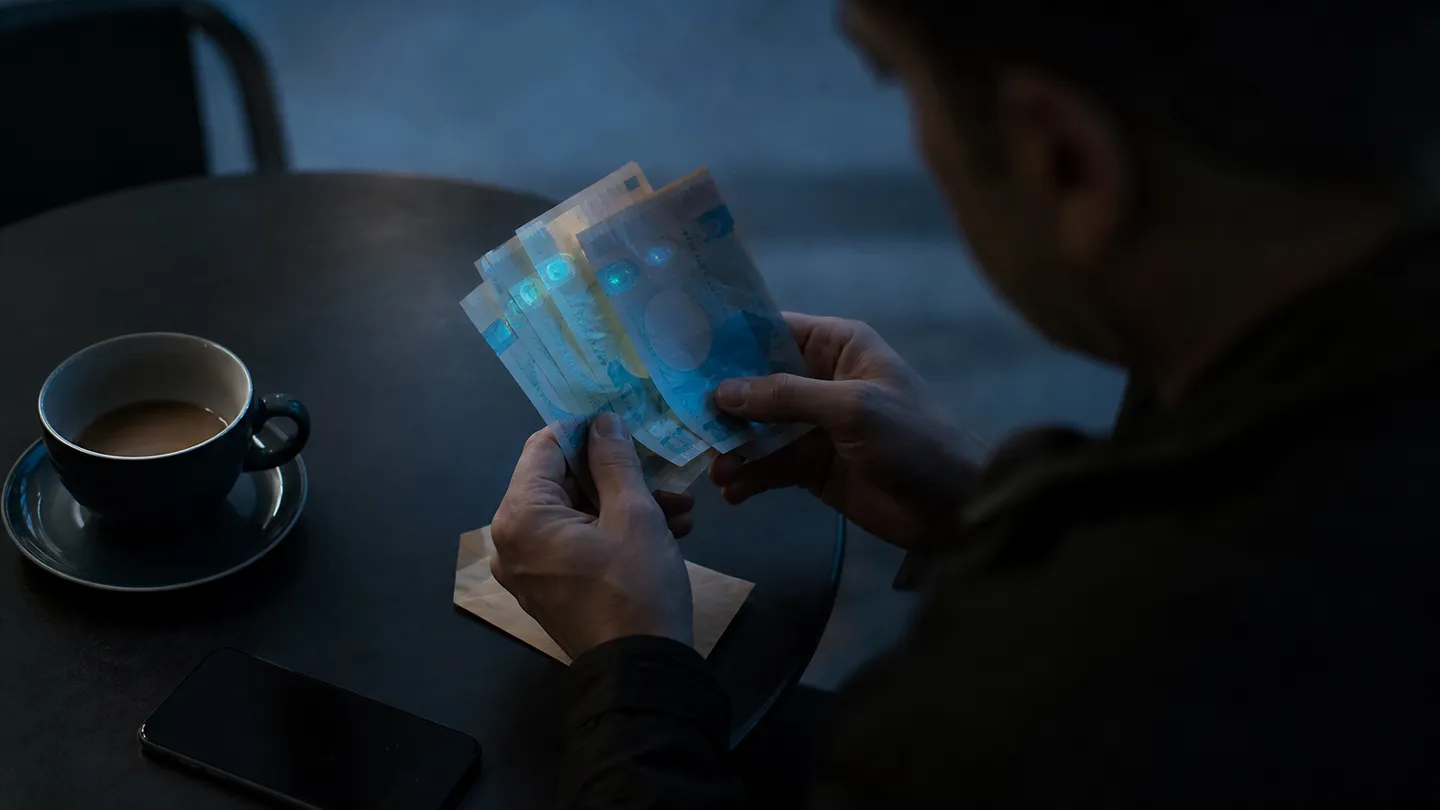
Measure it before use. Confirm that the prop is one-sided, differs from the genuine dimensions by the required amount and carries the applicable "SPECIMEN" marking.[3] If the delivered item instead resembles spendable currency, compare it with the features of current polymer £5, £10, £20 and £50 Bank of England notes:
- a see-through window;
- a hologram changing between the denomination and "Pounds";
- raised print;
- denomination-specific foil colours.[4]
These features are the same on Charles III and Elizabeth II notes.[4] A detector pen cannot identify counterfeits printed on polymer; the Bank recommends a good-quality ultraviolet lamp emitting at about 365 nanometres when checking fluorescent features.[5]
- 6. Stop if the result is not a compliant prop
Do not try to spend it. Claims that fake notes are "undetectable" conflict with Bank of England information showing that counterfeits are typically removed quickly, often after one use.[2] Possessing counterfeits with intent to pass them as genuine can carry up to 10 years' imprisonment on indictment, while knowing possession without lawful authority or excuse can carry up to two years.[1] If the delivered item differs from the documented prop specification, avoid passing or transferring it and obtain prompt legal advice about lawful surrender; report the original advert to the hosting platform.[2]
Risks, Limitations and Guarantees
Buying counterfeit money in the UK presents serious legal risks. Under the Forgery and Counterfeiting Act 1981, knowingly possessing counterfeit notes without lawful authority can lead to a prison sentence of up to two years. If you intend to pass them as genuine, the penalty increases to a maximum of ten years' imprisonment[1]. Additionally, importing counterfeit notes without Treasury consent is illegal and can lead to further legal complications[1].
It's crucial to verify the seller's legitimacy before making any purchase. Many online advertisements for counterfeit notes are scams designed to trick buyers into losing money[2]. If you come across such an advert, it's advisable to report it rather than attempt to purchase.
For prop money, strict compliance with the Bank of England's reproduction conditions is necessary. Reproductions must be one-sided and either 25% larger or smaller than genuine notes to be considered lawful[3]. Moreover, any reproduction showing more than 50% of one side typically requires a "SPECIMEN" marking to avoid legal issues[3].
Return and cancellation policies can vary significantly among sellers, and many may not offer refunds. Always clarify these policies before finalising a transaction to prevent potential financial loss.