We show you how to check cash. Start with "Feel, Tilt, Check": examine the texture and raised printing, tilt for moving or colour-shifting features, then hold the note to light for its watermark and embedded security thread[1]. Do not rely on a detection pen alone, because it can give false results[2]. First, feel and tilt the note before using any tool.
Check Counterfeit Money: Tools and Techniques
| Method | Price | Timeframe | Requirements | Limitations |
|---|---|---|---|---|
| Feel, Tilt, Check | Free | Immediate | Access to the note | Requires tactile and visual inspection |
| Cash Assist App | Free | Immediate | Smartphone with camera | Does not determine counterfeits, only identifies denomination |
| Counterfeit Detection Pens | Varies ($10-$50) | Immediate | Access to the pen and note | Not always accurate, can produce false results |
| Magnification Tools | Varies ($20-$100) | Immediate | Access to the tool and note | Requires knowledge to interpret microprinting |
| Ultraviolet Light | Varies ($20-$200) | Immediate | Access to the light and note | Requires knowledge of UV responses for different denominations |
| Professional Authentication Services | Varies ($50+) | 1-2 days | Send note to service | Costly and may require shipping time |
| Law Enforcement Reporting | Free | As needed | Suspicion of counterfeit | Requires separation from real cash and prompt reporting |
How to Check a Banknote Before Accepting It
- 1. Identify the denomination and design
Start with the note itself. Confirm whether it is a $1, $2, $5, $10, $20, $50, or $100 Federal Reserve note.[3] The Cash Assist app for Android or iOS can identify the denomination and show which security features to inspect, but it cannot decide whether the note is counterfeit.[4] Before rejecting an unfamiliar design, remember that Federal Reserve notes issued from 1914 onward remain legal tender and may lack newer features.[3][5]
- 2. Feel the paper and raised printing
Next, use touch. Genuine Federal Reserve note paper is 75 percent cotton and 25 percent linen, with embedded red and blue security fibres.[6] Raised intaglio printing should give the surface a slightly rough feel rather than the texture of ordinary smooth paper.[6] We suggest comparing the suspect note with a genuine note of the same denomination and design where available.
- 3. Tilt the note
Now watch the moving features. On a current-design $100 bill, the blue 3-D Security Ribbon is woven into the paper, and its bells and 100s move when the note is tilted.[6] The bell and numeral 100 also change colour from copper to green.[6] Tilt in more than one direction, because the ribbon images can appear to move side to side or up and down.[6]
- 4. Hold it to a light
Check through the paper. Use a light source to find the watermark and embedded security thread, which are central parts of the official "Feel, Tilt, Check" routine.[1] A genuine current-design $100 note has a Benjamin Franklin watermark visible from both sides and a thread marked "USA 100".[6] Do not rely on a counterfeit-detection pen alone, because it can give false results and should not replace these security-feature checks.[2]
- 5. Use UV light or magnification when needed
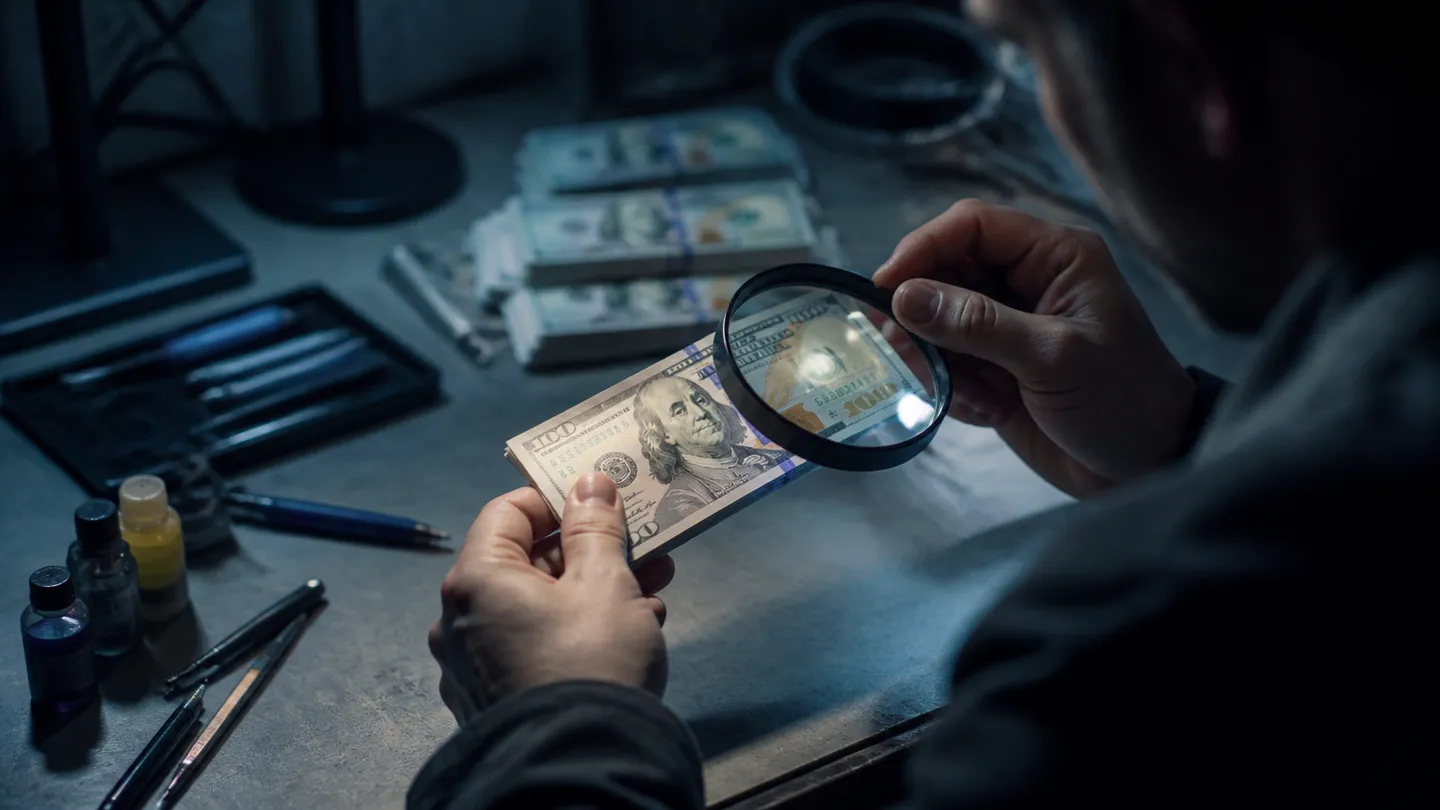
Add tools for a closer check. Under ultraviolet light, current-design security threads glow blue on $5 notes, orange on $10 notes, green on $20 notes, yellow on $50 notes, and pink on $100 notes.[3] For a current-design $100 bill, magnification can reveal "THE UNITED STATES OF AMERICA" on Franklin's collar, "USA 100" near the watermark, "ONE HUNDRED USA" along the golden quill, and small 100s in the borders.[7] There is no app verdict to wait for, so compare each visible feature directly with the guidance shown for that denomination.[4]
- 6. Decide, separate, and report
Act on the combined result. If the features do not match, do not mix the note with genuine cash; separate it and give it promptly to law enforcement.[2] Individuals, including those in Seattle, should contact a local Secret Service field office, while businesses and financial institutions may use SSF 1604; electronic submissions through the USDollars website ended on November 1, 2024.[8] A counterfeit note cannot be exchanged for genuine currency, and knowingly passing, selling, possessing, or concealing one with intent to defraud can carry a fine, imprisonment for up to 20 years, or both under 18 U.S.C. § 472.[2][9]
Risks, Limitations, and Guarantees
When verifying banknotes, there are inherent risks and limitations to consider. The most significant risk is accepting a counterfeit note, which cannot be exchanged for genuine currency. If a counterfeit is accepted, the holder typically loses its value, and the Federal Reserve advises separating the suspect note from real cash and reporting it to law enforcement promptly[2].
Detection tools have limitations, too. For instance, counterfeit detection pens can yield false results, making it essential to rely on multiple security features, such as watermarks and security threads, rather than a single tool[2]. The Cash Assist app can help identify a bill's denomination and display security features, but it does not confirm whether a note is counterfeit[4].
Moreover, older genuine bills may lack newer security features, leading to potential false alarms when rejecting them[5]. Understanding the current design and security features of Federal Reserve notes is crucial, as all notes issued from 1914 onward remain legal tender[3].
Finally, if you suspect a note is counterfeit, it is vital to act quickly. The reporting process has changed, and individuals should contact a local Secret Service field office, while businesses may use specific forms[8]. Accidental acceptance without fraudulent intent is not punished under law, but knowing the risks can help avoid complications[9].
Straight answers
What is the best counterfeit money detector?
No single detector is best for every note. We suggest combining a UV light with visual and tactile checks, then using magnification when microprinting needs closer inspection; a detector pen alone is unreliable and may give false results[2]. Choose a device that lets you inspect denomination-specific thread colours rather than one that provides only a simple pass-or-fail signal[3].
Is the Cash Assist app a real or fake app?
Cash Assist is a real, official app from the U.S. Currency Education Program for Android and iOS[4]. Its camera identifies the denomination and shows which security features to inspect, but it does not determine whether a bill is genuine or counterfeit[4].
What happens if you accidentally pay with counterfeit money?
An accidental, good-faith payment is not the fraudulent conduct targeted by federal counterfeiting law[9]. If you discover the problem, do not try to spend the note again; separate it from genuine cash and contact law enforcement promptly[2]. The counterfeit cannot be exchanged for genuine currency, so its holder normally loses the value[2].
Links and references
- 1. Decoding Dollars: The $100 | U.S. Currency Education Program
- 2. How Do I Determine if a Banknote Is Genuine? What Should I Do if I Think I Have a Counterfeit Note? | Federal Reserve Board
- 3. The Seven Denominations | U.S. Currency Education Program
- 4. Cash Assist Mobile App | U.S. Currency Education Program
- 5. Cashier Toolkit | U.S. Currency Education Program
- 6. $100 Note | U.S. Currency Education Program
- 7. Cashier Toolkit: A Guide to Identifying Genuine Currency
- 8. Report a Counterfeit | U.S. Currency Education Program
- 9. 18 U.S. Code § 472 — Uttering Counterfeit Obligations or Securities
Explore More on Counterfeit Detection
Discover additional resources and tips to stay informed.
Learn More