A $20 bill marked "For Motion Picture Purposes," "Replica," or similar wording is prop money, not accepted cash[1]. We advise checking a current-design note by feeling its raised printing, tilting the lower-right 20 for a copper-to-green colour shift, and holding it to light for the portrait watermark and "USA TWENTY" security thread[2][3].
What “For Motion Picture Purposes” Means on a $20 Bill
Motion-picture money, often marked with phrases like "For Motion Picture Purposes" or "Replica," serves as a prop and is not considered legal tender. While it may closely resemble genuine currency in terms of size, colour, and layout, it is crucial to recognise that such notes are intended solely for film and television productions. According to the IRS, these replicas are explicitly not accepted as cash payments, and any attempt to use them as real money can lead to serious legal consequences[1].
When examining prop money, you will typically find disclaimers that clearly indicate its status as non-legal tender. These disclaimers may include altered issuer names and nonstandard portraits, which further distinguish them from authentic U.S. currency. For instance, a genuine $20 bill features an Andrew Jackson watermark and a security thread that reads "USA TWENTY," both of which are absent in motion-picture money. It is important to note that even if the prop money is visually convincing, it does not hold any monetary value[2][3].
In scenarios where prop money is used fraudulently—such as attempting to spend it as real currency—the individual may face charges under federal law. Specifically, knowingly passing or attempting to use counterfeit obligations can lead to fines or imprisonment of up to 20 years[4]. The distinction between prop money and actual currency becomes critical when considering the legal implications of its use.
To avoid confusion, we encourage cash-handling consumers and small-business owners to familiarize themselves with the features of genuine $20 bills. Checking for the raised printing, colour-shifting ink, and embedded security features can help ensure that you are dealing with authentic currency. Always remember, if you suspect that someone is attempting to use prop money as real cash, it is essential to separate it from legitimate currency and report the incident to local authorities[5].
The 30-Second Check: How to Spot a Motion-Picture $20
To quickly identify a motion-picture $20 bill, we recommend a straightforward scan-and-touch checklist. Begin by closely reading all printed wording on the bill. Look for phrases such as "For Motion Picture Purposes" or "Replica." These terms clearly indicate that the bill is not valid cash[1]. Next, compare the portrait of Andrew Jackson and the seals; genuine notes feature distinct details that are often blurred or missing in prop versions.
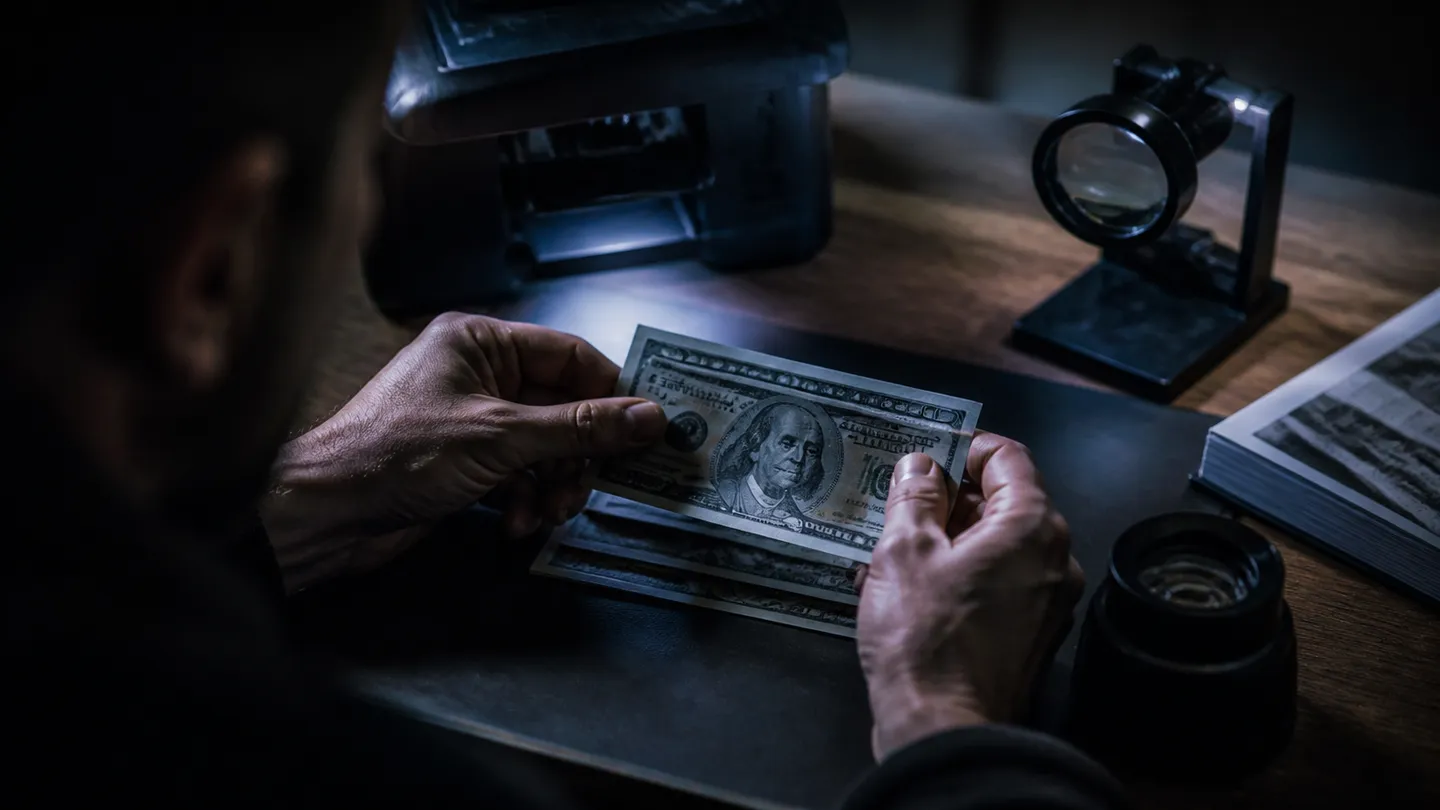
Inspect both sides of the bill. Genuine currency has an embedded thread to the left of Jackson’s portrait that reads "USA TWENTY" and glows green under ultraviolet light[3]. On the lower right, the numeral 20 should change from copper to green when tilted, a feature that is often absent in motion-picture money[3]. We also advise feeling the paper; real U.S. currency is made of 25 percent linen and 75 percent cotton, giving it a unique texture with embedded red and blue security fibres[3].
When holding the bill to the light, check for the Andrew Jackson watermark to the right of the printed portrait. If the watermark is missing or poorly defined, it’s a strong indication of counterfeit or prop money[3].
Be on the lookout for red flags such as repeated serial numbers, which are a common feature in prop money, and any flat or glossy surfaces that do not match the texture of real bills. Blurred borders and missing embedded features are additional signs that you may be dealing with a counterfeit or motion-picture note.
Using several checks rather than relying on a single clue is crucial in identifying a fake. This thorough approach ensures that you are better equipped to distinguish between genuine currency and motion-picture money. Remember, if you suspect a note is counterfeit, separate it from real cash and notify local authorities immediately[5].
Security Features on a Genuine Modern $20 Bill
Identifying genuine currency involves understanding its unique security features. A modern $20 bill includes several elements designed to prevent counterfeiting, and knowing where to find them can make a significant difference.
The Andrew Jackson watermark is a prominent feature located to the right of the printed portrait. This watermark is visible from both sides of the bill and should appear as a faint image of Jackson when held up to the light. If the watermark is missing or poorly defined, it may indicate a counterfeit or prop note[3].
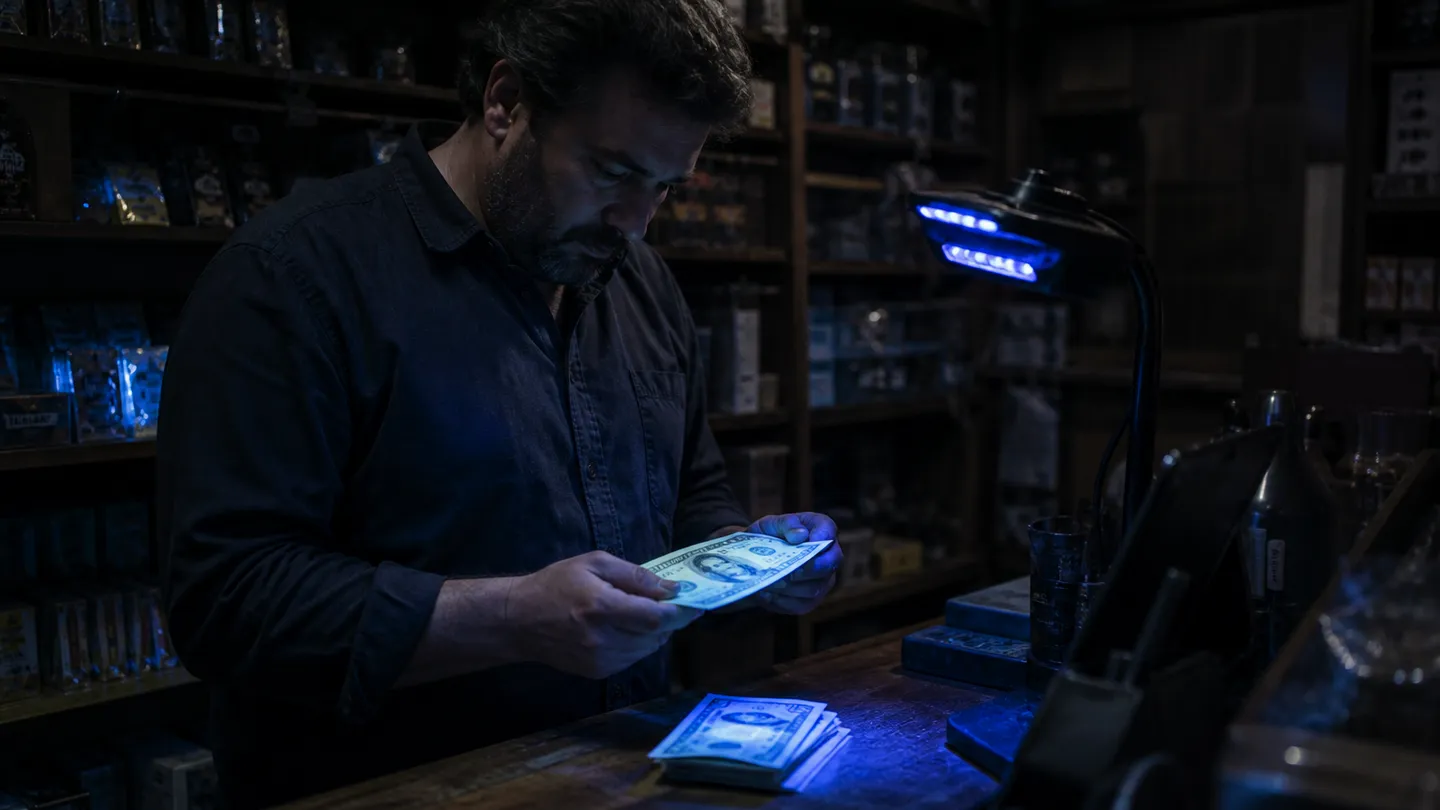
Next, the security thread is embedded to the left of Jackson's portrait. It reads "USA TWENTY" along with a small flag, and this thread can be seen from both sides of the note. Under ultraviolet light, the thread glows green, adding another layer of security that is often absent in fake notes[3].
Another critical feature is the colour-shifting ink used in the lower-right numeral "20." When you tilt the note, the numeral should shift from copper to green. This effect is a clear indicator of authenticity and is not typically replicated in motion-picture money[3].
In addition to these features, genuine currency is made with raised printing, which creates a distinct texture that can be felt by running your fingers over the bill. This raised printing is a result of the special composition of the paper, which is 25 percent linen and 75 percent cotton, along with embedded red and blue security fibres[3].
Microprinting is another subtle security feature found on the bill, typically located in various areas around the portrait and seals. This text is only visible under magnification and should appear crisp and clear. If the microprinting is blurred or missing, it could indicate a counterfeit note.
For the best comparison, we recommend having a known genuine $20 bill on hand. This allows you to visually and physically compare the features side by side. Additionally, the U.S. Currency Education Program provides resources and guides that can help you further understand how to identify authentic currency[2].
Taking the time to familiarise yourself with these features can help you avoid the pitfalls of counterfeit or prop money. Always remember to check for multiple indicators rather than relying on a single feature to make your determination.
Real $20 vs Motion-Picture Money vs Counterfeit
To effectively distinguish between a genuine $20 bill, motion-picture money, and counterfeits, we can compare their key features side by side. Below is a table summarising the critical differences:
| Feature | Real $20 Bill | Motion-Picture Money | Counterfeit |
|---|---|---|---|
| Legal-Tender Wording | No specific markings | Marked with "For Motion Picture Purposes" or "Replica"[1] | No specific markings, may imitate real currency |
| Portrait | Andrew Jackson | Altered or different portraits | May resemble Andrew Jackson but lacks detail |
| Paper Feel | 25% linen, 75% cotton; textured feel[3] | Often glossy, lacks texture | Varies; may feel flat or smooth |
| Watermark | Andrew Jackson watermark visible[3] | Generally absent | May be poorly defined or missing |
| Security Thread | Embedded thread reads "USA TWENTY"[3] | Absent or poorly replicated | May include fake threads |
| Color-Shifting Ink | Numeral 20 shifts from copper to green[3] | Typically absent | May use similar colours but lacks true effect |
| Serial Numbers | Unique, non-repeating | Often contains repeated numbers | May replicate real serial numbers |
| Reverse Design | Detailed and specific design | Simplified or altered design | Often lacks detail or clarity |
| Common Disclaimers | None | Explicit disclaimers present[1] | No disclaimers; may misrepresent as real |
The presence of markings such as "For Motion Picture Purposes" or "Replica" clearly indicates that a note is prop money and not valid for transactions. However, it is important to note that realistic appearance alone does not guarantee authenticity or legality. For example, there have been reports of prop money being used fraudulently, highlighting that even clearly marked bills can be misused in real-world scenarios[6].
When assessing the authenticity of a note, we recommend a thorough examination. Genuine U.S. currency includes distinct features such as the Andrew Jackson watermark, the security thread that glows under ultraviolet light, and the unique texture of the paper. If a note lacks these features, it may either be prop money or a counterfeit. Always remember to check multiple security elements rather than relying on a single characteristic for your determination[5].
Why the Bill’s Series and Age Matter
Why the Bill’s Series and Age Matter
The series year and age of a $20 bill play a crucial role in identifying its authenticity. Older genuine notes may lack some features found on the current colourized design. For instance, the Series 2001 $20 bill predates the redesigned note issued in 2003. This means that if you're examining a Series 2001 note, it won't have the later background colours or some modern security features, but this does not imply that it is counterfeit.
When assessing an older note, it's essential to match the series year with the expected features. For example, a Series 2001 $20 should have an Andrew Jackson watermark, a green-glowing security thread that reads "USA TWENTY," and a numeral 20 that shifts from green to black when tilted, rather than the copper to green shift seen in newer bills[3]. It’s also important to note that the older 1990–1998 design lacks the portrait watermark and colour-shifting ink, which are found in the Series 1996, 1999, and 2001 notes[3].
Before concluding that a bill is counterfeit, we advise checking the following features against its series:
- Portrait Layout: Ensure the layout matches the expected design for that series.
- Security Features: Look for the appropriate watermark, security thread, and any colour-shifting ink.
- Serial Number: Verify that the serial number is unique and not repeated.
Keep in mind that all genuine U.S. currency remains legal tender regardless of its age. The absence of modern features on an older bill does not automatically suggest it is fake[7]. Taking the time to verify these aspects can help avoid unnecessary confusion and ensure that you are handling authentic currency.
Counterfeit-Detection Myths That Can Cost You Money
Counterfeit-Detection Myths That Can Cost You Money
Many cash-handling consumers and small-business owners often rely on quick checks to determine the authenticity of a $20 bill, but these methods can lead to costly mistakes. Common myths include the belief that a counterfeit detector pen, ultraviolet light, the feel of the paper, or a single watermark check can definitively prove a bill is real. However, these methods have significant limitations and can yield false positives.
For instance, counterfeit detector pens are not always reliable. They can produce inaccurate results, particularly with altered genuine notes that may react positively to the pen's ink but are still counterfeit[5]. Similarly, while ultraviolet light can reveal certain features, it cannot account for the nuances of all counterfeit bills. Some low-quality prop money may also glow under UV light, fooling those who rely solely on this test.
The feel of the paper is another commonly misused method. Genuine U.S. currency is made from a specific blend of 25 percent linen and 75 percent cotton, giving it a unique texture[3]. However, some counterfeit notes or prop money can mimic this feel, leading to confusion. A single check, such as feeling the paper or inspecting a watermark, is insufficient for accurate identification.
To effectively identify a genuine $20 bill, we advise using a layered approach. This includes examining the wording and design, checking embedded features like the Andrew Jackson watermark and the security thread that reads "USA TWENTY"[3]. Tilt the bill to observe the colour-shifting ink on the numeral 20, which should change from copper to green[3].
A comprehensive comparison against a known genuine note is also beneficial. We recommend using multiple indicators, such as checking for microprinting and the bill's serial number, to confirm authenticity. Remember, relying on a single feature can lead to mistakes, especially when dealing with altered notes or high-quality replicas. Always be vigilant, and if you suspect a note is counterfeit, separate it from your cash and notify local authorities[5].
Is Motion-Picture Money Legal to Own or Use?
Motion-picture money, often marked with phrases like "For Motion Picture Purposes" or "Replica," is legal to own as long as it complies with federal regulations. The Internal Revenue Service (IRS) defines prop money specifically for use in films and music videos, ensuring it is not used as legal tender[1]. However, it is crucial to understand that merely having these markings does not make it lawful to attempt to spend such notes. The IRS explicitly states that any note labelled with "For Motion Picture Purposes" is not accepted as cash[1].
Federal regulations outline clear guidelines for the reproduction of U.S. currency. For instance, it is permissible to create one-sided illustrations of currency as long as they are not larger than 150% or smaller than 75% of the genuine note's dimensions. Additionally, any production files must be destroyed after use[8]. While making movies or commercials may involve realistic representations of currency, this does not extend to creating spendable replicas that could mislead consumers.
The law is strict regarding the passing of counterfeit notes. Under 18 U.S.C. § 472, knowingly attempting to use or distribute counterfeit U.S. currency can lead to serious penalties, including fines and imprisonment for up to 20 years[4]. Therefore, even if a note is marked for motion-picture use, if someone attempts to spend it, they are violating federal law.
Reports have surfaced of individuals using prop money fraudulently, highlighting that clear disclaimers do not prevent misuse[6]. This underscores the importance of distinguishing between motion-picture money and genuine currency. Always ensure that any prop money is stored securely and never attempt to pass it off as real currency to avoid legal repercussions.
What to Do If You Receive or Find a Fake $20 Bill
If you find yourself in possession of a fake $20 bill, the first step is to refrain from spending, depositing, or knowingly passing the note to anyone else. This is crucial because if you attempt to use a counterfeit note, you could face serious legal consequences, including fines or imprisonment under federal law[4]. We strongly advise against confronting anyone you suspect of passing counterfeit money, as this can lead to potentially dangerous situations.
To properly handle the situation, you should preserve the bill with minimal handling. Avoid folding or crumpling the note, as this can damage any potential evidence. Instead, place the bill in a protective sleeve or envelope. It’s essential to record relevant details about the transaction, including the time, place, and a description of the individual who passed the note, if applicable. This information can be valuable for law enforcement.
Once you have documented the necessary details, you should report the incident to local law enforcement or the U.S. Secret Service. Both agencies are equipped to handle counterfeit currency cases and can provide guidance on the next steps. It’s important to note that reimbursement for the counterfeit bill is generally not guaranteed, as the loss is typically borne by the person who accepted it[5].
In summary, if you encounter a fake $20 bill, remember to keep it separate from legitimate currency, document the transaction, and report it to the appropriate authorities. Taking these steps can help you navigate the situation responsibly and potentially aid in the larger fight against counterfeiting.
Comparison of $20 Bill Types and Verification Criteria
| Criteria | Genuine Modern Notes | Genuine Older Notes | Labeled Motion-Picture Props | Deceptive Counterfeits |
|---|---|---|---|---|
| Watermark | Andrew Jackson portrait watermark [3] | Andrew Jackson watermark [3] | None | None |
| Security Thread | Glows green, reads 'USA TWENTY' [3] | Green-glowing thread [3] | May have similar wording | May replicate real threads |
| Colour-Shifting Ink | Numeral 20 shifts from copper to green [3] | Shifts from green to black [3] | Typically absent | May use similar colours but lacks true effect |
| Serial Numbers | Unique, non-repeating | Often contains repeated numbers | May replicate real serial numbers | May replicate real serial numbers |
| Reverse Design | Detailed and specific design | Simplified or altered design | Often lacks detail or clarity | Often lacks detail or clarity |
| Common Disclaimers | None | Explicit disclaimers present [1] | Marked 'For Motion Picture Purposes' [1] | No disclaimers; may misrepresent as real |
Common Mistakes and Misconceptions
These errors are avoidable. Before accepting a questionable note, use a short checklist:
- Look for wording such as "For Motion Picture Purposes" or "Replica" and refuse the note as payment[1].
- Match the expected security features to the note’s series and design family.
- Feel the paper, tilt the note, and hold it to light rather than trusting appearance alone[2].
Calling Every Suspicious Note a Counterfeit
People often use "prop money" and "counterfeit" interchangeably, which obscures what they have actually received. The IRS describes prop money as replicas used in motion pictures and music videos, commonly carrying an identifying phrase, while an unlabelled imitation may require further authentication[1]. We suggest classifying the item as genuine currency, labelled prop money, or a suspected counterfeit before deciding what to do next.
Assuming a Prop-Money Label Makes the Note Acceptable
A cashier may notice a disclaimer but accept the bill because the portrait, colour, and denomination still appear convincing. A note marked "For Motion Picture Purposes," "Replica," or similar wording is not an accepted cash payment, so no further security-feature check is needed to refuse it[1]. At a Seattle till, we advise treating the wording itself as decisive rather than placing the note in the cash drawer for later review.
Applying the Current Design Checklist to Every Bill
People sometimes reject an older genuine note because it lacks features they expect from the current design. Older designs can have a different security-feature set, and genuine US currency remains legal tender regardless of its issue date[3][7]. We recommend identifying the series and design family before comparing the note with the corresponding official features.
Treating a Detector Pen as a Final Answer
Detector pens are popular because they provide a quick mark, but speed does not make the result conclusive. The Federal Reserve warns that these pens are not always accurate and may produce false results[5]. We advise using a pen only as an initial prompt, then checking the built-in features appropriate to that note’s design.
Checking the Note Only After Completing the Sale
Busy employees may place a questionable bill in the till and plan to examine it when the queue clears. That delay can leave the business bearing the loss because counterfeit currency cannot be exchanged for genuine money[5]. We suggest completing the feel, tilt, and light checks before giving change, especially when the note has unusual wording or an unfamiliar design[2].
Conclusions
- Start with the wording. Labels such as "Replica" or "For Motion Picture Purposes" mean the note should not enter a cash drawer[1].
- We advise matching the bill’s design family before judging its security features, since older genuine currency may differ from current notes[3][7].
- Before giving change, compare several built-in details rather than letting one quick test decide, especially during a busy Seattle transaction.
- If the bill remains suspicious, keep it apart from legitimate cash, preserve its condition, record the transaction details, and contact the appropriate authorities[5].
- Never attempt to spend motion-picture money; knowingly passing counterfeit currency can bring fines and imprisonment of up to 20 years[4].
Next, use our Fake US Dollars: How to Spot Them guide to build a practical checking routine for other denominations.
Straight answers
Is motion picture money counterfeit?
Not automatically. Prop money is made for films or music videos and is commonly labelled "For Motion Picture Purposes" or "Replica", but it is not valid cash[1]. A realistic paper replica may become legally problematic when it resembles spendable currency or is possessed or passed with intent to defraud[9][4].
Where can I find realistic-looking fake $20 bills?
We do not recommend seeking spendable-looking replicas; instead, use a reputable theatrical-prop supplier that documents compliance with federal reproduction rules. Permitted colour illustrations must be one-sided and either less than 75 percent or more than 150 percent of a genuine note’s linear dimensions, with production files erased or destroyed after final use[8]. Permission to depict currency in films does not automatically make realistic paper replicas lawful[9].
How can I tell if an old $20 dollar bill is real or fake?
Start by identifying its series because an older genuine note may lack current security features. The 1990–1998 design uses a security thread and microprinting but does not have the portrait watermark or colour-shifting ink found on later designs[3]. Age alone is not evidence of counterfeiting, as genuine US currency remains legal tender regardless of when it was issued[7].
Does a 2001 $20 dollar bill have the same security features as a current bill?
No. A Series 2001 note should have an Andrew Jackson watermark, a green-glowing thread reading "USA TWENTY", and a numeral that shifts from green to black[3]. The current design instead uses a lower-right numeral that changes from copper to green, so comparing the older note against the current colour shift could cause a false rejection[3].
Links and references
- 1. 5.1.2 Remittances, Form 809 and Designated Payments | Internal Revenue Service
- 2. Decoding Dollars: The $20 | U.S. Currency Education Program
- 3. $20 Note | U.S. Currency Education Program
- 4. 18 USC 472: Uttering counterfeit obligations or securities
- 5. How do I determine if a banknote is genuine? What should I do if I think I have a counterfeit note? | Federal Reserve Board
- 6. Attorney General Nessel Reissues Consumer Alert on Recognizing Scams Following Reports of ‘Prop Money’ Used in Facebook Marketplace Sales
- 7. Cashier Toolkit | U.S. Currency Education Program
- 8. 31 CFR § 411.1 - Color illustrations authorized | Legal Information Institute
- 9. 18 USC 504: Printing and filming of United States and foreign obligations and securities