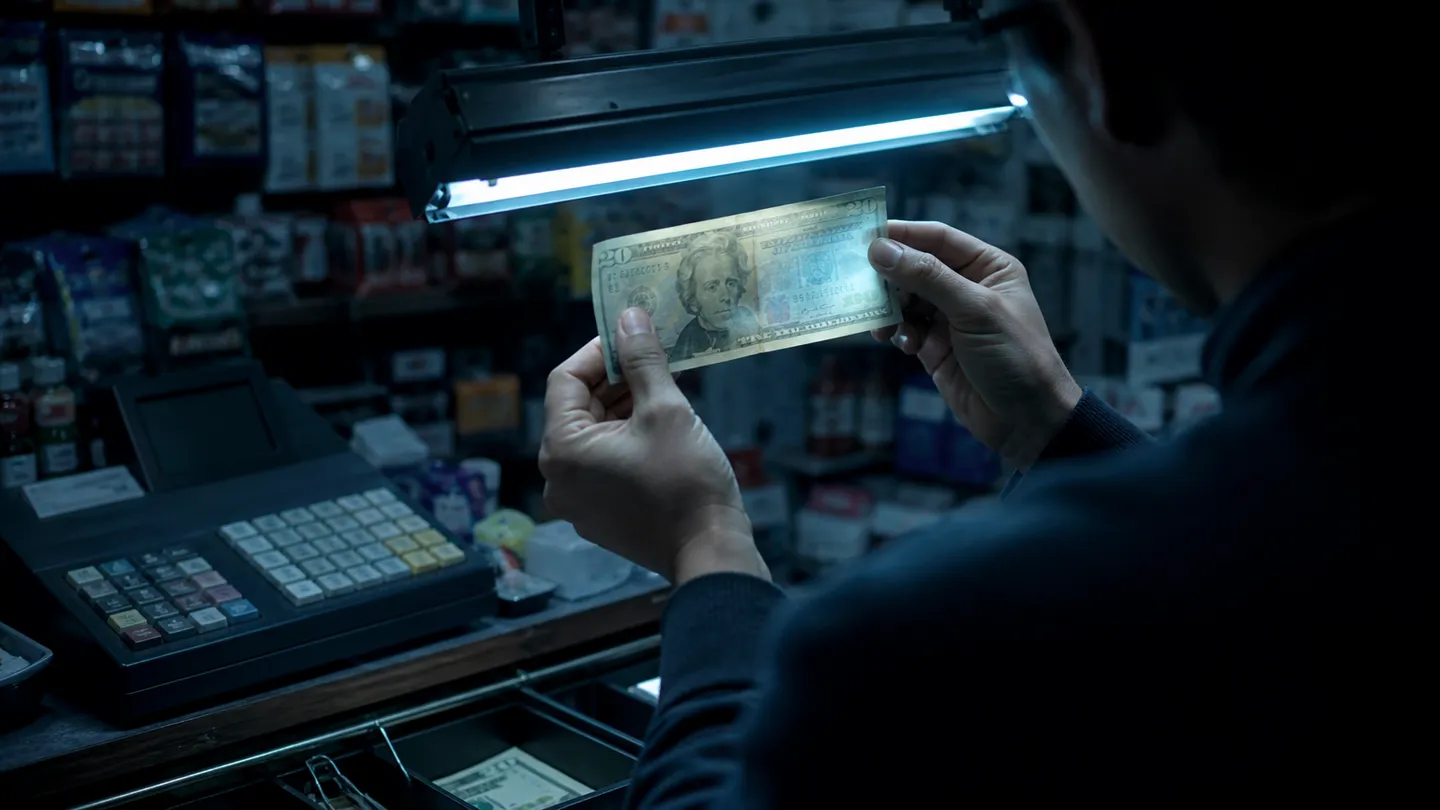
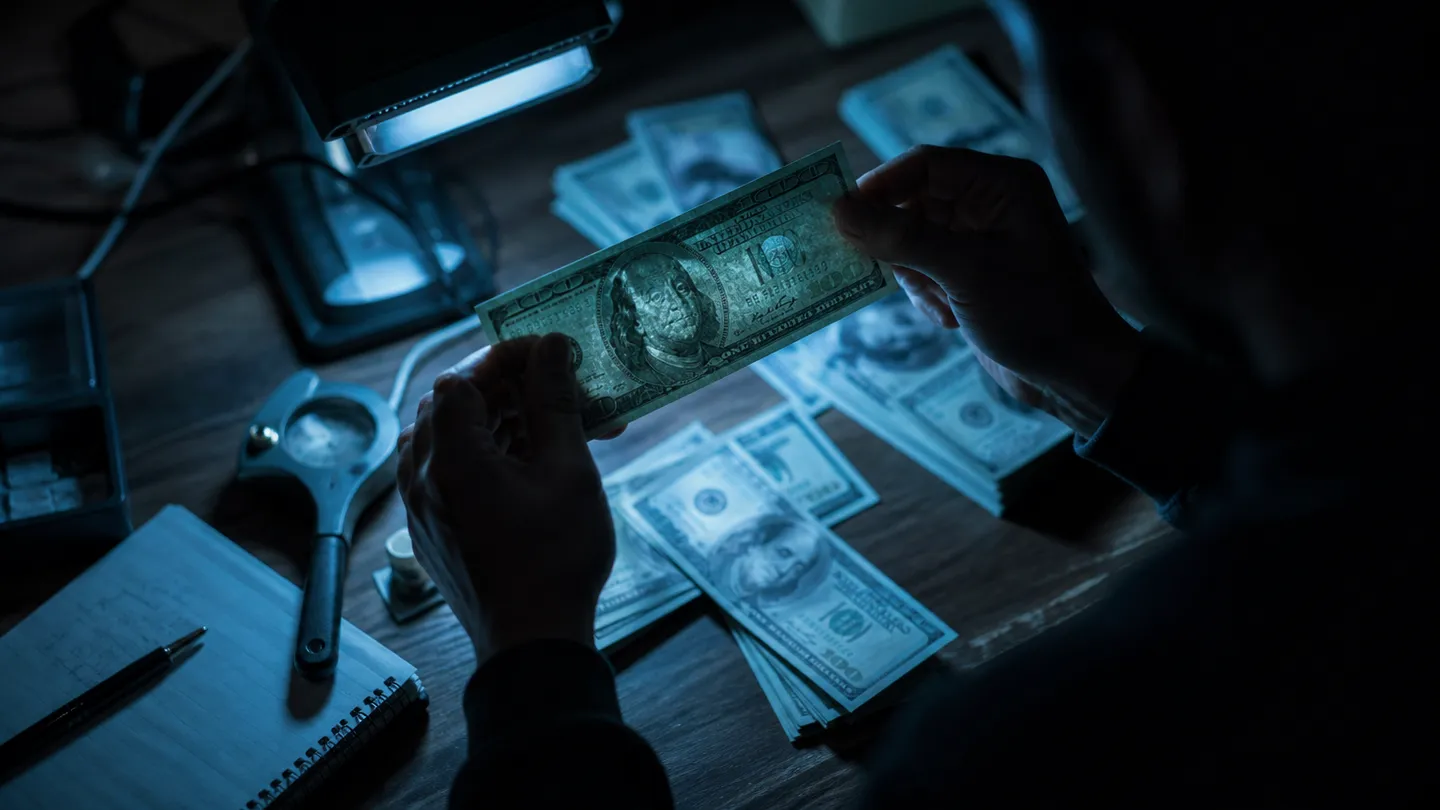
A fake $100 bill is a counterfeit note imitating genuine U.S. currency; check a current-design bill against light for the Franklin watermark and "USA 100" thread, then tilt it for moving ribbon images and copper-to-green ink[1][2]. An older genuine note may have no blue ribbon, so match features to its design and never rely only on a detection pen[3][4].
How to Check a $100 Bill in 60 Seconds
To verify the authenticity of a $100 bill quickly, we recommend a simple checklist based on several independent security features. This method is more effective than relying on just one test. Start by comparing the note with a known genuine bill from the same design generation. For the current design, issued from October 8, 2013, look for features specific to this series, such as the blue 3-D Security Ribbon and the Franklin watermark.
Look–Feel–Tilt Checklist
Feel: Genuinely printed bills have a distinct texture. Run your fingers over Franklin’s shoulder; you should feel the raised intaglio printing. The note is made of a cotton-linen blend that feels rougher compared to regular paper, which is often a giveaway for counterfeits[5][1].
Hold to Light: When held up to light, look for the Franklin portrait watermark on the right side and the embedded thread that reads "USA 100" on the left. Both features should be visible from either side of the bill. Under ultraviolet light, the security thread should glow pink, confirming its authenticity[1].
Tilt: Tilt the note back and forth. The blue 3-D Security Ribbon will display moving images of bells and the numeral 100, which should shift in colour from copper to green in the lower-right corner. This dynamic feature is unique to the current design and is a critical element for verification[1][2].
Inspect Fine Details: Look closely at the microprinting around the watermark and on Franklin’s collar. Genuine notes contain specific phrases like "THE UNITED STATES OF AMERICA" and "USA 100," which are difficult to replicate accurately[1].
Checking these features under normal light first helps to establish a baseline before moving to more complex inspections. Remember, never rely solely on counterfeit detection pens, as their accuracy can be misleading[4]. By using this checklist, we can quickly ascertain whether a $100 bill is genuine or potentially counterfeit.
First Identify Which $100 Bill Design You Have
To determine the authenticity of a $100 bill, the first step is identifying which design version you have. The current-design $100 note entered circulation on October 8, 2013, but it is essential to note that genuine bills may carry Series 2009 or Series 2009A designations rather than a 2013 series year[1]. Older designs remain legal tender, meaning they can still be used for transactions, but they lack some of the security features present in the newer notes.
The key distinguishing feature of the current design is the blue 3-D Security Ribbon, which is woven into the paper rather than printed on it. This ribbon displays moving images when the note is tilted, a feature that older designs do not possess[3][1]. If your bill does not have this ribbon, it could either be an older genuine note or a counterfeit.
To ensure an accurate assessment, we recommend using the series year and referencing the official U.S. Currency Education Program materials. This can help you select the correct feature checklist for verification. For instance, a genuine current-design note will also display specific features when held to the light, such as the Franklin portrait watermark and an embedded security thread that reads "USA 100," both visible from either side and glowing pink under ultraviolet light[1]. Meanwhile, older designs, like those from 1996 to 2013, will have a Franklin watermark and a "USA 100" security thread, but they will lack the blue ribbon and other unique features of the newer notes[1].
In summary, identifying the design of your $100 bill is crucial. Check for the blue 3-D Security Ribbon and other specific features to establish authenticity. By knowing which design you are dealing with, we can better determine whether the bill is genuine or potentially counterfeit.
Hold It to the Light: Watermark and Security Thread
To verify the authenticity of a $100 bill, holding it up to the light is one of the most effective methods. A genuine note should display a Benjamin Franklin watermark, visible from both sides of the bill, located to the right of the printed portrait. This watermark is not merely a printed image; it is an integral part of the paper itself, making it difficult to replicate accurately. If the watermark is absent or appears as a surface-printed imitation, it's a strong indication that the bill may be counterfeit.
Additionally, an embedded security thread marked with "USA 100" should be present on the left side of the note. This thread is another critical security feature that glows pink under ultraviolet light. This dual verification—visible to the naked eye and under UV light—ensures a more thorough examination. If either the watermark or the security thread is missing or poorly reproduced, we should treat the bill with suspicion.
It's also essential to remember that these visual checks should be supplemented with touch and tilt methods. For example, while the security thread and watermark are fundamental, they should not be the sole basis for determining authenticity. Relying exclusively on ultraviolet light or a counterfeit detection pen can lead to errors in judgment, as these tools may not always provide accurate results[4].
In summary, using both visual checks and ultraviolet light gives us a comprehensive approach to verifying a $100 bill. We should always check for the Franklin watermark and the "USA 100" security thread, as their presence and quality are key indicators of a genuine note. If any features appear suspicious, it’s advisable to conduct further checks or consult reliable resources to confirm authenticity.
Tilt the Bill: Blue Ribbon, Bell, and Color-Shifting Ink
Tilt the Bill: Blue Ribbon, Bell, and Color-Shifting Ink
To verify the authenticity of a current-design $100 bill, tilting the note is crucial. The blue 3-D Security Ribbon is not merely a printed stripe; it is woven into the bill's paper and features dynamic images that move when the note is tilted. Specifically, when we tilt the bill back and forth, the ribbon displays moving bells and the numeral "100". This movement is a key indicator of authenticity, as it contrasts sharply with static printed effects found on counterfeit notes[1].
An important aspect of this feature is the colour-shifting ink. When we tilt the bill, the bell inside the copper inkwell changes from copper to green, while the lower-right corner numeral "100" shifts from copper to green as well. This colour change is not only visually striking but serves as a reliable authentication feature[2]. Counterfeit bills may attempt to replicate this effect through printing, but they often fail to achieve the same dynamic movement and colour change.
In comparison, older $100 bills from the 1996-2013 design do not possess the blue ribbon or the colour-shifting features. Instead, these notes feature a static design, making them easier to identify as potentially counterfeit when compared to the current design[1]. Therefore, when checking a $100 bill, we should always tilt it to observe these specific movements and colour changes. If the ribbon is absent or the effects appear static, we should treat the bill with caution.
In summary, tilting the bill provides valuable insights into its authenticity. The blue 3-D Security Ribbon and colour-shifting ink are distinctive features of the current-design $100 bill, helping us quickly ascertain whether the note is genuine or potentially counterfeit.
Feel and Inspect the Printing, Paper, and Fine Details
When assessing the authenticity of a $100 bill, the feel and fine details are essential. Genuine currency features raised intaglio printing, particularly around Benjamin Franklin’s portrait and clothing. When you run your fingers over the bill, you should feel a noticeable texture, especially over Franklin's shoulder. However, it's crucial to remember that texture alone is not definitive proof of authenticity; it must be combined with other verification methods.
The paper used for genuine U.S. currency consists of approximately 75% cotton and 25% linen, making it distinct from regular paper. This composition includes embedded red and blue fibers that are randomly distributed throughout the bill, rather than printed on the surface. This means that if you see printed red-and-blue lines, it’s likely a sign of a counterfeit[5].
In addition to the texture and paper composition, we should examine the microprinting, sharp portrait lines, and the intricate details in the seals and borders. On a genuine current-design $100 note, microprinting can be found on Franklin's collar, stating "THE UNITED STATES OF AMERICA," and around the watermark area with "USA 100." These details are challenging for counterfeiters to replicate accurately[1].
Also, ensure that the serial numbers match and that the large gold "100" in the lower-right corner exhibits the correct color-shifting properties. When tilting the bill, the numeral should shift from copper to green, indicating its authenticity[2]. If you notice any discrepancies in these details, it’s wise to conduct further checks or consult reliable resources to confirm whether the bill is genuine.
By carefully inspecting the feel, printing, and fine details of a $100 bill, we can significantly enhance our ability to identify counterfeits. Remember, no single feature can guarantee authenticity; a combination of checks will provide the best assurance.
Fake $100 Bill vs. Real: Side-by-Side Checklist
Fake $100 Bill vs. Real: Side-by-Side Checklist
To help differentiate between genuine and counterfeit $100 bills, we have created a comprehensive checklist comparing key features. This table outlines what to expect on both current-design and older $100 notes, along with common warning signs and the limitations of each test.
| Feature | Expected on Genuine Note | Common Warning Sign | Limitations of the Test |
|---|---|---|---|
| Watermark | Franklin portrait watermark on right side | Absence or poor reproduction of watermark | Counterfeiters can imitate watermarks poorly |
| Security Thread | Embedded "USA 100" security thread on left side | Missing thread or non-glowing under UV light | Some counterfeits may include fake threads |
| Blue 3-D Security Ribbon | Present on current-design notes (2013-present) | Absence of ribbon on current-design bills | Older designs do not have this feature |
| Color Shifts | Bell in the inkwell and numeral 100 shift colour | Static colour with no movement | Counterfeiters may print static images |
| Raised Printing | Rough texture over Franklin's shoulder | Smooth or flat feel | Some counterfeit notes may mimic texture |
| Paper Composition | 75% cotton, 25% linen with embedded fibers | Printed red and blue lines | Counterfeiters can use similar paper |
| Microprinting | "THE UNITED STATES OF AMERICA," "USA 100," and more | Missing or illegible microprinting | Difficult to inspect without magnification |
| Serial Numbers | Unique serial numbers matching other features | Mismatched or repeated serial numbers | Counterfeiters can replicate serial numbers |
Current-design $100 notes were introduced on October 8, 2013, and carry features like the blue 3-D Security Ribbon and dynamic colour-shifting ink. Older notes, such as those issued from 1996 to 2013, lack these features but can still be genuine[1][3][1]. It is essential to consider the design version of the bill when assessing its authenticity.
If any of these features appear suspicious, further verification methods should be employed. Always remember that no single test can confirm authenticity; a combination of checks is the best way to ensure a $100 bill is genuine.
Counterfeit-Detection Myths and Unreliable Tests
Counterfeit-Detection Myths and Unreliable Tests
When it comes to detecting counterfeit $100 bills, several common myths can lead to false confidence. One prevalent misconception is that every genuine $100 bill features a blue stripe. In reality, this blue 3-D Security Ribbon is only present on the current-design notes issued since October 8, 2013. Older designs, like those from 1996 to 2013, remain legal tender and do not include this feature, yet they can still be genuine[1][3].
Another frequently relied-upon tool is the counterfeit detection pen. Many believe that these pens provide definitive answers regarding a bill's authenticity. However, these pens primarily test for starch, which means they can give false negatives on counterfeit notes made from bleached, lower-denomination bills[6]. For instance, counterfeiters have been known to take a genuine $1 or $10 bill, bleach it, and then print a $100 image, resulting in a fake that could pass a pen test[7]. Thus, relying solely on a detection pen can lead us astray.
Additionally, some people think that scratching Benjamin Franklin's shirt will reveal authenticity. This method is misleading, as it does not provide reliable evidence. Genuine $100 notes feature raised intaglio printing, which can be felt when we run our fingers over the bill, but this tactile check should be used in conjunction with other verification methods[1].
It's essential to clarify the terminology surrounding security features. The current $100 notes employ a watermark and a 3-D Security Ribbon, not a conventional portrait hologram. The Franklin watermark should be visible when held up to the light, and an embedded thread reading "USA 100" should also be present[1]. These features are more reliable indicators of authenticity than some of the myths that circulate.
In summary, we should be cautious about the methods we use to verify $100 bills. Understanding the actual security features and limitations of common tests can significantly enhance our ability to identify counterfeits. Always combine multiple verification techniques for the best results.
What to Do If You Suspect a Fake $100 Bill
If you suspect that you have received a counterfeit $100 bill, it’s crucial not to spend, return, or destroy the note. Instead, minimise handling it to preserve any potential evidence and remember where and from whom you received the bill. This information can be vital in any investigation that may follow.
We recommend contacting your local police department or the nearest U.S. Secret Service field office. They are equipped to handle counterfeit currency cases and can provide official instructions on what to do next. It's also essential for businesses to follow their internal cash-handling policies regarding suspicious notes. If a merchant believes a bill is counterfeit, they have the right to refuse it. Keep in mind that counterfeit currency cannot be exchanged for genuine money, even if it is confirmed as fake after being passed[4].
Important Steps to Follow
- Do not attempt to pass the bill: Passing a counterfeit note knowingly can lead to severe legal consequences, including fines and imprisonment for up to 20 years[8].
- Store the note separately: Keep the suspected counterfeit bill away from genuine currency to avoid confusion.
- Document details: If possible, record any information about the person who gave you the bill, including their appearance and vehicle details. This can assist law enforcement in their investigations.
- Surrender the note: Once you have reported it, hand over the note to the authorities as they will need it for evidence.
By following these steps, we can help combat the circulation of counterfeit bills and support law enforcement in their efforts to maintain the integrity of our currency system. Always remember, the best approach when faced with a suspicious $100 bill is to act cautiously and seek assistance from the appropriate authorities.
Fake $100 Bill Authentication Table
| Feature | Current Design (2013+) | Older Design (1996-2013) | Reliability Ranking |
|---|---|---|---|
| Watermark | Franklin portrait on right | Franklin watermark present | High |
| Security Thread | Embedded 'USA 100' | 'USA 100' glows under UV | High |
| Blue 3-D Security Ribbon | Present | Absent | Medium |
| Color Shifts | Bell and numeral 100 shift | Lower-right 100 shifts from green to black | High |
| Raised Printing | Rough texture over shoulder | Smooth feel | Medium |
| Paper Composition | 75% cotton, 25% linen | Varies, not specified | High |
| Microprinting | Multiple microprints present | Limited microprinting | Medium |
| Serial Numbers | Unique and matching | Mismatched or repeated | Medium |
Common Mistakes and Misconceptions
Avoid these shortcuts.
- Dating a note by the redesign year
- Rejecting a worn security ribbon
- Looking at the ribbon without tilting the note
- Trusting genuine currency paper
- Trying to recover the loss by spending the note
Expecting the redesign year in the series label
People sometimes expect the redesign year to appear beside "Series", then reject a note when the dates do not match. The current design entered circulation on October 8, 2013, but genuine notes carry Series 2009 or Series 2009A designations[1]. We should identify the design through its security features rather than treating the series label as a release date.
Rejecting a note because its ribbon is damaged
A worn or partly deteriorated ribbon can look suspicious, particularly when a cashier has only seconds to decide. Damage from circulation does not itself make the note counterfeit, so we should also examine the watermark and colour-shifting ink[9]. If those features disagree with the design, set the note aside for further checks rather than relying on ribbon condition alone.
Looking at the ribbon without moving the note
A printed blue strip may appear convincing when viewed straight on, which makes a quick visual check inconclusive. On a genuine current-design note, the ribbon is woven into the paper, while its bells and 100s move in different directions as we tilt it[1]. We advise tilting the note both back and forth and side to side, then comparing the observed movement with the expected pattern.
Treating genuine currency paper as proof of denomination
Bleached counterfeits can use authentic lower-denomination currency paper, so their feel may seem right and paper-based checks may not expose them[6]. A documented Secret Service case involved genuine $1 and $10 notes washed and reprinted as $100 bills, including multiple counterfeits carrying the same serial number[7]. We should therefore confirm that the backlit features match the claimed denomination: a Franklin watermark on the right and an embedded "USA 100" thread on the left[1].
Trying to pass the suspicious note elsewhere
Someone may try another Seattle shop after a refusal because a confirmed counterfeit cannot be exchanged for genuine money[4]. Knowingly passing or attempting to pass counterfeit currency with intent to defraud can bring a fine, imprisonment for up to 20 years, or both[8]. We should instead keep the note separate, record available details about the passer and vehicle, notify local police immediately, and surrender the note promptly[4].
Conclusions
Check calmly.
- Start by matching the note’s security elements to its design generation; an absent blue ribbon does not automatically mean counterfeit.
- Use several checks together, including transmitted-light details, moving imagery, colour changes, print texture, and serial-number consistency.
- Treat detection pens and paper feel as supporting clues, since altered lower-denomination currency may defeat these shortcuts[6][7].
- If the results conflict, stop the transaction, isolate the note, note where it came from, and follow workplace procedures.
- Never spend a suspected counterfeit to recover the loss; contact Seattle police or the nearest U.S. Secret Service field office for instructions[4][8].
Next, use our broader guide to Fake US Dollars: How to Spot Them when checking other denominations.
Straight answers
How can you tell a fake $100 bill?
We recommend matching the security features to the note’s design rather than trusting one test. On a current-design $100 note, hold it to light for the Franklin watermark and "USA 100" thread, then tilt it to check the moving ribbon and copper-to-green ink[1][2]. For the earlier design, look for the watermark, the thread glowing pink under ultraviolet light, and the lower-right numeral changing from green to black[1].
Are there fake $100 bills that look real?
Yes—some convincing counterfeits are printed on washed genuine $1 or $10 currency paper, so the texture or a detection pen may not expose them[6][7]. We advise checking whether the watermark and security thread match the claimed denomination, and looking for repeated serial numbers across suspicious notes[1][7].
Can an old $100 bill be real without a blue security ribbon?
Yes. The blue security ribbon appears only on the current design, while older US currency designs remain legal tender regardless of when they were issued[3]. A genuine earlier-design $100 note can instead have a Franklin watermark, a "USA 100" thread that glows pink under ultraviolet light, and a lower-right numeral that shifts from green to black[1].
Does a counterfeit detection pen work on $100 bills?
A detection pen can provide a clue, but it cannot confirm that a $100 bill is genuine because false results occur[4]. Pens detect starch in commercial paper, yet coated counterfeits and fakes printed on bleached genuine currency paper may defeat that test[6]. We suggest checking the denomination-specific watermark, security thread, moving ribbon and colour-shifting ink instead[1][2].

Links and references
- 1. $100 Note | U.S. Currency Education Program
- 2. Decoding Dollars: The $100 | U.S. Currency Education Program
- 3. The Seven Denominations | U.S. Currency Education Program
- 4. How Do I Determine If a Banknote Is Genuine? What Should I Do If I Think I Have a Counterfeit Note? | Federal Reserve Board
- 5. The Buck Starts Here: How Money Is Made | Bureau of Engraving and Printing
- 6. U.S. Currency Authentication Training Presentation | U.S. Currency Education Program
- 7. Florence Resident Pleads Guilty in Federal Court to Manufacturing and Passing Counterfeit Money | United States Secret Service
- 8. 18 USC 472: Uttering Counterfeit Obligations or Securities
- 9. Quality/Durability of Redesigned $100 Note | U.S. Currency Education Program