Fake money bills are imitations of genuine currency, ranging from illegal counterfeits made or used with intent to defraud to replicas intended for screen productions or compliant illustrations.[1][2][3] We should never spend them: labels such as "For Motion Picture Use Only" or "Replica" do not make a bill safe to pass as payment.[4]
What Are Fake Money Bills?
Fake money bills encompass a variety of imitations of genuine currency, each serving different purposes and governed by distinct legal frameworks. This umbrella term includes counterfeit currency, prop money, play money, educational printables, and novelty notes. The primary distinction among these categories lies in their intent, design, realism, and legal status.
Counterfeit currency is produced with the intent to defraud, aiming to deceive recipients into accepting it as real money. The law is clear: making or using counterfeit U.S. obligations can lead to severe penalties, including fines and imprisonment for up to 20 years[1]. In contrast, prop money is designed for use in films or theatrical productions, while play money is typically used by children for games. Educational printables may be used in classroom settings to teach about currency, and novelty notes are often created for entertainment purposes.
For example, a $20 or $100 bill might be replicated in prop money for a film scene, ensuring that it is not used as legal tender. Prop money must adhere to specific guidelines, such as being one-sided and not exceeding 75% or 150% of the genuine item’s dimensions[2]. Additionally, any bill labelled "For Motion Picture Use Only" or "Replica" is clearly marked to indicate it should not be used as real currency[4].
Understanding these differences is crucial. While prop and novelty products can be harmless when used appropriately, attempting to pass counterfeit notes can lead to serious legal repercussions. Always verify the intended use of any fake money before handling it to avoid potential issues.
Types of Fake Money Bills and How They Differ
Types of Fake Money Bills and How They Differ
Fake money bills can be categorised into several types, each with distinct characteristics and legal implications. The key categories include counterfeit currency, motion-picture prop money, realistic replica money, children's play money, printable educational bills, and souvenir or fantasy notes. Understanding these differences is essential, particularly since counterfeit currency is defined by deceptive intent, not merely by print quality.
| Type | Appearance | Typical Markings | Intended Use | Legal Risk | Confusion with Genuine Currency |
|---|---|---|---|---|---|
| Counterfeit Currency | High-quality, often indistinguishable | None (deceptive intent) | Fraudulent transactions | Up to 20 years imprisonment[1][5] | High |
| Prop Money | Realistic but often labelled | "For Motion Picture Use Only" | Film and theatre productions | Legal if used correctly, but misuse can lead to fraud charges[4] | Moderate |
| Realistic Replica Money | Looks like real currency | "Replica" or similar markings | Collectibles, displays | Legal unless passed as real money | Moderate to High |
| Children's Play Money | Bright colours, oversized | None | Play and educational purposes | Legal, but should not resemble real currency too closely | Low |
| Printable Educational Bills | Simple designs, often black and white | None | Teaching about currency | Legal, educational use | Low |
| Souvenir/Fantasy Notes | Themed designs, often whimsical | "Not legal tender" | Collectibles, gifts | Legal if clearly marked | Low |
Counterfeit currency is strictly illegal, as it is created with the intent to defraud and can lead to severe penalties, including imprisonment for up to 20 years[1][5]. Motion-picture prop money, on the other hand, is designed for entertainment purposes and must comply with specific regulations, such as being one-sided and not exceeding certain dimensions[2]. Despite these clear distinctions, there are cases where prop money has been misused, leading to significant financial losses[6].
When dealing with any type of fake money, it is crucial to recognise its intended use and legal status to avoid unintentional legal complications. Always check labels and markings, as they often indicate whether the item is safe to use or not.
Common Legitimate Uses for Replica and Play Money
Replica and play money serve various legitimate purposes across different fields, primarily in film, education, and training. In the entertainment industry, prop money is a staple for creating realistic scenes without the risk of handling actual currency. For instance, a director might use clearly marked filler bills in a crowded scene to simulate a bustling marketplace, ensuring that the audience feels immersed in the action without any legal implications. Federal law allows the use of prop money in motion-picture films, provided it adheres to specific guidelines, such as being one-sided and not exceeding 75% or 150% of the genuine item's dimensions[2][3].
In educational settings, play money is an excellent tool for teaching students about currency management and financial literacy. For example, teachers often use replica bills to help students practice making change from a $20 note, which enhances their understanding of basic math and money concepts. This hands-on approach not only makes learning engaging but also equips students with essential life skills.
Furthermore, replica money finds its place in board games and budgeting practice. Many board games simulate financial transactions, and using play money adds to the experience without confusing players with real currency. In retail training, employees may use prop money to practice cash handling and customer interactions, ensuring they are prepared for real-world scenarios without the risk associated with actual cash.
It is crucial to maintain control over prop money on set and ensure it never enters ordinary circulation. Misuse of prop money can lead to significant legal consequences, as evidenced by documented cases where individuals attempted to use prop money for fraudulent purposes, resulting in substantial financial losses[6]. Labels such as "For Motion Picture Use Only" or "Replica" are not merely suggestions; they serve as warnings that such bills should never be treated as legal tender[4]. By understanding these legitimate uses and adhering to the legal framework, we can enjoy the benefits of replica and play money while avoiding potential pitfalls.
Prop Money vs. Counterfeit Money: The Legal Distinction
Understanding the difference between prop money and counterfeit money is crucial, especially in the context of U.S. law. While labels like "prop," "copy," or "motion picture use only" suggest a legal distinction, they do not automatically confer legality upon every product or its use. The primary factor that differentiates counterfeit currency from legitimate prop money is the intent behind its creation and use. According to federal law, making or using counterfeit U.S. obligations with intent to defraud can lead to severe penalties, including imprisonment for up to 20 years[1].
The law specifically outlines that knowingly passing, selling, or possessing counterfeit obligations with deceptive intent carries similar consequences[5]. On the other hand, prop money is designed for specific, legitimate uses, such as in films or theatrical productions. However, even prop money must adhere to strict guidelines. For example, it must be one-sided and not exceed 75% or more than 150% of the genuine item's dimensions[2]. Additionally, any reproductions intended for motion-picture use must comply with specific legal restrictions, although physical prints face different regulations[3].
Labels indicating "For Motion Picture Use Only" or "Replica" serve as warnings. They do not guarantee that the item is free from legal complications. In fact, such markings can alert bank tellers and others to potential fraud[4]. There have been documented cases where individuals have misused prop money, leading to significant financial losses and legal repercussions[6].
It is essential to remember that possessing prop money does not automatically protect one from the law. The intent behind its use, the likelihood of deception, and whether it is transferred or accepted as real currency all play critical roles in determining legality. Before using any form of fake money, we should ensure that we fully understand its intended purpose and the applicable legal framework.
How to Recognize Real U.S. Currency and Suspicious Bills
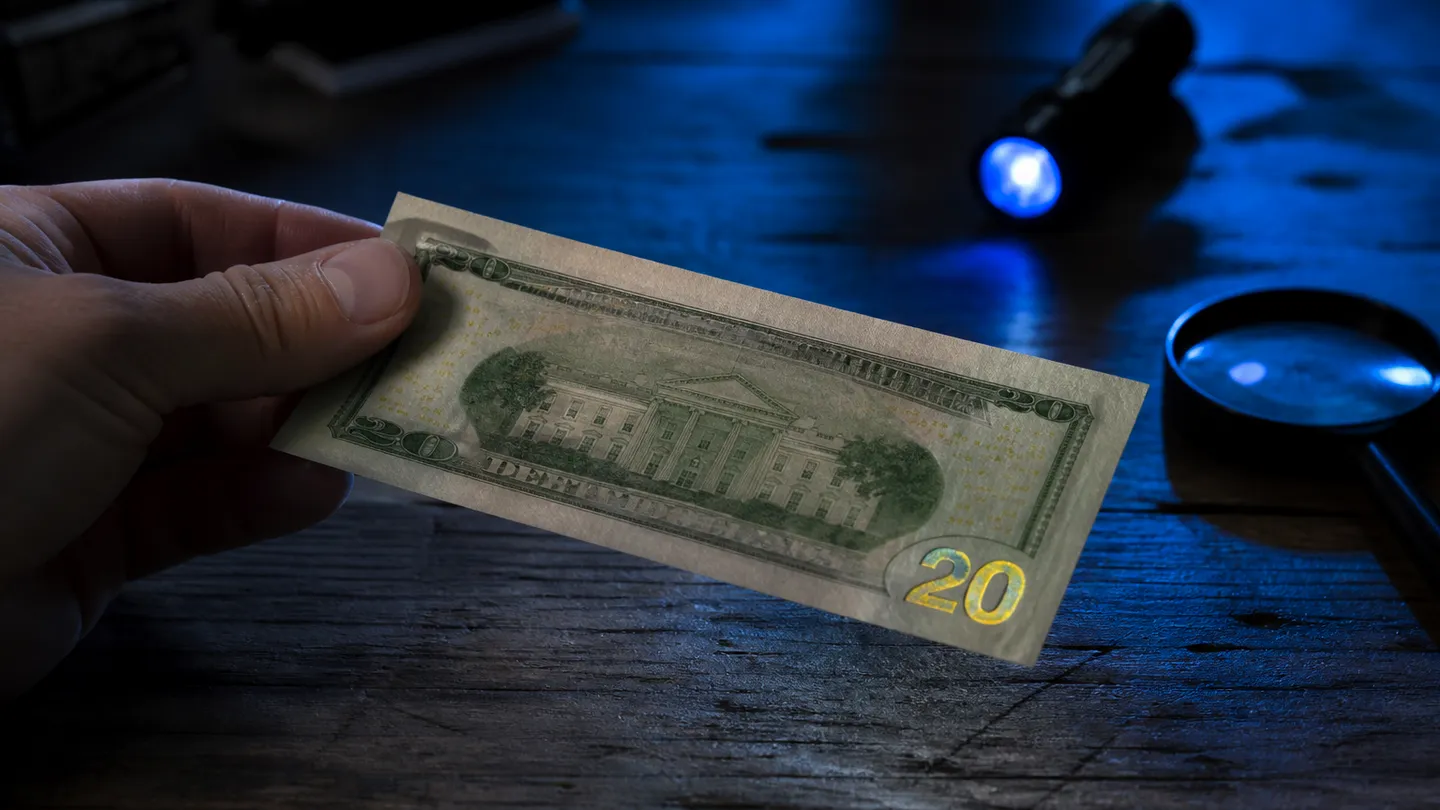
Recognising genuine U.S. currency is essential to avoid accepting counterfeit notes. Genuine Federal Reserve notes have distinct features that can be checked to ensure authenticity. When examining a $20 or $100 bill, we should focus on several key characteristics, including the feel of the paper, the presence of raised printing, watermarks, security threads, and colour-shifting ink.
The paper used for genuine notes is composed of 75% cotton and 25% linen, giving it a slightly rough texture. This texture is a result of the raised printing process, which creates a tactile difference when we touch the bill[7]. For example, the current-design $20 note features a watermark of Andrew Jackson visible from both sides, a security thread that glows green under ultraviolet light, and a lower-right numeral that shifts in colour from copper to green when tilted[8]. Similarly, the $100 note includes a blue 3-D Security Ribbon woven into the paper, a colour-shifting Bell in the Inkwell, and a Franklin watermark that is also visible from both sides[9].
While counterfeit-detection pens are commonly used, they are not foolproof. These pens can produce false positives, leading to incorrect conclusions about a bill's authenticity[10]. Instead, we recommend checking the built-in features of the note, such as watermarks and security threads, as these provide a more reliable indication of authenticity. The absence of modern security features does not automatically imply that a bill is counterfeit, as older designs remain legal tender[11].
It is crucial to remain vigilant when handling cash. If any aspect of the bill seems suspicious, we should refrain from accepting it and verify its authenticity through the features mentioned. By understanding these characteristics, we can better protect ourselves from inadvertently accepting counterfeit currency. For further guidance, the U.S. Currency Education Program and the United States Secret Service provide detailed resources on recognising genuine currency.
What ATMs, Banks, and Retailers Do With Fake Bills
When it comes to handling fake money, ATMs and cash-processing equipment play a crucial role in detecting counterfeit currency. These machines inspect various characteristics, including size, magnetic or infrared features, and image patterns. However, detection is not infallible; some counterfeit notes may still slip through. For instance, Federal Reserve cash-processing machines can examine around 100,000 notes per hour, yet about 15% of deposited notes are destroyed due to wear or damage, which highlights the limitations of these systems[12][13].
Banks are particularly cautious when it comes to counterfeit currency. If a bank detects a suspicious note, they typically do not reimburse the individual who presented it simply because it is counterfeit. Instead, the bank may retain the note for further examination and report it to the United States Secret Service, which is responsible for investigating counterfeit currency[14]. This means that individuals or businesses bearing the loss must absorb the financial impact of the counterfeit note.
If you find yourself in possession of a suspicious bill, it's vital to take immediate action. Here’s a checklist to guide your next steps:
- Do not spend the bill: Attempting to use a counterfeit note is illegal and can lead to severe penalties.
- Limit handling: The less you touch it, the better, as this can help preserve evidence.
- Record where it came from: Documenting the source can assist authorities in their investigation.
- Contact a bank or appropriate authority: Reporting the note can help prevent further circulation of counterfeit currency.
Understanding what happens to fake bills in financial institutions can help us navigate the risks associated with counterfeit currency. By taking the necessary precautions, we can protect ourselves from potential legal issues and financial losses.
How to Choose Fake Money for a Legitimate Purpose
How to Choose Fake Money for a Legitimate Purpose
Selecting the right type of fake money for your specific needs is essential to ensure compliance with legal regulations and to avoid any misuse. Here’s a purpose-based checklist to help guide your selection process:
Visible Replica Markings: Always look for clear markings like "For Motion Picture Use Only" or "Replica". These labels indicate that the money is not intended for real transactions and help avoid legal issues[4].
One-Sided vs. Two-Sided Designs: For film and theatre, one-sided designs are preferred as they comply with federal guidelines, which state that permissible illustrations must be one-sided[2]. In contrast, two-sided designs may be more suitable for educational or gaming purposes where realism is important.
Camera Distance: Consider how close the camera will be to the money. If filming close-ups, ensure the details are realistic enough to avoid scrutiny. For background scenes, less detail may suffice.
Denomination Mix: Depending on your use case, a mixed set of denominations can be beneficial. For instance, a 100-piece mixed set could include various denominations, which is ideal for educational purposes, teaching currency management and financial literacy.
Age Suitability: Ensure that the design and appearance of the money are appropriate for the intended audience. For example, younger students might benefit from more colourful and simplistic designs.
Material: Opt for prop money made from materials that mimic the texture of real currency. Genuine Federal Reserve notes are composed of 75% cotton and 25% linen, giving them a distinctive feel[7]. While replicas don’t need to be identical, a realistic texture enhances the learning or filming experience.
Quantity: Plan for the quantity needed based on your project. While a 100-piece set is a good example, assess your specific needs to avoid excess or shortage.
Seller Disclosures: Always purchase from reputable sellers who provide clear information on the intended use of their products. This can help avoid accidental purchases of items that may be misinterpreted as legal tender.
For specific scenarios, such as close-up filming, background scenes, classroom counting, or board games, it's crucial to choose the right type of prop money. For example, in film production, we should prioritise compliance with federal laws, while in educational settings, the focus should be on teaching financial concepts without creating confusion with real currency. By following this checklist, we can ensure that our use of fake money remains both legitimate and effective.
Fake Money Myths and Claims to Check
When it comes to fake money, several myths and claims often circulate that can mislead individuals about its legality and safety. We should critically evaluate these claims to avoid potential legal issues.
Claim: Motion picture money is always legal.
Verdict: Misleading.
While federal law permits the use of motion-picture money for film and television, it must adhere to strict guidelines. For instance, the money must be one-sided and cannot exceed specific size restrictions[2]. Labels like "For Motion Picture Use Only" do not guarantee that the money is free from legal complications, as they can alert bank tellers to potential fraud[4].
Claim: An ATM will catch every fake.
Verdict: False.
ATMs equipped with cash-recycling technology can scan for authenticity, but they are not infallible. Federal Reserve cash-processing machines can inspect around 100,000 notes per hour, yet some counterfeit notes may still go undetected[12][13]. Users should not assume that every machine will catch every counterfeit bill.
Claim: A counterfeit-detection pen proves a bill is genuine.
Verdict: Inaccurate.
Counterfeit-detection pens can produce false results, leading to incorrect conclusions about a bill's authenticity. The Federal Reserve recommends checking built-in features such as watermarks, security threads, and raised printing instead[10]. Reliance solely on a pen can result in accepting counterfeit currency unknowingly.
Claim: Banks replace counterfeit cash.
Verdict: Incorrect.
If a bank detects counterfeit currency, it typically does not reimburse the individual who presented it. Instead, the bank retains the note for examination and reports it to the United States Secret Service, which investigates such cases[14]. This means that individuals or businesses accepting counterfeit notes generally bear the loss.
Understanding these myths helps us navigate the complexities of fake money and reinforces the importance of realism and disclaimers in assessing legality. We should always verify the intended use and compliance with legal regulations concerning any form of fake currency.
Comparison of Fake Money Types and Their Risks
| Type | Realism | Required Markings | Legitimate Applications | Confusion Risk | Legal Risk |
|---|---|---|---|---|---|
| Counterfeit Currency | High | None | None | Very High | Up to 20 years imprisonment [1][5] |
| Prop Money | Moderate | 'For Motion Picture Use Only' | Film, Theatre | Moderate | Depends on use; can be illegal if misused [4] |
| Replica Money | Low | 'Replica' | Education, Games | Low | Legal if used correctly [2] |
| Motion Picture Money | Moderate | 'For Motion Picture Use Only' | Film, TV | Moderate | Legal if guidelines followed [3] |
Common Mistakes and Misconceptions
Treating Every Fake Bill as the Same Product
Fake money is not one category. Counterfeit currency is created or handled with fraudulent intent, while prop and play money may serve legitimate creative or educational purposes; making a false U.S. obligation with intent to defraud can carry imprisonment for up to 20 years[1]. We suggest matching each product to a clear use case: visibly fictional money for classrooms and games, controlled props for productions, and nothing designed for real transactions.
Trusting a Seller's "Federal Compliant" Claim
A product page is not legal clearance. If a seller relies on the rules for colour illustrations, we should confirm that the image is one-sided and either less than 75% or more than 150% of genuine linear dimensions, alongside the required file-handling conditions[2]. Screen depictions and physical reproductions are also treated differently, so permission for filmed or projected currency does not automatically cover printed bills[3].
Assuming a Disclaimer Prevents Confusion
Printed wording does not control how someone uses the bill. Labels such as "For Motion Picture Use Only" and "Replica" are warning signs rather than permission to spend the item[4], and one documented scheme used motion-picture money against at least 13 online sellers, causing $229,200 in losses[6]. We should keep realistic props away from wallets, tills, payment areas, and unattended locations where another person could mistake them for cash.
Choosing Maximum Realism for Every Purpose
More realism can create more risk. A Seattle classroom activity or board game rarely needs currency that resembles spendable cash, while a film production may need controlled visual detail only when the camera can actually capture it. We advise choosing obviously fictional colours and layouts for hands-on activities, then organising any realistic production props through check-out, supervised use, and separate storage.
Before buying or using fake money bills, make sure we can answer:
- What specific scene, lesson, game, or display requires them?
- Will people handle the bills, or will they appear only on screen?
- Could a shopper, student, performer, or cashier mistake them for real currency?
- Who will control, collect, and store every prop after use?
- Does the seller provide measurable specifications rather than a vague compliance claim?
Conclusions
Keep the purpose clear.
- We should identify whether the notes are for a lesson, performance, game, or display before comparing appearance or price.
- Counterfeits have no legitimate use, while replicas and production props can serve lawful purposes only within applicable limits[1][2][3].
- Greater realism is not always better; for a Seattle classroom, conspicuously fictional colour and design can reduce needless confusion.
- Before purchasing, we should check dimensions, sides, markings, materials, seller descriptions, and how every note will be issued, recovered, and stored.
- If a bill appears suspicious, we should avoid passing it on and retain the details needed for an official report[14].
Next, use Fake US Dollars: How to Spot Them to learn which physical features deserve attention.
Straight answers
What is the difference between prop money and counterfeit money?
The key difference is fraudulent intent. Counterfeit currency is a false U.S. obligation made or handled with intent to defraud, while prop money is intended for controlled creative or educational use; relevant offences can carry imprisonment for up to 20 years[1][5]. A "Replica" or "For Motion Picture Use Only" label does not make a note lawful to spend[4].
Can fake money be used in movies, photos, and music videos?
Yes, but filming currency and producing physical replicas are treated differently. Federal law permits motion-picture films, microfilms, and slides depicting obligations for projection or telecasting, while printed props remain subject to separate restrictions[3]. For colour illustrations, we should ensure they are one-sided and either less than 75% or more than 150% of the genuine note's linear dimensions, with production files erased or destroyed after final use[2].
How can I tell whether a U.S. dollar bill is real or fake?
Check several built-in features rather than relying on a counterfeit-detection pen, which can give false results[10]. A current-design $100 note should have a woven blue security ribbon, colour-shifting Bell in the Inkwell, Franklin watermark, and security thread glowing pink under ultraviolet light[9]; a current-design $20 should have a Jackson watermark, "USA TWENTY" thread glowing green, and a copper-to-green numeral[8]. Older designs issued since 1914 remain legal tender, so a missing modern feature does not by itself prove that a bill is counterfeit[11].
Links and references
- 1. 18 U.S.C. § 471 — Obligations or Securities of the United States
- 2. Currency Image Use | U.S. Currency Education Program
- 3. 18 U.S. Code § 504 — Printing and Filming of United States and Foreign Obligations and Securities
- 4. Teller Toolkit | U.S. Currency Education Program
- 5. 18 U.S.C. § 472 — Uttering Counterfeit Obligations or Securities
- 6. St. Louis County Man Admits Defrauding Online Sellers with Prop Money
- 7. Decoding Dollars: The $100 | U.S. Currency Education Program
- 8. $20 Note | U.S. Currency Education Program
- 9. $100 Note | U.S. Currency Education Program
- 10. How Do I Determine if a Banknote Is Genuine? | Federal Reserve Board
- 11. The Seven Denominations | U.S. Currency Education Program
- 12. Currency | Federal Reserve Financial Services
- 13. The Key Features of a Cash Recycler | Hyosung Americas
- 14. Handling Counterfeit Currency | Federal Reserve Financial Services