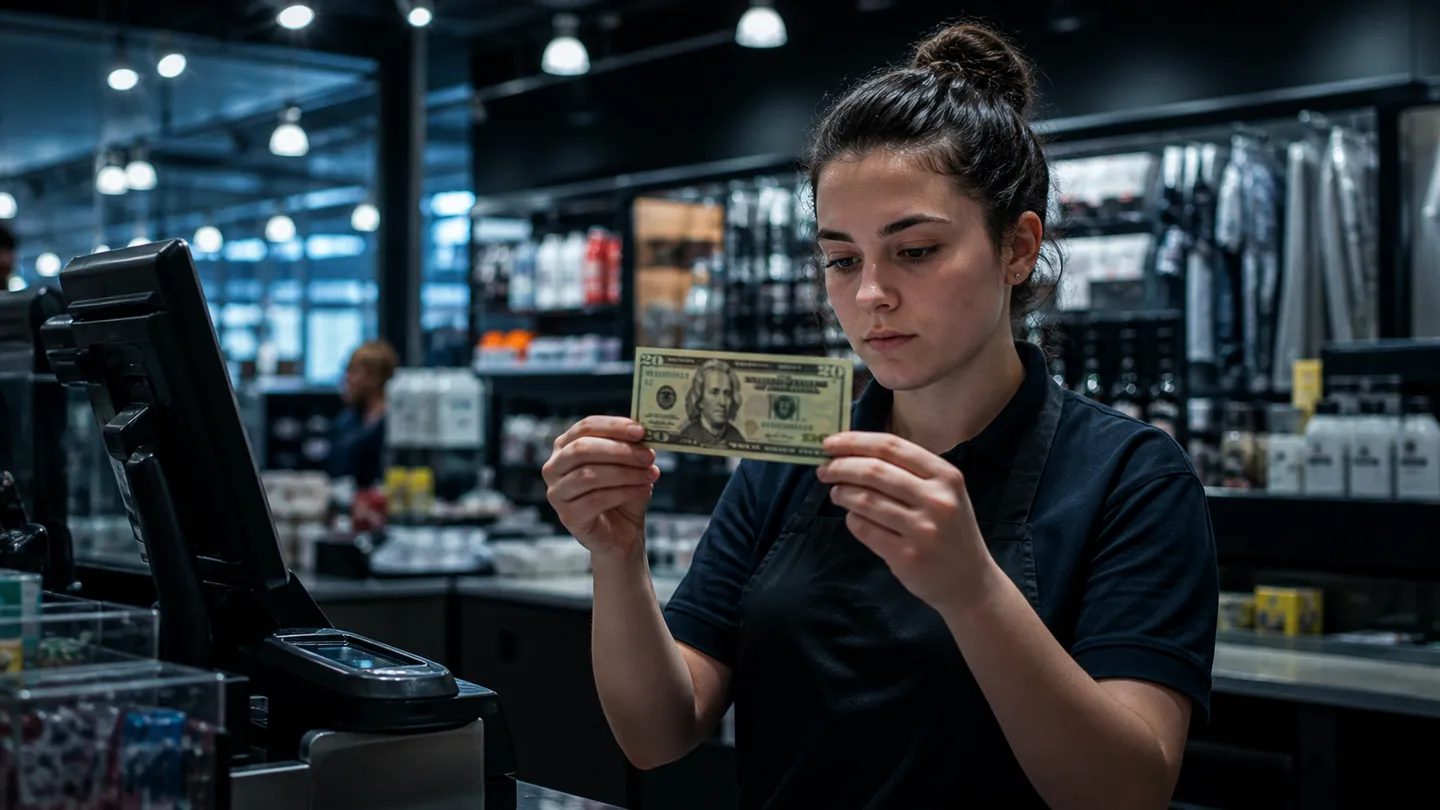
A fake $20 bill is an imitation of U.S. currency; we recommend comparing a suspicious note with a genuine bill, then checking its paper feel, printing, security features, and colour-shifting details. If doubts remain, do not accept or pass the note; stay calm and contact local police or the U.S. Secret Service for guidance.
How to Check a $20 Bill in 30 Seconds
To verify a U.S. $20 note quickly, we can follow a simple three-step process: feel the paper, tilt the note, and hold it to the light. This method allows us to identify several key security features that distinguish genuine currency from counterfeits.
Checklist for Verification
Feel the Paper: Genuine $20 bills are made from a unique cotton-linen blend, giving them a distinct texture. The raised printing should be noticeable, particularly on the portrait of Andrew Jackson. If the bill feels too smooth or flimsy, it may be counterfeit.
Tilt the Note: When we tilt the bill, we should observe the colour-shifting ink on the lower right corner. The numeral "20" should change from copper to green as we shift the angle. If this effect is absent or inconsistent, the bill could be fake.
Hold it to Light: By holding the note up to the light, we can check for the embedded security thread, which runs vertically through the bill. This thread is visible as a faint line and should read "USA Twenty" when viewed from the front. Additionally, the portrait watermark, which mirrors Andrew Jackson's image, should be visible on the right side of the bill when held up to the light.
Additional Features to Check
- Microprinting: Look closely for tiny text around the portrait and within the security features. Genuine notes include microprinting that is difficult to replicate.
- Security Fibres: Genuine bills contain red and blue security fibres embedded in the paper. If the fibres are absent or only printed on the surface, the bill is likely counterfeit.
- Ultraviolet Light Test: Under UV light, genuine $20 bills will display certain features that counterfeits usually lack. This test can provide additional reassurance if we have access to a UV light source.
Relying on multiple features rather than a single sign is crucial for accurate verification. If any aspect seems off, we should not accept the note and consider reporting it to local authorities or the U.S. Secret Service. For further details on recognizing counterfeit money, you can check our guide on Fake US Dollars: How to Spot Them.
Security Features on a Genuine $20 Bill
Security Features on a Genuine $20 Bill
Identifying the security features on a genuine U.S. $20 note is essential for verifying its authenticity. One key feature is the portrait watermark, which depicts Andrew Jackson. This watermark is located to the right of Jackson's portrait and is visible when the bill is held up to the light. It should appear as a faint image of Jackson that matches the printed portrait on the bill.
To the left of the portrait, there is an embedded security thread that runs vertically through the note. This thread includes the repeated text "USA TWENTY" that can be seen when the bill is held against the light. Under ultraviolet light, this security thread emits a green glow, further confirming the note's authenticity.
Another important feature is the lower-right numeral, which uses colour-shifting ink. When the bill is tilted, the numeral "20" should change from copper to green. If this colour shift is not evident, the bill may be counterfeit and should be examined more closely.
In addition to these features, genuine $20 bills are printed using raised printing techniques, which can be felt by running a finger over the surface. The fine-line details around Jackson's portrait and other areas are intricate and difficult to replicate. Microprinting is also present, featuring tiny text that can be found around the portrait and within the security features.
Moreover, the paper used for genuine bills is a distinctive cotton-linen blend, giving it a unique texture. Embedded within this paper are red and blue security fibres that are randomly distributed. If these fibres are missing or appear printed on the surface, the bill is likely counterfeit.
In summary, examining these security features—watermark, embedded thread, colour-shifting ink, raised printing, microprinting, and the cotton-linen paper—will help us determine the authenticity of a $20 bill. Always be vigilant and consider multiple features when assessing a note. If any discrepancies arise, do not accept the bill and report it to the appropriate authorities.
Fake $20 Bill vs. Real $20 Bill: Side-by-Side Signs
Fake $20 Bill vs. Real $20 Bill: Side-by-Side Signs
To effectively distinguish between a fake and a real $20 bill, we can compare several key features side by side. Below is a table summarising these characteristics:
| Feature | Real $20 Bill | Fake $20 Bill |
|---|---|---|
| Paper Feel | Made of cotton-linen blend, textured and sturdy | Often feels smooth or flimsy |
| Print Sharpness | Clear, sharp images and text | Blurry or poorly defined prints |
| Portrait | Andrew Jackson's portrait is detailed and vibrant | May appear distorted or washed out |
| Borders | Clean, distinct borders with intricate details | Borders may be uneven or poorly defined |
| Serial Numbers | Evenly spaced, consistent font | Often unevenly spaced or different fonts |
| Watermark | Portrait watermark visible when held to light | May be printed on the surface, lacking depth |
| Security Thread | Embedded thread that reads "USA TWENTY" | Dark line imitating the thread |
| Colour-Shifting Ink | Numeral "20" shifts from copper to green when tilted | No colour shift or inconsistent effect |
It’s important to note that spotting one unusual detail does not automatically indicate a bill is counterfeit. We need to consider the overall combination of features. For instance, a bill may have a clear portrait but feel too smooth, suggesting it could be fake.
If we come across a suspicious bill, we should check multiple features. For example, if the serial numbers are unevenly spaced but the watermark looks fine, it's still essential to verify other aspects like the paper feel and the presence of the embedded security thread.
When in doubt, do not accept or pass the note. Instead, contact local authorities or the U.S. Secret Service for further guidance. Remember, vigilance is key when handling cash, and knowing how to identify genuine currency can save us from potential loss.
Check the Series Before You Reject the Bill
Understanding the series of a $20 bill is crucial before making any assumptions about its authenticity. Genuine older designs, like the small-portrait notes, remain legal tender and may lack some features found on the current $20 design. For instance, the small-portrait notes, issued before the 1996 redesign, do not include the advanced security features introduced later. This means that when we encounter an older bill, we shouldn't automatically reject it just because it lacks certain modern elements.
When examining the different series of $20 notes, we can categorise them into three main designs. The first is the small-portrait note, which features a simple design and lacks advanced security features. The second design is the 1996-style redesign, which introduced some enhanced security measures, such as a larger portrait and a security thread. Finally, the colourful design introduced with Series 2004 includes more sophisticated features like colour-shifting ink and improved microprinting.
To accurately verify a bill, we should match it against an official reference for its series year rather than comparing every note only to the current $20. For example, if we have a 1996-style note, we can expect to see certain features that are not present in the Series 2004 design. This approach allows us to assess the bill's authenticity based on its specific series rather than applying modern standards universally.
In summary, before rejecting a $20 bill, we should check its series and understand the features associated with that particular design. By comparing the note against the appropriate reference, we can make a more informed decision and avoid mistakenly dismissing genuine currency. If we remain uncertain about the bill's authenticity, it's wise to consult local authorities or the U.S. Secret Service for further assistance.
Detection Pens, UV Lights, and Common Counterfeit-Checking Myths
Using detection pens and UV lights are common methods for verifying the authenticity of a U.S. $20 note, but they are not foolproof. An iodine-based pen primarily tests the chemistry of the paper. While it can indicate whether the paper is similar to that of genuine bills, it can also produce false confidence. For instance, some counterfeiters use paper that mimics the feel of real currency but may not have all the security features. A successful pen test does not guarantee authenticity, as counterfeiters can produce bills that pass this simple check.
When it comes to UV lights, they can be useful for verifying certain features of a $20 bill. The embedded security thread should glow green under ultraviolet light, which is a good sign. However, relying solely on UV light is insufficient for authentication. Counterfeiters can replicate this glow, meaning we must examine additional features, like the portrait watermark and color-shifting ink, to confirm the note's legitimacy.
Several myths surround the verification of $20 bills. One common belief is that all genuine bills feel identical. In reality, there can be variations in texture and feel among different series of notes due to changes in printing technology and materials used. Another misconception is that duplicate serial numbers are easy to spot. While genuine bills have unique serial numbers, counterfeiters can produce bills with identical numbers that might not be immediately noticeable. Lastly, the idea that a successful pen test proves authenticity is misleading. As previously mentioned, this method only checks paper chemistry and does not account for other critical security features.
By understanding the limitations of detection pens and UV lights, as well as dispelling these myths, we can approach the verification of a $20 bill with a more informed perspective. Always consider multiple features and methods when assessing a note's authenticity to ensure you are making the safest decision.
Prop Money, Replica Bills, and Counterfeit Currency
Prop Money, Replica Bills, and Counterfeit Currency
Recognising the differences between prop money, replica bills, and counterfeit currency is vital for anyone handling cash. Prop money is often used in film and theatre productions, and it typically features clear labels such as "FOR MOTION PICTURE USE ONLY." This label is a dead giveaway that the note is not valid currency. Additionally, prop money may have altered portraits, incorrect dimensions, or one-sided printing. If you come across a bill that lacks the standard features of a genuine U.S. $20 note, it should be treated with suspicion.
Realistic-looking replica bills can be particularly tricky. While they may appear convincing at first glance, they should never be accepted as currency. The intent behind the use of these replicas matters legally; even if someone uses them innocently, they can still face consequences under laws such as 18 U.S.C. § 472, which prohibits the possession or distribution of counterfeit currency. If we suspect that a note is a replica or prop, we must refrain from accepting it and consider reporting it to the local authorities or the U.S. Secret Service.
To assist in identifying potential prop or replica money, we can look for specific signs. Here’s a quick checklist to help us:
- Labels: Look for any markings indicating the bill is not legal tender.
- Portraits: Check for altered images or discrepancies in the depiction of Andrew Jackson.
- Dimensions: Compare the size of the bill with a genuine note; prop money often has incorrect dimensions.
- Printing: Examine the bill for one-sided printing or poor-quality details.
By focusing on these recognition tips, we can better navigate the complexities of authenticating U.S. currency. Remember, if any aspect of a bill seems off, it is safer to reject it and consult with authorities rather than risk accepting counterfeit or non-legal tender notes.
What to Do If You Receive a Suspected Fake $20 Bill
If you suspect that you have received a counterfeit $20 bill, it’s crucial to prioritise safety and follow a clear decision path. First and foremost, do not confront or detain anyone who may have given you the note. This could escalate into a dangerous situation. Additionally, avoid returning the bill if doing so might put you at risk. Instead, take a step back and assess the situation calmly.
Start by recording details about where and when you received the bill. This information will be helpful for authorities later. Minimise your handling of the note to avoid contamination or damage. Place it in an envelope or protective cover to preserve its condition. This way, you can present it to law enforcement or other officials without altering its state.
After securing the note, it’s important to contact local police or the U.S. Secret Service. The U.S. Secret Service is specifically responsible for investigating counterfeit currency under laws like 18 U.S.C. § 472. They can provide guidance on the next steps and may send an officer to assist you.
While you may consider taking the bill to a bank, be aware that banks typically do not reimburse for counterfeit currency. They may examine the bill, but if it is confirmed as fake, you will not receive compensation. Instead, the authorities will take over the investigation, which is why it’s essential to reach out to them promptly.
In summary, if you receive a suspected fake $20 bill, do not confront anyone, avoid passing it along, and report it to the relevant authorities. By following these steps, we can help combat counterfeit currency and protect ourselves and our communities.
Can You Get in Trouble for Accidentally Using a Counterfeit $20?
Accidentally possessing or passing a counterfeit $20 bill can lead to serious consequences, but the legal implications differ based on intent. If we unknowingly receive a counterfeit note, we are generally not held criminally liable. However, knowingly passing a fake bill with the intention to defraud falls under federal law, specifically 18 U.S.C. § 472. This statute outlines that individuals can face severe penalties, including a prison sentence of up to 20 years.
Once we suspect that a bill is counterfeit, attempting to spend it again can create significant legal risks. It is crucial to understand that the moment we have reason to believe a note is fake, we should refrain from using it. Continuing to attempt to pass the bill, even if we initially received it unknowingly, can be interpreted as intent to defraud. This puts us in a precarious legal position, as authorities may view our actions as knowingly trying to circulate counterfeit currency.
To avoid potential legal issues, we advise that if we come into possession of a suspicious $20 bill, it is best to handle it responsibly. This includes documenting how we obtained the bill and reporting it to local authorities or the U.S. Secret Service. They are equipped to deal with counterfeit currency and can provide guidance on the proper steps to take. Remember, while we may not face repercussions for accidentally accepting a counterfeit note, our actions following that point are critical in determining our legal standing.
In summary, always exercise caution with currency. If in doubt, do not attempt to pass the bill and seek help from the appropriate authorities. By being vigilant and informed, we can protect ourselves from the risks associated with counterfeit currency.
Comparison of Security Features in $20 Bills by Series
| Feature | 1996-Style Note | 2004 and Later Notes | Notes |
|---|---|---|---|
| Portrait Size | Smaller | Larger | Larger portrait introduced in 1996 |
| Security Thread | Present | Enhanced | Thread is more visible in 2004 notes |
| Colour-Shifting Ink | Absent | Present | Introduced in Series 2004 |
| Watermark | Absent | Present | Watermark of Andrew Jackson added in 2004 |
| Microprinting | Limited | Improved | More detailed microprinting in 2004 notes |
| UV Features | Basic | Advanced | Thread glows green under UV light |
| Texture | Standard | Varied | Different textures due to printing technology |
| Serial Numbers | Unique | Unique | Counterfeiters can replicate numbers |
| Common Myths | Feel identical | Varies by series | Texture can differ among series |
Common Mistakes and Misconceptions
Mistakes often come from shortcuts.
Treating a Prop-Money Listing as an Authentication Guide
Sales pages are designed to describe products. They may highlight obvious replica markings while omitting the full process needed to assess a suspicious $20 bill. Before relying on any guide, we should ensure it covers:
- the note’s design and condition;
- several independent security features;
- comparison with a known genuine note;
- safe handling when the result remains uncertain.
Expecting a Worn Note to Look Perfect
Genuine cash can become faded, stained, folded, or softened through circulation. Staff may mistake ordinary wear for evidence of counterfeiting, especially when fine printing or colour changes appear weaker than expected. We suggest comparing unaffected areas and considering the note’s overall design rather than rejecting it for damage alone.
Accepting a Note Because One Check Passes
One positive result can create false confidence. A matching texture, convincing portrait, or favourable detector result does not explain whether the remaining features belong together correctly. We should check several independent elements and treat any serious inconsistency as a reason to pause the transaction.
Comparing the Bill with Memory or a Screen Image
Memory is an unreliable reference. Online images can be resized, colour-adjusted, incomplete, or taken from prop-money listings that resemble genuine currency at a glance. When possible, we should compare the suspicious bill with a known genuine note of the same design, without relying on colour alone.
Damaging the Note During Examination
Aggressive checking can destroy useful evidence. Scraping ink, tearing an edge, applying tape, or repeatedly marking the paper may make later examination harder. If uncertainty remains, we should stop testing, keep the note separate, and avoid writing directly on it.
Accusing the Customer at the Till
Suspicion does not prove intent. In a Seattle shop, a cashier can pause the sale, involve a supervisor, and request another payment method without confronting or detaining the customer. Before acting, we should follow the business’s cash-handling procedure and record relevant details only when it is safe to do so.
Conclusions
- Pause before accepting the note. We should request another payment method and involve a supervisor rather than accuse or restrain the customer.
- Check features together. Compare the portrait, watermark, security thread, colour-shifting ink, microprinting, and print quality with a genuine bill of the same design.
- Do not let one result decide. A detector pen, UV response, familiar texture, or convincing serial number cannot settle authenticity alone.
- Protect the note and ourselves. If doubts remain, we should stop handling it, keep it separate, record the circumstances safely, and contact the appropriate authorities instead of spending it.
For a broader cash-checking routine, continue with Fake US Dollars: How to Spot Them.
Straight answers
How can you compare a fake $20 dollar bill vs real?
Place the suspect note beside a genuine bill of the same design, then compare fine lines, portrait detail, embedded fibres and raised printing. We should also view both notes against light and tilt them, since copied images may look convincing while embedded and changing features do not behave correctly. A difference in colour alone is not decisive because wear, lighting and screen images can mislead us.
Can a counterfeit detector pen prove a $20 bill is real?
No, a detector pen only checks how the paper reacts to its ink. A counterfeit printed on altered genuine currency paper may produce a favourable result, while some contaminated or treated genuine notes may react unexpectedly. We should use the pen as one screening step and examine several physical security features before accepting the bill.
Is passing a counterfeit $20 bill a felony?
Knowingly passing counterfeit currency with an intention to defraud can be prosecuted as a federal felony. Accidentally using a fake note is different because criminal liability generally depends on knowledge and intent, but attempting to spend it after recognising the problem creates legal risk. We should stop using the note and follow local law-enforcement guidance if authenticity remains in doubt.