Realistic fake $100 bills should be clearly identifiable props, not counterfeit notes: choose designs marked "For Motion Picture Use Only" or "Replica", control them on set, and keep them away from genuine cash and transactions.[1] A "COPY" label alone does not make a replica legal; colour currency illustrations must be one-sided, use permitted reduced or enlarged dimensions, and have production files erased or destroyed after final use.[2]
Realistic Fake $100 Bills: Quick Comparison
When searching for realistic fake $100 bills, understanding the differences among various compliant prop categories is essential. We have compiled a comparison table based on verifiable specifications to help you make an informed choice. This table excludes counterfeit notes and products intended for passing as genuine currency.
| Category | Print Quality | One-Sided/Two-Sided | Paper Finish | Aging | Pack Size | Visible Replica Markings | Intended Use | Typical Price Range |
|---|---|---|---|---|---|---|---|---|
| High-Quality Prop Money | High | Two-Sided | Textured to mimic cotton | New | 100 bills | "For Motion Picture Use" | Film, theatre, magic shows | $30 - $50 |
| Standard Prop Money | Medium | One-Sided | Smooth | Slightly aged | 50 bills | "Replica" | Photography, events | $15 - $30 |
| Low-Quality Prop Money | Low | Two-Sided | Paper-like | Aged | 20 bills | "COPY" | Casual use, practice | $10 - $20 |
It's important to note that the current-design $100 note, which entered circulation on October 8, 2013, features advanced security elements like a blue 3-D security ribbon and a colour-shifting Bell in the Inkwell[3]. Compliant prop money should not replicate these features in a manner that could mislead. Genuine currency paper consists of 75% cotton and 25% linen, which gives it a distinctive feel; prop bills may not accurately replicate this texture[4].
When selecting prop money, ensure that the dimensions are close to the actual size of a genuine $100 note, which measures 6.14 by 2.61 inches[5]. This will help maintain realism in visual media. Always look for visible replica markings, as they are key in distinguishing prop money from counterfeit currency. For example, wording such as "For Motion Picture Use Only" is a clear indicator that the note is intended for legal uses[1].
For those involved in filmmaking or similar projects, we recommend investing in high-quality prop money to avoid potential legal issues and ensure a professional appearance in your work.
Best Realistic Prop $100 Bills by Use Case
Best Realistic Prop $100 Bills by Use Case
When selecting realistic prop $100 bills, it’s vital to consider the intended use to ensure you choose the right type of prop money. For close-up shots in film or photography, premium double-sided props are worthwhile. These bills typically feature high-quality printing and a textured finish that mimics real currency, making them ideal for capturing intricate details. For instance, a close-up pack containing 100 high-quality bills might cost between $30 and $50, providing a professional look for your project.
In contrast, for background cash piles in scenes or music videos, inexpensive one-sided or oversized prop money can be sufficient. These options often come in larger quantities, such as a 1,000-bill stack, and are priced lower, typically around $15 to $30. They are perfect for filling a scene without the need for intricate details, as the focus will not be on the money itself.
When it comes to magic routines, we recommend using mid-range prop money that is two-sided and has visible markings indicating its status as a replica. This ensures that you maintain the illusion while staying compliant with legal regulations. Additionally, for classroom use, oversized play money can serve as a practical teaching tool, allowing students to engage with currency concepts without the risk of confusion with real notes.
To summarise, here’s a quick reference for different use cases:
| Use Case | Recommended Prop Type | Price Range |
|---|---|---|
| Film Close-Ups | Premium Double-Sided Bills | $30 - $50 |
| Background Cash Piles | Inexpensive One-Sided Bills | $15 - $30 |
| Magic Routines | Mid-Range Two-Sided Bills | $20 - $40 |
| Classroom Use | Oversized Play Money | $10 - $20 |
Choosing the right type of prop money based on your project’s needs not only enhances the overall quality but also helps avoid potential legal issues associated with using counterfeit-like currency. Always ensure that the props you select are clearly marked as replicas and comply with regulations to keep your production safe and professional.
What Makes a Fake $100 Bill Look Real on Camera?
What Makes a Fake $100 Bill Look Real on Camera?
Several factors contribute to making a fake $100 bill appear realistic on camera. We need to consider the choice of paper, print quality, and various design elements that mimic genuine currency.
The texture of the paper is crucial; genuine U.S. banknotes are made from 75% cotton and 25% linen, giving them a distinctive feel and slightly rough texture due to raised printing[4]. High-quality prop money often uses a matte finish, which can replicate this texture better than glossy paper, making it less reflective and more realistic in various lighting conditions.
Print resolution is another important aspect. The clarity and precision of the printing, especially for intricate details like microprinting and colour-shifting ink, can significantly affect realism. Genuine notes feature a variety of security elements, including a blue 3-D security ribbon and a portrait watermark of Benjamin Franklin, which should not be replicated in a misleading way[3][4]. Prop money should also have random serial numbers to avoid patterns that might reveal it as fake.
Dimensions matter as well; a genuine $100 note measures approximately 156 × 66.3 mm[5]. Prop money that is noticeably larger or smaller will stand out on camera. Edge alignment is essential, too; misaligned edges can be a giveaway that the note is not real.
Realistic aging can enhance believability, particularly for scenes depicting older cash. Prop money that appears worn or slightly faded can add authenticity. Double-sided printing is non-negotiable; one-sided bills can easily be identified as props, especially in scenes requiring dynamic angles.
Camera distance and focus also play a pivotal role. The level of detail required varies with how close the camera is to the prop money. For instance, a close-up shot may reveal flaws that would otherwise go unnoticed from a distance. Additionally, lighting can affect how details are perceived; softer lighting can help mask minor imperfections.
In summary, when selecting prop money, ensure that it closely mimics the dimensions and feel of genuine notes, incorporates random serial numbers, and features a matte finish for realism. Understanding these factors can help create a more convincing visual experience while avoiding potential legal pitfalls.
Legal Requirements and Replica Markings to Check
Labels such as "COPY," "PROP," or "FOR MOTION PICTURE USE ONLY" do not automatically guarantee that a physical replica is lawful. The legality of prop money is primarily governed by federal statutes, particularly 18 U.S.C. §§ 474 and 504, which address counterfeiting and the use of currency-like designs. Under these laws, knowingly passing or possessing counterfeit U.S. obligations with intent to defraud can result in severe penalties, including fines and imprisonment for up to 20 years[6]. Additionally, 31 CFR Part 411 outlines specific regulations regarding the use of currency images, indicating that prominent replica markings alone may not provide a legal safeguard[2].
When purchasing prop money, it is essential to verify several factors to ensure compliance with the law. Here’s a checklist to guide your selection:
- Permanent Markings: Ensure the prop money has clear markings such as "For Motion Picture Use Only" or "Replica" to indicate its intended use.
- Altered Design: Check that the design does not closely mimic genuine currency features, such as the blue 3-D security ribbon or colour-shifting ink, which can lead to confusion[3][4].
- Seller Disclosures: Only buy from reputable sellers who provide clear information about the prop money’s compliance with legal standards.
- Intended Use: Consider how you plan to use the prop money. For example, using it in a film or stage production is typically acceptable, but using it in transactions could lead to legal issues.
- Safe Storage: Keep prop money securely stored and separate from genuine cash to prevent accidental misuse, which could result in criminal charges[7].
By following these guidelines, we can help ensure that our use of realistic fake $100 bills remains within legal boundaries while enhancing our creative projects.
Real-Aged, New-Series, and Play-Money Designs Compared
Real-Aged, New-Series, and Play-Money Designs Compared
When it comes to selecting realistic-looking $100 prop bills, understanding the differences between real-aged prop money, new-series movie money, obvious play money, and digitally printed reproductions is essential for achieving the desired visual effect in various contexts.
Real-aged prop money often has an artificial finish that mimics the look of worn currency. While it may appear convincing, this type does not carry any monetary or collectible value. Its primary strength lies in its ability to create an authentic atmosphere, making it suitable for scenes where the money should appear old and used. However, it is important to ensure that it is marked clearly as a replica to avoid any legal complications.
On the other hand, new-series movie money, which replicates the characteristics of the current-design $100 note introduced on October 8, 2013, features advanced security elements like a blue 3-D security ribbon and colour-shifting ink[3]. This type of prop money is ideal for close-up shots due to its high-quality print and attention to detail. However, it is crucial that these security features are not replicated in a way that could mislead viewers into thinking they are genuine currency.
Obvious play money is typically designed for educational purposes or casual use, such as for children or teaching about currency. This type usually lacks the detail and realism of high-quality prop money, making it less suitable for professional film or photography work. Its strengths lie in its affordability and accessibility, often coming in large quantities, but it may not hold up under scrutiny in close-up shots.
Finally, digitally printed reproductions can vary widely in quality. Some may be designed to look exactly like real money, while others may be clearly marked as replicas. When using these types, it's important to consider their intended use. For instance, they may work well for background cash stacks in wide shots, but may not be convincing in close-ups.
In summary, when choosing between these options, consider your project requirements. Real-aged prop money is best for authenticity in older settings, new-series movie money excels in close-up scenes, obvious play money is suitable for education, and digitally printed reproductions can serve various purposes depending on their quality. Always ensure that whatever type you choose is clearly marked as a replica to comply with legal standards.
How to Evaluate a Listing Before You Buy
When considering purchasing realistic fake $100 bills, careful evaluation of the listing is crucial to ensure you receive quality prop money that meets your needs. Start by verifying the bill count and denomination mix to ensure you are getting the quantity you expect. For example, if you are buying a pack advertised as containing 100 bills, confirm this matches the seller's description.
Next, examine the front and back printing quality. High-quality replicas should closely mimic the genuine $100 note, which features distinct elements such as the blue 3-D security ribbon, raised printing, and the portrait watermark of Benjamin Franklin. Genuine U.S. banknotes measure 6.14 by 2.61 inches, so any prop bills that deviate noticeably from these dimensions may stand out in your project[5].
Pay attention to the paper finish as well. Authentic currency is made from a blend of 75% cotton and 25% linen, giving it a unique texture that feels slightly rough due to raised printing[4]. If the prop money feels too smooth or glossy, it might not be realistic enough for your needs.
Additionally, check for replica wording. Prop money should include markings such as “For Motion Picture Use Only” or “Replica,” which indicate it is not intended for actual currency use[1]. Listings that promise that bills will pass counterfeit pens, machines, or cashiers should raise red flags, as these claims are often misleading; counterfeit-detection pens can produce false results, and genuine security features are the best indicators of authenticity[7].
A simple calculation of the cost per bill can help gauge the value of your purchase. If a pack of 100 bills costs $30, the cost per bill is $0.30. For a pack of 1,000 bills priced at $250, the cost per bill is $0.25. This helps you compare options effectively and choose the best deal.
Finally, review the return policy. A reputable seller should offer a clear return policy in case the product does not meet your expectations. Ensure that the listing photos accurately represent the product you will receive, as misleading images can lead to disappointment.
By following these guidelines, we can make informed decisions when purchasing realistic fake $100 bills, ensuring that our projects are both visually appealing and legally compliant.
How Real $100 Bills Differ from Prop Money and Counterfeits
Identifying genuine U.S. $100 bills involves recognising several security features that are absent in prop money and counterfeits. To ensure the authenticity of a note, we suggest using the following checklist:
- Portrait Watermark: Genuine notes feature a watermark of Benjamin Franklin that is visible from both sides when held up to the light.
- Color-Shifting Ink: In the lower right corner, the numeral "100" shifts from green to black when tilted, a feature that is not replicated in most prop money[8].
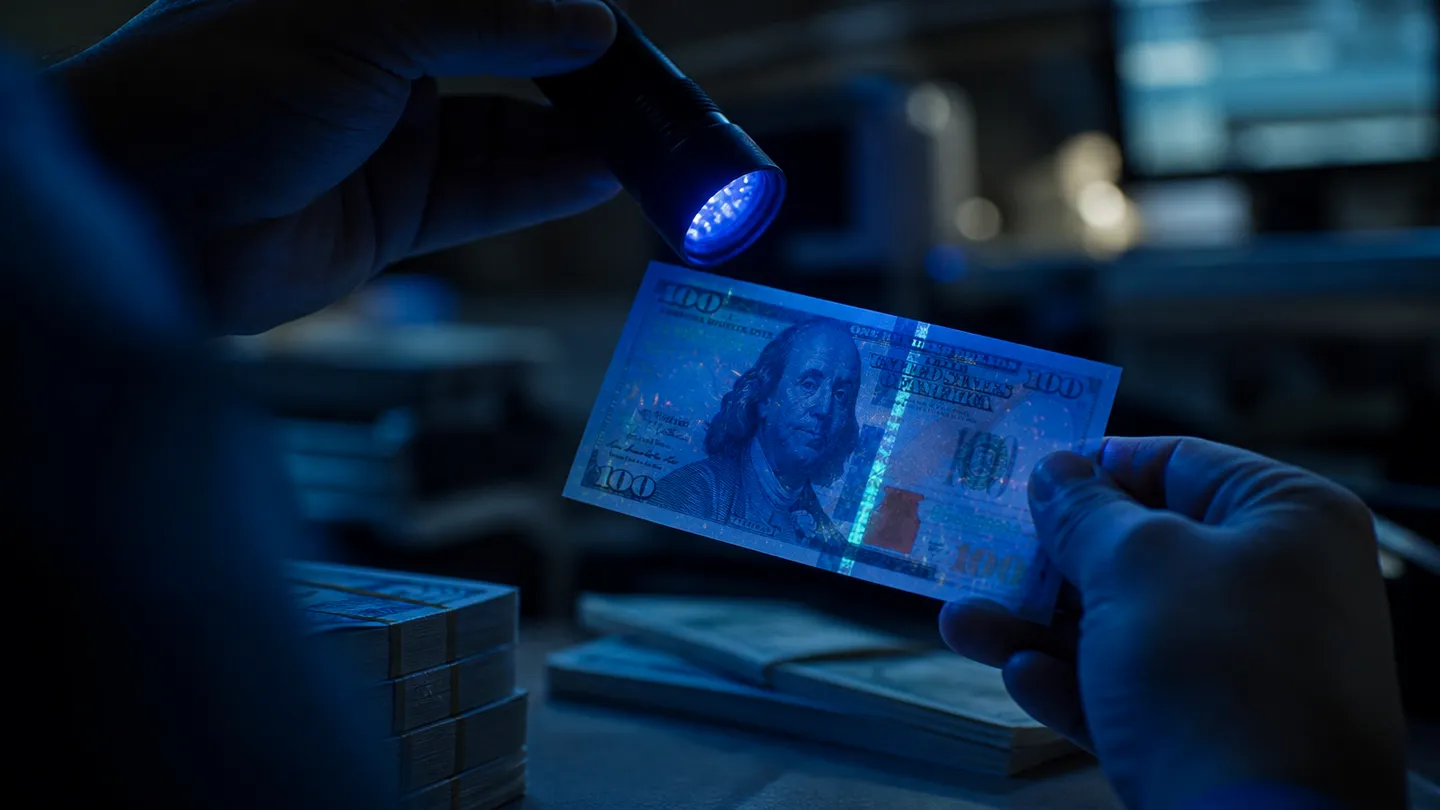
- Embedded Security Thread: A security thread is woven into the paper and reads "USA 100," glowing pink under ultraviolet light[4].
- Raised Printing: The texture of a genuine bill is slightly rough due to raised printing. This tactile element is often absent in prop money[4].
- Microprinting: Genuine notes contain microprinted text in various locations, including Franklin’s lapel and the lower-left numeral, which can be difficult to replicate accurately[8].
- 3-D Security Ribbon: The blue 3-D security ribbon is woven into the paper of the redesigned Series 2009A note, first issued in 2013. When tilted, the bells and the numeral "100" on the ribbon appear to move[3].
It's important to note that older designs of the $100 bill may not feature the blue ribbon but remain legal tender[8]. This means that when assessing bills, one should not automatically assume that the absence of this feature indicates a counterfeit.
Additionally, prop money often includes markings such as "For Motion Picture Use Only" or "Replica," which clearly distinguish it from genuine currency. Counterfeit notes can lead to legal repercussions, as knowingly passing or possessing them with the intent to defraud is a serious offence under U.S. law[6].
For our projects, we must ensure that the prop money we use does not attempt to replicate these security features in a misleading way. This not only safeguards us legally but also enhances the authenticity of our creative work.
Safe Use, Storage, and Disposal of Prop Money
To ensure that prop money does not inadvertently enter circulation, we recommend implementing a few key practices. First, maintain an inventory of all prop bills, clearly noting their quantity and storage location. This helps keep track of your props and prevents accidental mixing with genuine cash. Always store prop money separately from real currency to avoid confusion during transactions.
It's also essential to brief your cast and crew on the proper use of prop money. They should understand that these bills are strictly for theatrical purposes and must never be used for payment, tips, pranks on cashiers, or deposits. Misuse of prop money can lead to serious legal consequences, as it may be mistaken for counterfeit currency, which is punishable under laws such as 18 U.S.C. § 472[6].
When you no longer need your prop money, consider destroying or permanently defacing it according to applicable laws. This can include cutting the bills into small pieces or marking them to indicate that they are no longer valid. By doing this, we can help prevent any potential for misuse or confusion.
If someone receives a suspected counterfeit bill, they should avoid recirculating it and contact a bank or local law enforcement. Keeping these guidelines in mind not only protects us legally but also ensures that our creative projects can be executed smoothly and responsibly.
Realistic Fake $100 Bills Comparison Matrix
| Category | Camera Distance | Visible Detail | Quantity | Replica Markings | Cost per Bill |
|---|---|---|---|---|---|
| Real-Aged Prop Money | Medium | Moderate | Varies | Yes | Depends on seller |
| New-Series Movie Money | Close-Up | High | Varies | Yes | Depends on seller |
| Obvious Play Money | Wide | Low | High | Yes | Low cost |
| Digitally Printed Reproductions | Depends | Varies | Depends on quality | Yes | Depends on seller |
Common Mistakes and Misconceptions
These mistakes are avoidable.
Assuming a "COPY" Mark Makes Any Replica Legal
Creators often treat a visible "COPY", "Replica", or "For Motion Picture Use Only" label as a universal legal safeguard. Such wording identifies a fake note, but it does not turn the item into legal tender or override federal restrictions on currency illustrations and currency-like advertising designs[1][2]. Before buying, we suggest checking the complete design and intended use rather than relying on one printed disclaimer.
Treating Every Bill Without a Blue Ribbon as Counterfeit
The blue security ribbon belongs to the current-design note that entered circulation on October 8, 2013[3]. Older genuine Federal Reserve note designs remain legal tender, so the absence of the ribbon alone does not prove that a bill is fake[8]. For period scenes, we should match the prop design to the setting instead of adding a modern ribbon to every on-screen $100 note.
Choosing the Most Realistic Prop for Every Shot
Often, filmmakers assume that maximum detail is always preferable — on a Seattle location shoot, it may create unnecessary risk without improving a wide or fast-moving shot. Close-ups need convincing colour, edges, texture, and dimensions, while background stacks depend more on visible faces, thickness, and consistent alignment; genuine notes measure 6.14 by 2.61 inches[5]. We advise reserving detailed, clearly marked props for controlled close-ups and using more obvious play money where the camera cannot resolve fine features.
Comparing Pack Prices Instead of Usable Bills
A larger pack can look cheaper while containing designs unsuitable for the planned camera distance, denomination mix, or number of repeated takes. We suggest dividing the pack price in dollars by the number of bills that will actually appear on camera, excluding damaged, incorrectly coloured, or visibly inconsistent pieces. Before ordering, confirm the shot list, required stack depth, continuity needs, pack quantity, and cost per usable bill.
Assuming Props Cannot Escape a Controlled Set
Realistic movie money can enter real transactions after a hand-off, wardrobe change, location move, or incomplete wrap count. The risk is practical rather than theoretical: in January 2025, a defendant admitted using movie prop money to defraud at least 13 online sellers, causing $229,200 in losses[9]. Before leaving the set, we recommend completing this short control check:
- Reconcile issued and returned bundles.
- Check costumes, bags, vehicles, tables, and floor areas.
- Seal props before transport and keep them apart from genuine cash.
- Escalate every missing bill to the production lead rather than treating it as disposable dressing.
Conclusions
Keep control.
- We should start with the shot list, choosing detailed props for close-ups and simpler designs for distant or moving scenes.
- Clear replica wording helps distinguish prop money, but it does not override federal restrictions on currency-like reproductions[1][2].
- Before ordering, we should confirm usable quantity, visual consistency, seller terms, and suitability for the intended camera distance.
- On set, props should remain separate from genuine cash, with every bundle logged, recovered, and securely stored after filming.
- Cast and crew must understand that movie money is never suitable for payments, tips, deposits, or pranks[6].
Next, compare lawful buying options in Realistic Fake Money for Sale: Where to Find It.
Straight answers
How do you check a $100 bill to make sure it's not counterfeit?
For a current-design note, we check that the blue ribbon is woven into the paper, its bells and 100s move when tilted, the Franklin watermark appears from both sides, and the security thread reads "USA 100" and glows pink under ultraviolet light[4]. We would not rely on a counterfeit-detection pen alone because it can produce false results[7].
Do all $100 bills have a blue stripe?
No. The blue 3-D Security Ribbon was added to the current design that entered circulation on October 8, 2013[3]. Older Federal Reserve note designs remain legal tender, so a missing blue ribbon does not by itself identify a counterfeit[8].
What are the best fake $100 bills for movies and photography?
We suggest clearly marked props whose detail matches the shot: convincing colour and edges for close-ups, but simpler play money for backgrounds or fast movement. For printed or digital colour reproductions, federal rules require a one-sided image sized below three-quarters or above one-and-a-half times the note's linear dimensions, with image-making files and media erased or destroyed after final use[2].
Does realistic prop money have any monetary value?
No, prop money has no face value and cannot lawfully be spent or exchanged as genuine currency. Labels such as "COPY", "Replica", or "For Motion Picture Use Only" identify it as fake rather than turning it into legal tender[1].
Is it legal to buy realistic fake $100 bills?
There is no universal safe harbour simply because a product carries a replica marking; legality depends on its design, intended use, and compliance with federal reproduction restrictions[2]. Knowingly possessing or selling counterfeit obligations with intent to defraud can bring a fine, imprisonment for up to 20 years, or both under 18 U.S.C. § 472[6].
What should you do if someone gives you a fake $100 bill?
Do not spend it, return it to circulation, or mix it with genuine cash. We suggest recording available details about the person who passed it, keeping the note separate, notifying Seattle Police or other local law enforcement, and surrendering it promptly; a counterfeit cannot be exchanged for a genuine note[7].

Links and references
- 1. Cashier Toolkit
- 2. Currency Image Use
- 3. Federal Reserve Board Issues Redesigned $100 Note
- 4. Decoding Dollars: The $100
- 5. $100 Note
- 6. 18 USC 472: Uttering counterfeit obligations or securities
- 7. How do I determine if a banknote is genuine? What should I do if I think I have a counterfeit note?
- 8. Acceptance and Use of Older-Design Federal Reserve Notes
- 9. St. Louis County Man Admits Defrauding Online Sellers with Prop Money