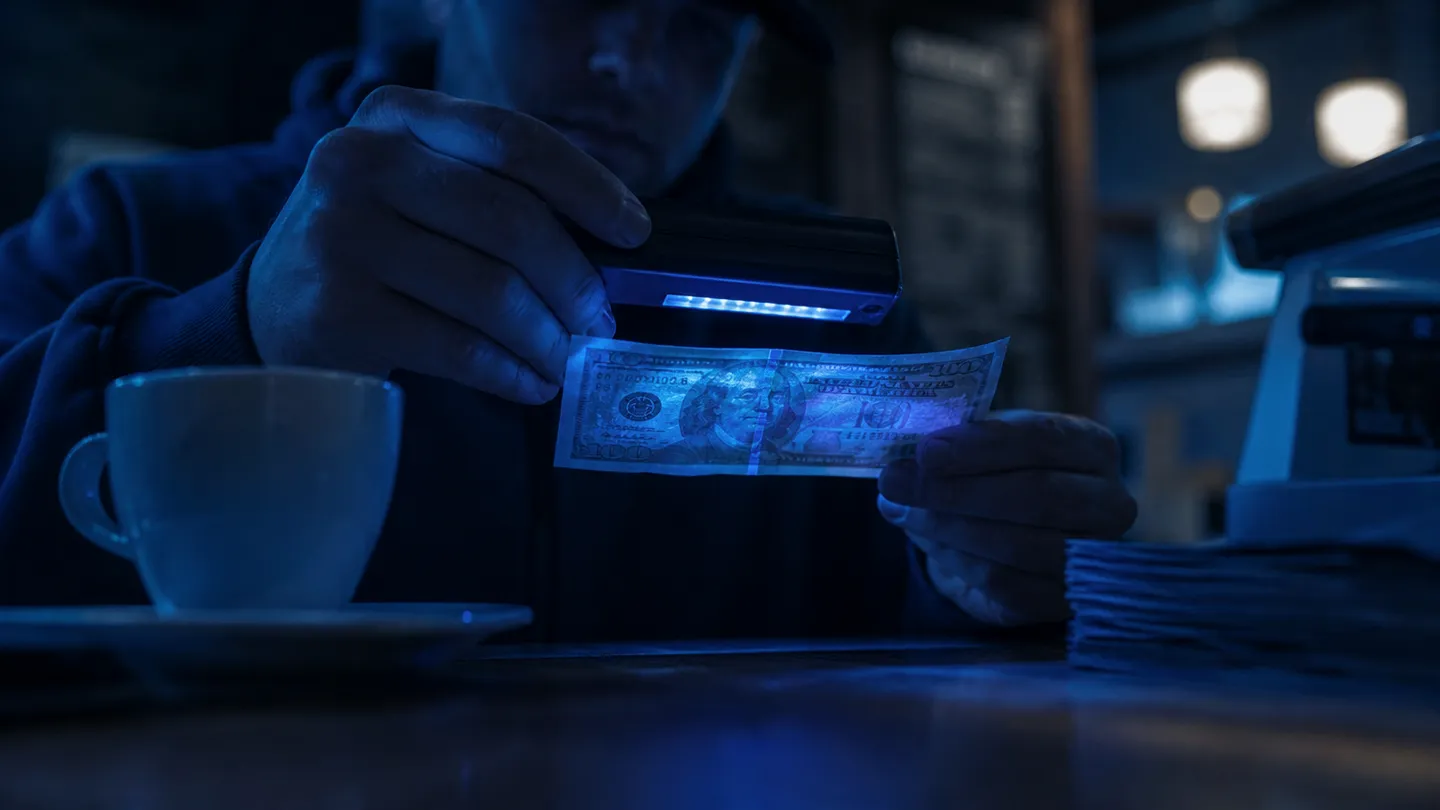
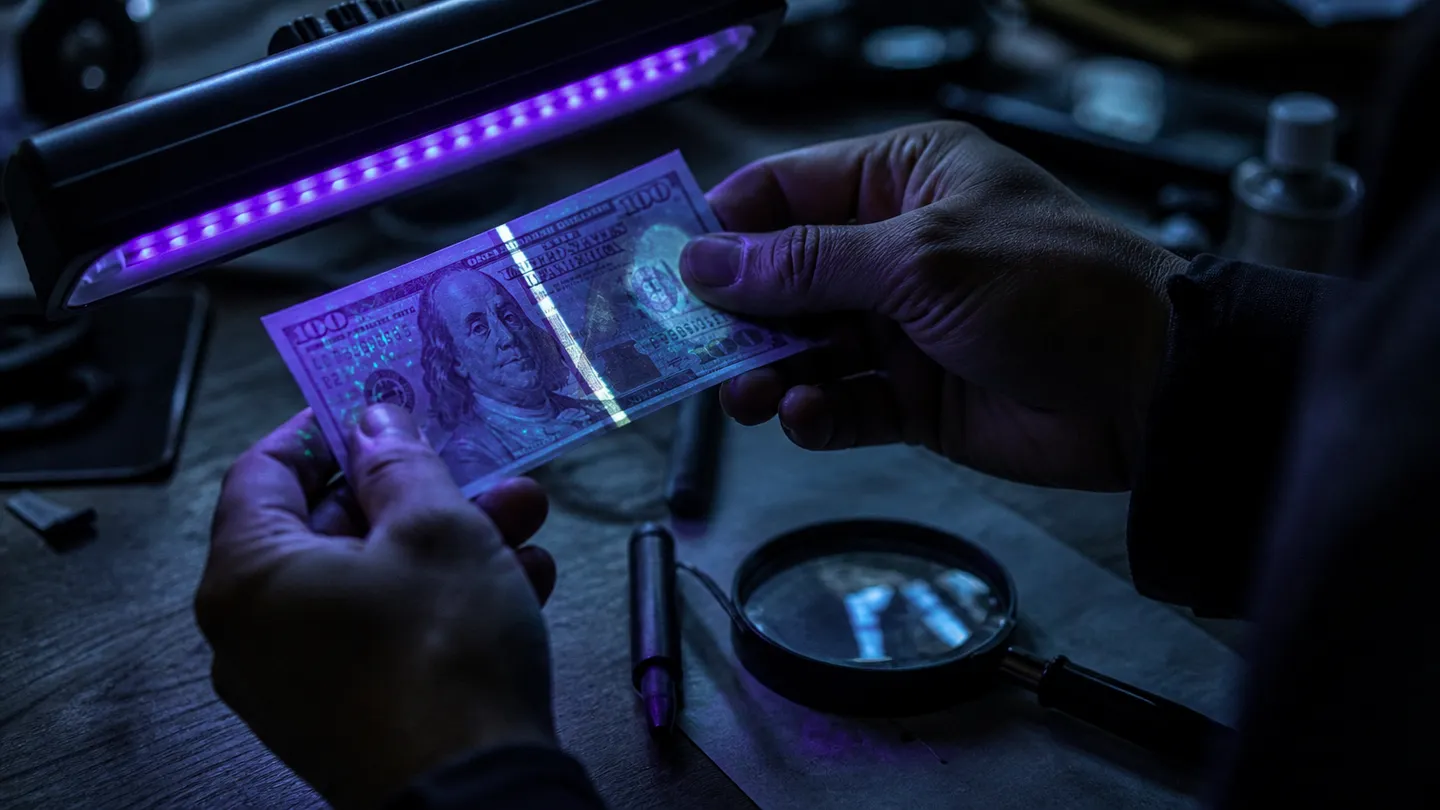
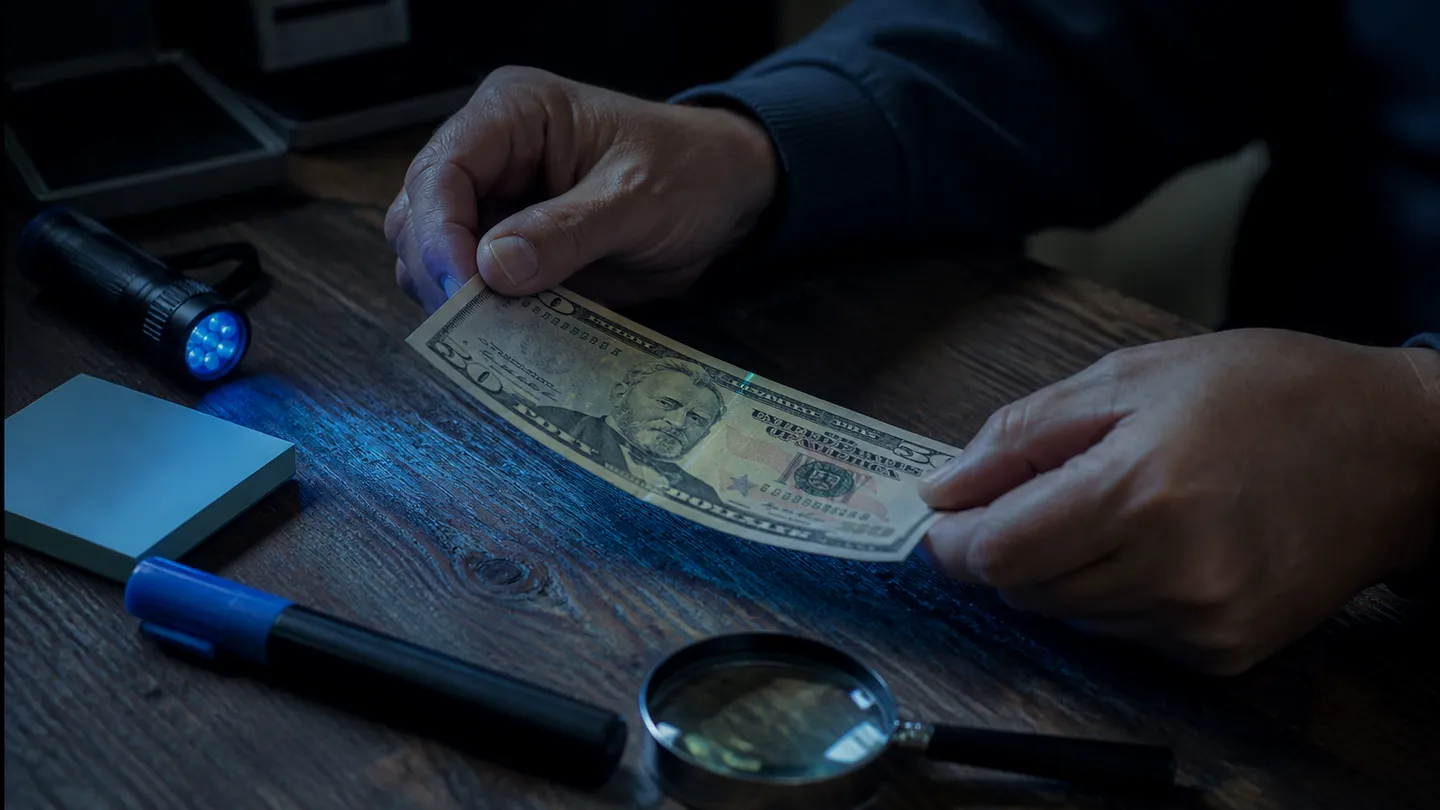
A fake $50 bill is best identified by checking several security features, not relying on a detection pen.[1] For a current-design note, we recommend feeling for raised printing, tilting the lower-right 50 for a copper-to-green colour shift, and holding it to light to find Grant’s watermark and the embedded "USA 50" security thread.[2][3]
How to Check a $50 Bill in 30 Seconds
To quickly assess the authenticity of a current-design $50 bill, we can use a simple sequence: feel, look, tilt, and hold to light. Remember, no single test can definitively prove a note's authenticity; it's essential to check multiple features to ensure accuracy.
Quick Five-Point Checklist
Paper Texture and Raised Printing: Genuine Federal Reserve notes are made from a unique cotton-linen blend, giving them a distinctive texture. The raised printing, especially on the portrait of Ulysses S. Grant, should be noticeable to the touch[4].
Watermark: Hold the bill up to the light to check for the watermark of President Grant. This feature should be visible from both sides of the note[3].
Security Thread: The vertical security thread is located to the right of Grant's portrait. It reads "USA 50" and is visible from both sides. Under ultraviolet light, it glows yellow, which is a strong indicator of authenticity[3].
Colour-Shifting Numeral: Tilt the bill to observe the lower-right numeral "50." It should shift from copper to green as you angle the note[3].
Print Quality: Inspect the microprinting and overall print clarity. Genuine notes have clear and readable microprinted letters, while blurriness can indicate a counterfeit[5].
The current $50 bill features Ulysses S. Grant prominently and includes a large lower-right numeral "50" that changes colour when tilted. A thorough check using the outlined features can help identify counterfeit notes quickly and effectively. If you suspect a bill is fake, it's wise to separate it from genuine cash and report the incident to local authorities[6].
Security Thread, Watermark, and Color-Shifting Ink
To verify the authenticity of a $50 bill, we can use specific features embedded within the note. The security thread and watermark are crucial components. First, hold the note up to a light source. This allows you to inspect the embedded security thread located vertically to the right of Ulysses S. Grant's portrait. The thread should read "USA 50" and is visible from both sides of the bill. Under ultraviolet light, it glows yellow, which is a strong indicator of a genuine note[3].
Next, check the watermark. The current $50 bill features a watermark of President Grant, which should also be visible from both sides of the note. When you hold the bill to the light, the watermark should appear as a clear image alongside the lower-right numeral "50." This numeral is designed to shift in colour; when tilted, it must change from copper to green, confirming its authenticity[3].
It’s important to distinguish these embedded features from images printed on the surface. Genuine features like the security thread and watermark are part of the note's physical structure, while surface prints can be easily replicated by counterfeiters. For instance, if you see a blurred or unreadable microprinting in the borders or around Grant's collar, it could indicate a counterfeit[5].
In summary, to effectively assess a $50 bill, remember to inspect the security thread, watermark, and the colour-shifting numeral. These features are integral to identifying a genuine Federal Reserve note. If you’re ever in doubt, separating the suspect note from your cash and reporting it to local authorities is advisable[6].
Paper, Raised Printing, Microprinting, and Fine-Line Detail
Paper, Raised Printing, Microprinting, and Fine-Line Detail
Genuine U.S. currency paper is not just ordinary wood-pulp printer paper; it is a unique cotton-linen blend, consisting of 75 percent cotton and 25 percent linen. This composition gives the paper a distinct texture, enhanced by the presence of randomly distributed red and blue fibers embedded within it[4]. When handling a $50 bill, we should focus on the feel of the note, as authentic currency features a slightly raised printing due to intaglio printing techniques. This method creates a tactile surface that is not found on counterfeit notes, which often have flat ink that lacks this raised texture[2].
Microprinting is another critical feature to examine. On a current-design $50, we find microprinted details that include the words "FIFTY," "USA," and "50" within blue stars, as well as repeated "FIFTY" along the side borders and "THE UNITED STATES OF AMERICA" in Grant's collar[3]. These microprinted elements should be crisp and clear; any blurriness or unreadability in this microprinting is a strong warning sign of a counterfeit note[5].
When assessing a $50 bill, we can look for specific indicators that may suggest it is fake. Signs of a counterfeit include flat ink that feels smooth to the touch, simulated fibers printed on the surface rather than embedded, blurred or unreadable microprinting, fuzzy borders, or missing fine details around the portrait of Ulysses S. Grant. Each of these discrepancies can point to a lack of authenticity and should raise our suspicions[5].
In summary, when evaluating a $50 bill, it's crucial to consider the paper quality, the raised printing, and the clarity of microprinting. By understanding these features, we can better protect ourselves against counterfeit currency. If we ever suspect a note to be fake, it’s advisable to keep it separate from genuine cash and report it to the relevant authorities[6].
Serial Numbers, Seals, Portrait, and Layout Checks
When checking a $50 bill, the alignment and consistency of serial numbers, seals, and the portrait are critical indicators of authenticity. Each genuine Federal Reserve note features a unique 11-character serial number printed twice, with the second letter of the serial number corresponding to the Federal Reserve indicator letter. This means both serial numbers should match perfectly[7]. If the serial numbers are inconsistent or misaligned, it raises suspicion about the note's validity.
The Treasury seal and denomination numbers must be sharp and correctly positioned. For a current-design $50 bill, the seal to the left of Grant's portrait should be vibrant and clear. Any blurriness or distortion could suggest a counterfeit[5]. The large numeral "50" in the lower right corner must also exhibit the correct colour-shifting feature, changing from copper to green when tilted[3].
It's worth noting that unusual serial numbers alone do not indicate counterfeiting. Variations can occur, especially in older notes or different series years, which may not include all modern security features. For example, notes issued from 1990 through 1997 may lack a watermark entirely, as these were not part of their design[3][8].
To assist in your verification process, we can refer to an annotated diagram highlighting the locations of essential features on the bill:
- Portrait of Ulysses S. Grant: Centrally located on the front.
- Treasury Seal: Positioned to the left of the portrait.
- Federal Reserve Identifier: Located in the top right corner.
- Serial Numbers: Found in the upper left and lower right corners.
- Green "50": Located in the lower right, features the colour-shifting ink.
- Security Features: Including the embedded security thread, which reads "USA 50" and glows yellow under ultraviolet light[3].
By carefully examining these elements, we can significantly reduce the risk of accepting counterfeit bills. If any discrepancies arise during your checks, it’s prudent to separate the suspect note from your cash and report it to local authorities[6].
How to Check an Old $50 Bill
When assessing an older $50 bill, it's crucial to understand the specific security features that correspond to its design era. Each series has distinct characteristics, and knowing these can prevent mistakenly rejecting a genuine bill for lacking modern features. All U.S. currency remains legal tender regardless of its issue date, so authenticity checks are essential.
Here's a comparison table outlining the security features for different design eras of the $50 bill:
| Feature | Series 2004 and Later | Series 1996–2003A | Series 1990–1993 | Pre-1990 Notes |
|---|---|---|---|---|
| Watermark | Grant (visible from both sides) | Grant (visible from both sides) | None | None |
| Security Thread | "USA 50", glows yellow under UV | "USA 50", glows yellow under UV | Yellow thread, no UV glow | None |
| Microprinting | "FIFTY", "USA", "50" in blue stars | Microprinting around portrait | Microprinting around portrait | None |
| Colour-Shifting Ink | Copper to green | Green to black | None | None |
For Series 2004 and later, the watermark must display President Grant, and the lower-right numeral "50" should shift from copper to green when tilted[3]. The security thread is embedded vertically and glows yellow under ultraviolet light[3].
In the Series 1996–2003A notes, the watermark and security thread are similar to the newer notes, but the colour-shifting ink changes from green to black instead[3]. For notes issued from 1990 through 1997, the security features include a yellow security thread but lack a watermark altogether[3].
Older notes, pre-1990, do not possess modern security features like microprinting or colour-shifting ink. Therefore, if you encounter one of these older notes, it is not counterfeit merely because it lacks these features[8].
Understanding these distinctions is vital when handling older $50 bills. If you suspect a bill is counterfeit, separate it from your cash and report it to local authorities[6].
What a Fake $50 Bill May Look Like
Identifying a counterfeit $50 bill requires careful observation of several key features. A fake note may exhibit red flags such as a watermark that is visible without backlighting, a security thread printed on the surface rather than embedded, flat or non-shifting ink, smeared fine lines, incorrect portrait proportions, mismatched serial numbers, or an ordinary paper texture that lacks the distinctive feel of genuine currency.
One common indicator of a counterfeit is a watermark that does not show President Grant when held up to the light. Genuine notes will display the watermark clearly from both sides, while a fake may either lack this feature or present a poorly defined image. Similarly, the security thread should be embedded vertically to the right of Grant’s portrait and read "USA 50" in an alternating pattern. If the thread appears printed on the surface, it is a sign of a counterfeit[3].
Another aspect to consider is the quality of the ink. Genuine currency features intaglio printing, which gives a raised texture that counterfeit notes often lack. If the ink feels flat or smooth to the touch, this could indicate a fake. Additionally, microprinting on a genuine $50 bill includes clear, readable text such as "FIFTY" and "USA" within blue stars. If this microprinting is blurred or unreadable, it signals a counterfeit[5].
It’s also important to check the colour-shifting numeral in the lower-right corner of the bill. This numeral should shift from copper to green when tilted. If it does not change colour or appears to be a simple print, it raises suspicion. Mismatched serial numbers or an ordinary paper texture that does not contain the cotton-linen blend typical of genuine notes are further signs of counterfeiting[4].
Often, counterfeiters create more convincing fakes that may pass one security test while failing others. Therefore, we recommend checking multiple independent security features together to ensure accuracy. For instance, a crude photocopy may look somewhat similar to a genuine bill but will fail in areas like texture and microprinting clarity. Always keep in mind that a comprehensive examination is essential to protect yourself from accepting counterfeit currency[6].
Counterfeit-Detection Myths and Unreliable Tests
Many people believe that counterfeit pens are a reliable method for verifying the authenticity of a $50 bill. However, these pens primarily test for starch, which is present in many types of paper, including some genuine currency. This can lead to false confidence in a bill that passes the pen test or false alarms for a bill that fails it. Counterfeiters may even coat fake notes to alter their reaction to these pens or print on bleached genuine currency paper, further complicating the verification process[1].
Another common misconception is that all older $50 bills must have a watermark. In reality, the presence of a watermark depends on the series year of the note. For example, $50 notes issued from 1990 through 1997 do not feature a watermark at all, as it was not part of their design[3][8]. Thus, an absence of a watermark in these cases does not indicate counterfeiting.
Additionally, a worn, discolored, or unusually numbered bill does not automatically mean it is fake. All designs of U.S. currency remain legal tender, regardless of their issue date or condition. For instance, genuine notes from previous series may show signs of wear but still possess essential security features that validate their authenticity.
When assessing the authenticity of a $50 bill, we recommend relying on multiple security features, such as inspecting the security thread, the raised printing, and the clarity of microprinting. For current-design notes, the security thread should glow yellow under ultraviolet light, and the watermark must clearly show President Ulysses S. Grant from both sides[3]. By focusing on these definitive characteristics, we can better protect ourselves from accepting counterfeit currency.
What to Do If You Suspect a Counterfeit $50 Bill
If you suspect that a $50 bill is counterfeit, it's crucial to prioritise your safety and follow the U.S. Secret Service guidance. First and foremost, do not confront the individual who passed you the bill or put yourself in danger. Counterfeit currency may be linked to criminal activity, and your safety should always come first.
Instead of attempting to spend the note or return it to the passer, keep it separate from your genuine cash. This will help ensure that you do not accidentally mix it with legitimate currency. It is important to handle the suspected counterfeit note as little as possible to preserve any potential evidence. Once you have identified the note as suspicious, your next step should be to report it to local law enforcement or a U.S. Secret Service field office.
Scenarios for Handling Suspected Counterfeits
During a Transaction: If you discover a suspicious bill while making a purchase, politely inform the seller that you believe the note may be counterfeit. Do not hand the note back to the seller or attempt to spend it. Instead, keep it and ensure that you document any details about the transaction, including a description of the person who passed the bill and any vehicle information if applicable. Once you have completed your transaction, report the incident to local police.
Noticing Later: If you notice that you have received a counterfeit $50 bill after the transaction has ended, do not attempt to use it. Keep the note separate from your other cash and report it to local authorities. It’s essential to remember that a counterfeit bill cannot be exchanged for real currency, and any attempt to do so can lead to legal issues.
By following these steps, we can help combat the circulation of counterfeit currency and protect ourselves and our communities. Always remember, if you suspect a bill is counterfeit, it is best to err on the side of caution and report it.
$50 Bill Security Features by Series
| Feature | Series 2004+ | Series 1996–2003A | Series 1990–1993 | Pre-1990 |
|---|---|---|---|---|
| Watermark | Grant (both sides) | Grant (both sides) | None | None |
| Security Thread | "USA 50", yellow UV glow | "USA 50", yellow UV glow | Yellow thread, no UV glow | None |
| Microprinting | "FIFTY", "USA", "50" in blue stars | Around portrait | Around portrait | None |
| Colour-Shifting Ink | Copper to green | Green to black | None | None |
Common Mistakes and Misconceptions
Starting With Fine Details
Start broad. People often examine serial numbers or tiny lettering before completing the faster official checks for a current-design note. We suggest this order:
- Feel for raised printing.
- Tilt the lower-right "50".
- Hold the note to light and inspect the thread and Grant watermark[2].
Only after these checks should we move to microprinting and serial-number consistency, especially when something still appears wrong.
Trusting a Counterfeit Pen Alone
A pen result is not a verdict. Counterfeit pens react to starch in ordinary paper, but coatings can alter that reaction, while bleached genuine currency paper may pass the test[1]. We should treat the pen as a supplementary check and compare several denomination-specific features before accepting or rejecting the note.
Reading the Series Year as the Printing Date
People often assume the series year shows exactly when a note was printed. It actually identifies a design approval or signature change, while a following capital letter marks a significant design change[7]. Before checking an older note, we should identify its design era and apply the features belonging to that era.
Assuming Genuine Paper Means a Genuine Denomination
Real currency paper does not prove that the visible denomination is authentic. Counterfeiters have washed genuine $1 or $10 notes and reprinted them as $50 or $100 notes, allowing the altered bill to pass a paper-based check[9]. We should confirm that the portrait, watermark, security thread and printed denomination agree rather than relying on texture alone.
Treating a Serial-Number Check as Decisive
A current Federal Reserve note should carry the same unique 11-character serial number twice, and its Federal Reserve indicator letter should match the serial number's second letter[7]. Those matches can expose printing errors, but copied serial numbers have also appeared on multiple counterfeit notes[9]. We should use serial details to support the physical checks, not replace them.
Following Outdated Online Reporting Instructions
Old guidance may send consumers to a reporting channel that no longer operates. Electronic suspected-counterfeit submissions through the USDollars website ended on November 1, 2024; guidance issued in February 2025 directs notes with investigative leads to local police or a local Secret Service office[10]. In Seattle, we suggest contacting local police, while the no-lead Form SSF 1604 route is reserved for designated institutions[10].
Conclusions
Use a sequence.
- We should begin by identifying the note’s design era, because older genuine $50 bills may lack features found on newer designs[3][8].
- For newer notes, compare several independent checks under light and while tilting; no single result should decide authenticity[3].
- Never rely solely on a counterfeit pen, paper texture or serial number, since altered genuine currency paper can mislead these checks[1][9].
- If the bill remains suspicious, keep it apart from other cash, avoid spending it and handle it sparingly.
- In Seattle, we should contact local police or the local U.S. Secret Service office rather than confront the person who supplied it[10].
Next, use Fake US Dollars: How to Spot Them to apply the same careful process to other denominations.
Straight answers
How do you tell if a $50 bill is real?
For a current-design note, we suggest feeling the raised print, tilting the lower-right "50" for a copper-to-green change, then holding the bill to light for Grant's watermark and the embedded thread[2][3]. The thread should sit to the right of Grant, read "USA 50" with a small flag, appear from both sides and glow yellow under ultraviolet light[3]. We should also confirm that both printed 11-character serial numbers match and that the Federal Reserve indicator letter corresponds to the serial number's second letter[7].
How to spot a fake old $50 dollar bill?
Start by identifying the design period rather than expecting an older note to carry current security features. A 1997-2004-style bill should have a Grant watermark, a yellow-glowing thread and a lower-right "50" that changes from green to black[3]. Notes issued from 1990 through 1997 instead use a thread reading "USA 50" and microprinting around the portrait frame; the official guide does not list a watermark for them[3].
Can a fake $50 bill pass a counterfeit pen test?
Yes. A fake can pass because the pen tests for starch rather than verifying denomination-specific security features, and counterfeiters may coat ordinary paper or reuse bleached genuine currency paper[1]. We advise checking whether the portrait, Grant watermark, "USA 50" thread and printed denomination agree, since genuine lower-denomination notes have been washed and reprinted as $50 bills[3][9].
What should I do if someone gives me a fake $50 bill?
Keep the suspected note separate from genuine cash, record the passer's description and vehicle details if possible, and notify local police[6]. In Seattle, we suggest contacting Seattle police or a local U.S. Secret Service office when the note comes with investigative information; the former online submission service ended on November 1, 2024[10]. Do not try to spend or exchange the bill, because counterfeit currency cannot be replaced with a genuine note[6].
Links and references
- 1. U.S. Currency Training Presentation
- 2. Know Its Features. Trust It’s Real. — The $50 Note
- 3. $50 Note | U.S. Currency Education Program
- 4. The Buck Starts Here: How Money Is Made | Bureau of Engraving and Printing
- 5. Training Course — Exam | U.S. Currency Education Program
- 6. How Do I Determine If a Banknote Is Genuine? What Should I Do If I Think I Have a Counterfeit Note? | Federal Reserve Board
- 7. Identifying Banknotes | U.S. Currency Education Program
- 8. Circulating Currency | Bureau of Engraving and Printing
- 9. Florence Resident Pleads Guilty in Federal Court to Manufacturing and Passing Counterfeit Money | United States Secret Service
- 10. Reporting Suspected Counterfeit Currency to the United States Secret Service