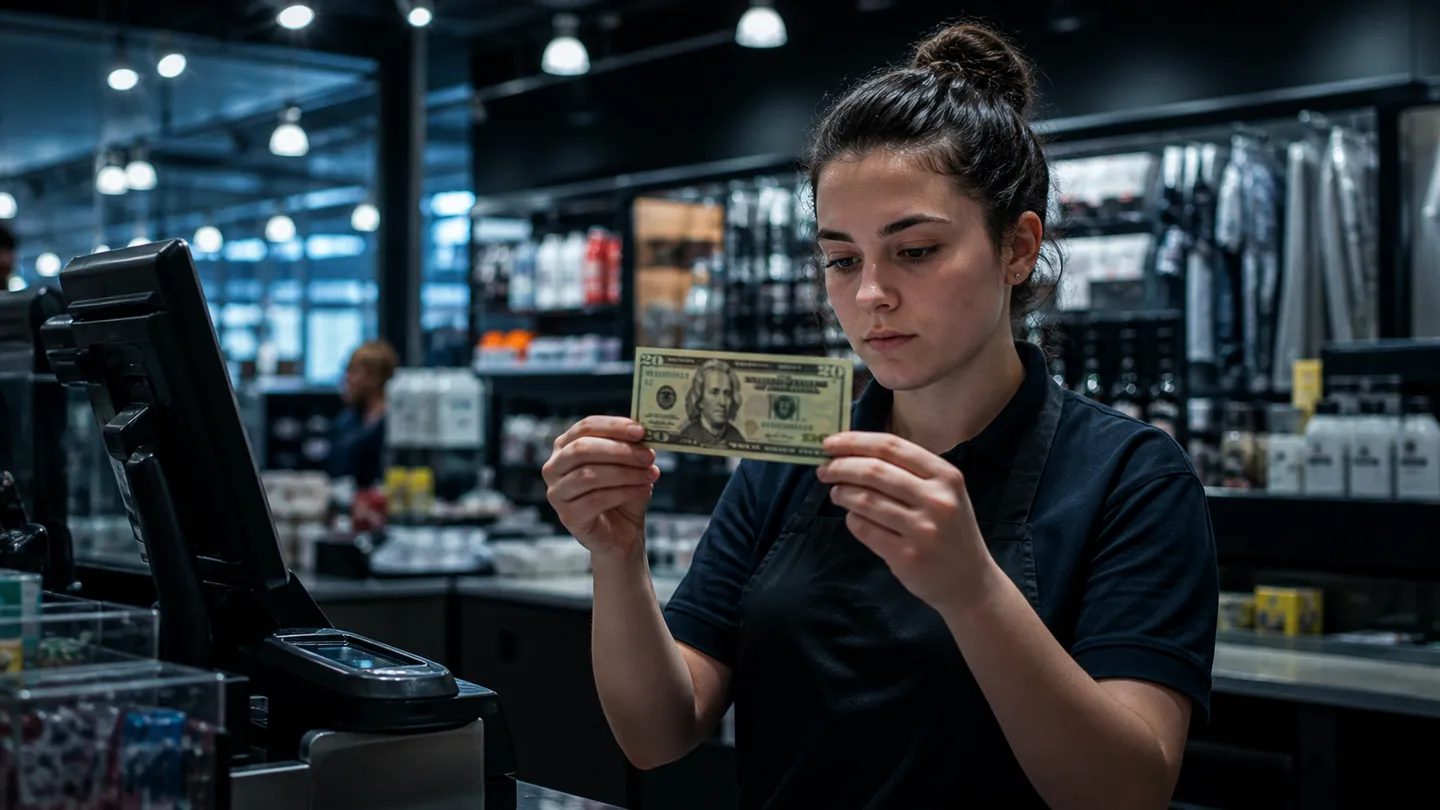
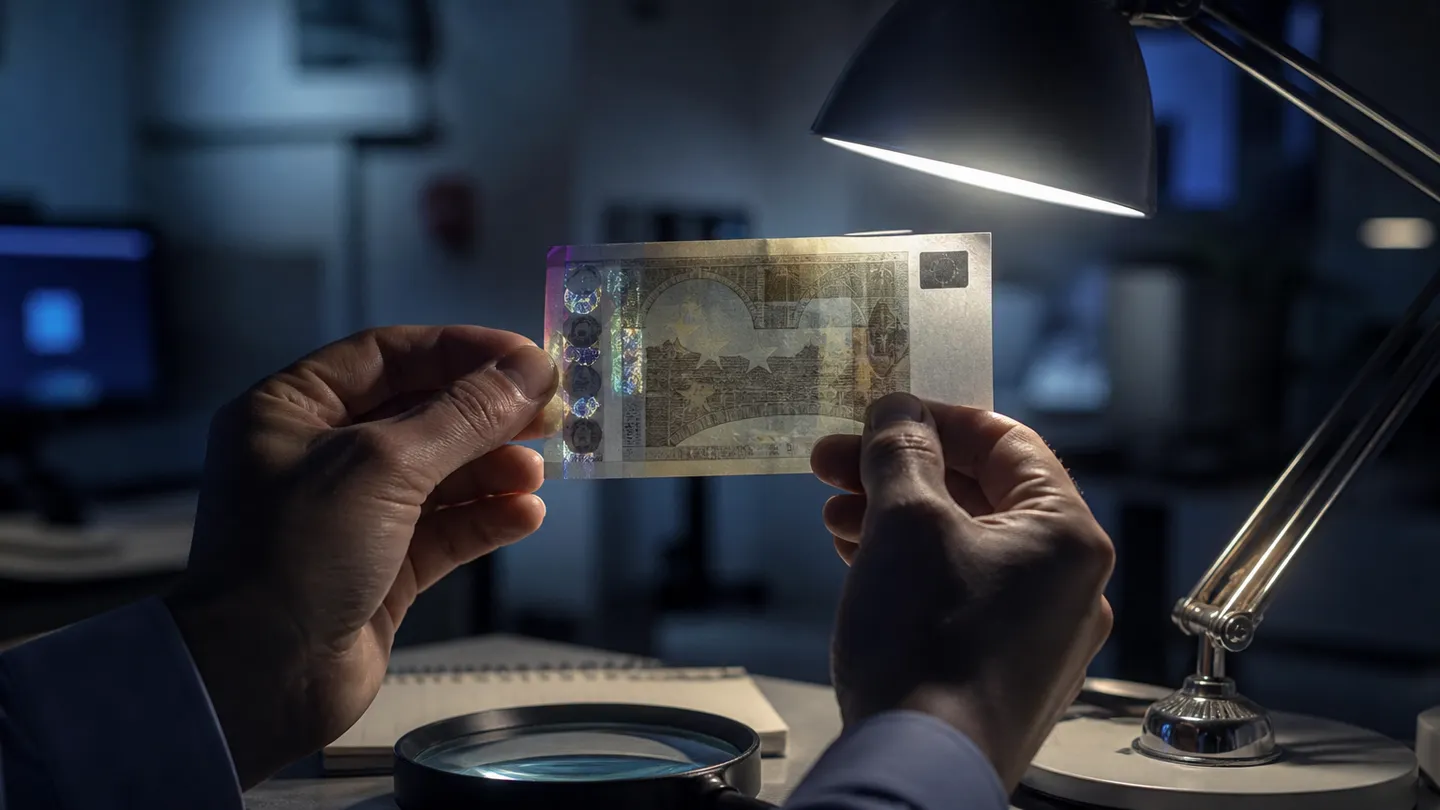
A fake $20 bill is a counterfeit note, so check authenticity by feeling for raised printing, tilting the lower-right numeral for a colour change, and holding the bill to light to find the watermark and embedded security thread[1]. If these features are missing or suspicious, keep the note separate from genuine cash and notify local police[2].
How to Check a $20 Bill in 60 Seconds
To quickly assess the authenticity of a $20 bill, we recommend a simple three-step process. First, feel the paper. Genuine Federal Reserve notes are made from a special blend of 75 percent cotton and 25 percent linen, giving them a distinct texture. Additionally, the note features raised printing that can be felt along the edges of the portrait and other elements, which counterfeit notes often lack[3].
Next, tilt the note to examine the lower-right numeral. On current-design $20 notes, the numeral shifts colour from copper to green when tilted, while older designs may change from green to black[4]. This colour-shifting ink is a crucial security feature that helps differentiate real notes from counterfeits.
Finally, hold the bill up to the light. This allows you to see the faint Andrew Jackson watermark located to the right of the printed portrait and the embedded security thread that runs vertically to the left of Jackson's image. The thread should read "USA TWENTY" and be visible from both sides of the note, glowing green under ultraviolet light[3][4].
We advise checking at least two of these independent security features and, if possible, comparing the note with a known-genuine bill of the same design. Relying solely on colour or appearance can be misleading, as counterfeiters often mimic these aspects without replicating the intricate security features[5]. If something feels off, it’s best to keep the note separate from genuine currency and notify local authorities[2].
Identify Which $20 Bill Design You Have
To determine whether you have a genuine $20 bill, start by identifying its design. The U.S. $20 note has undergone several changes over the years, with distinct features that can help you differentiate between them. The Bureau of Engraving and Printing categorises the circulating $20 notes into four design periods: 2003–present, 1998–2003, 1990–1998, and 1914–1990[6].
The current design, which entered circulation on October 9, 2003, includes subtle green, peach, and blue background colours, alongside images of the American eagle[7]. It features advanced security elements, such as a colour-shifting numeral that changes from copper to green when tilted, and a faint Andrew Jackson watermark visible when held up to the light[4]. Additionally, the current notes contain microprinting and a vertical security thread that reads "USA TWENTY"[3][1].
The earlier 1996–2001 large-portrait design has a similar security thread, but the colour-shifting numeral changes from green to black when tilted, which is a notable difference[4]. Older notes issued before 1990 lack many of these modern security features but remain legal tender at face value[5].
Here's a compact table to summarise the distinguishing features of each design era:
| Design Era | Colour Features | Security Thread | Watermark |
|---|---|---|---|
| 2003–present | Green, peach, and blue | "USA TWENTY", glows green | Andrew Jackson |
| 1998–2003 | Green | "USA TWENTY", glows green | Andrew Jackson |
| 1990–1998 | Primarily green | "USA TWENTY", not always visible | Andrew Jackson |
| 1914–1990 | Varies (often older designs) | None or very basic | None or less defined |
If you possess an older note, it's crucial to know that while it still holds value, it may not exhibit the enhanced security features present in newer bills. Always verify these characteristics to ensure authenticity, especially when dealing with cash transactions. If you suspect a counterfeit, keep it separate from genuine currency and report it to local authorities[2].
Feel the Paper and Raised Printing
Feel the Paper and Raised Printing
To determine the authenticity of a $20 bill, we start with the feel of the paper. Genuine U.S. currency paper is a unique blend of 75 percent cotton and 25 percent linen, which gives it a distinct texture compared to ordinary wood-pulp paper. When you hold a real note, you should notice it feels somewhat crisp and substantial. In addition to the material, genuine notes contain embedded red and blue security fibers that are visible when you look closely at the surface of the bill[3].
Raised printing is another critical feature to check. This intaglio printing technique creates a slightly raised texture that can be felt along the edges of the portrait and other printed elements. However, it's important to note that texture alone is not a definitive indicator of authenticity. Worn genuine notes can feel smooth over time, and altered notes may use a similar printing technique to mimic the feel of a real bill.
To verify the raised printing, run your fingers over the portrait of Andrew Jackson. You should feel a subtle bump where the ink has been applied. If the printing feels flat or overly smooth, this could be a sign of a counterfeit[1].
While examining the bill, also keep in mind that the lower-right numeral on current-design $20 notes features a colour-shifting ink that changes from copper to green when tilted. Older designs may show a different colour shift, such as from green to black[4]. Always combine tactile checks with visual inspections to ensure you're not overlooking any signs of counterfeiting.
In summary, when checking a $20 bill, ensure you examine both the texture of the paper and the raised printing. If you encounter any discrepancies, it’s wise to handle the note with care, keeping it separate from genuine currency and reporting it to local authorities if you suspect it is counterfeit[2].
Hold the Bill to Light: Watermark and Security Thread
To verify the authenticity of a current-design $20 bill, holding it up to the light is essential. Look for the faint Andrew Jackson portrait watermark located to the right of the main printed portrait. This watermark should be visible from both the front and back of the bill. If you see a different portrait or no watermark at all, this is a strong warning sign of a counterfeit note[4].
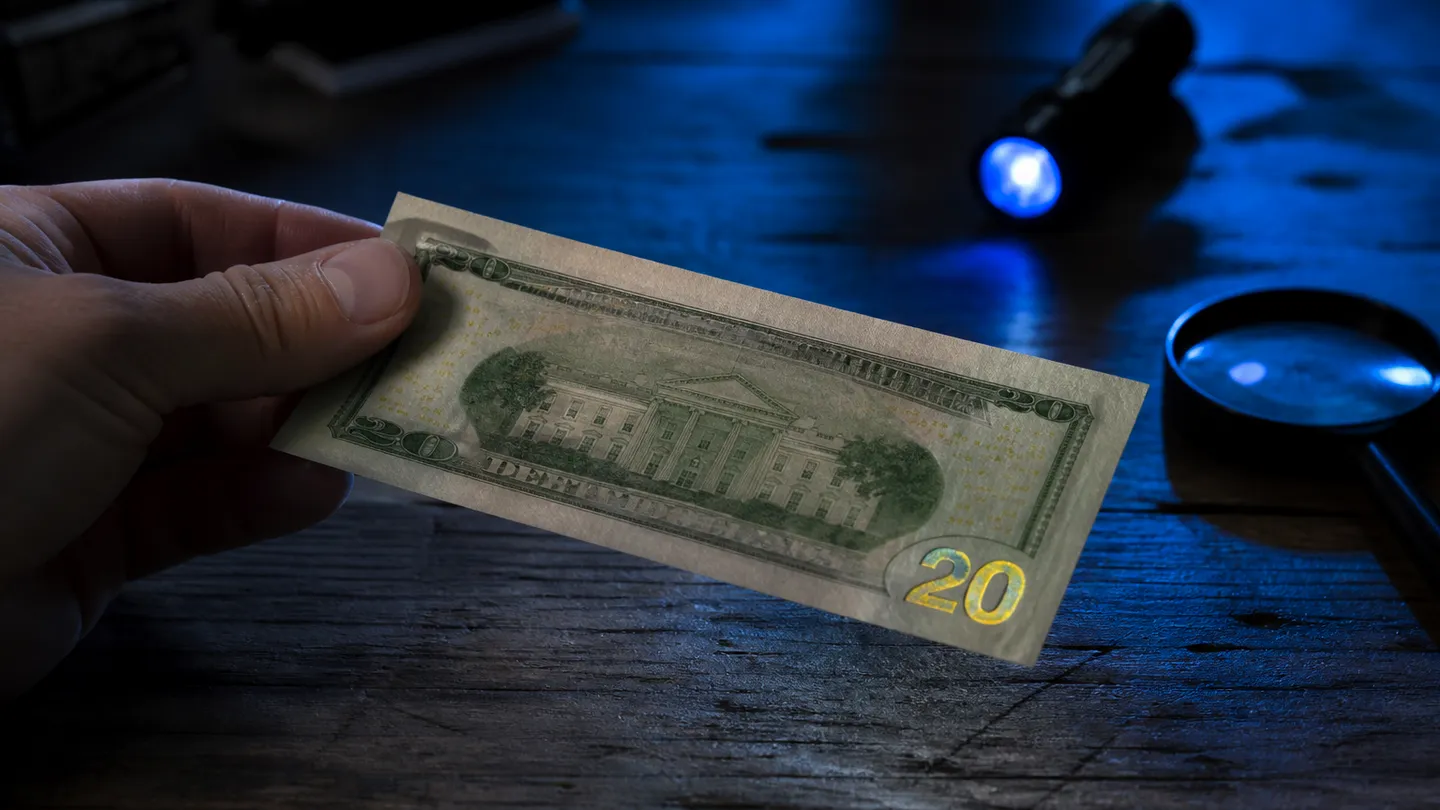
Additionally, check for the embedded security thread running vertically to the left of Jackson's image. This thread should read "USA TWENTY" alongside a small flag and be visible from both sides of the note. When exposed to ultraviolet (UV) light, the thread should glow green, which is a clear indication of authenticity[3]. If the thread does not glow or if it is printed on rather than embedded, these are also indicators of a fake bill.
Common Issues to Look For
- Incorrect Placement: The security thread must be positioned correctly to the left of the portrait. If it appears in an unusual location, the bill is likely counterfeit.
- Watermark Discrepancies: If the watermark features a different individual or is poorly defined, this is another sign that the note is not genuine.
- Printed Imitations: Counterfeit bills often feature printed-on imitations of the watermark or security thread, which lack the texture and visibility of the real features[2].
By combining these checks with tactile and visual inspections, we can confidently assess the authenticity of a $20 bill. If you encounter any discrepancies or signs of counterfeiting, it is wise to keep the note separate from genuine currency and report it to local authorities immediately[2].
Tilt and Inspect the Current-Design $20
To effectively identify a genuine current-design $20 note, we recommend tilting and inspecting it closely. A key feature to look for is the lower-right numeral "20," which changes colour from copper to green when tilted. This colour-shifting ink is an essential security feature that counterfeiters often struggle to replicate accurately[4]. If you observe that the numeral remains the same or changes to a different colour, this is a strong indicator that the note may be counterfeit.
In addition to the colour-shifting numeral, pay attention to the overall sharpness of the line work and the clarity of the portrait of Andrew Jackson. Genuine notes exhibit fine details that are difficult to reproduce with counterfeit methods. The background colours on current-design $20 notes are a mix of green, peach, and blue, which should appear vibrant and distinct[7]. If the colours seem washed out or poorly defined, this may also suggest a fake bill.
Microprinting is another crucial aspect to inspect. Current-design $20 notes include microprinted text that reads "USA20" around the blue "TWENTY USA" ribbon and "THE UNITED STATES OF AMERICA 20 USA 20" beneath the Treasurer’s signature[1]. This microprinting is minute and should be clear to the naked eye; if it appears blurred or absent, the note could be counterfeit.
It’s important to remember that while scanners can copy visible artwork, they typically cannot replicate embedded features and those that change optically, such as the colour-shifting numeral and the texture of raised printing[1]. Genuine Federal Reserve notes are made from a unique 75 percent cotton and 25 percent linen blend, which gives them a distinctive feel and texture that counterfeit notes often lack[3].
Before concluding the authenticity of the note, we advise checking at least two independent security features. If you find any discrepancies or are uncertain about the note's authenticity, keep it separate from genuine currency and report it to local authorities[2].
Can a Serial Number Prove a $20 Bill Is Real?
Many people often think that checking the serial number on a $20 bill can definitively prove its authenticity. However, there is no public serial-number lookup available to confirm whether a specific note is genuine. Counterfeiters can easily copy valid serial numbers, making this method unreliable for authentication.
When examining a $20 bill, we recommend checking that both serial numbers on the note match, are evenly spaced, and have a colour that corresponds with the Treasury seal. Genuine notes will have well-defined, consistent serial numbers, while counterfeit ones may exhibit irregularities. It's also important to note that the series year on the bill identifies a design or signature series, not necessarily the year the bill was printed. For instance, a note may have a series year of 2013 but could have been printed in a later year.
We advise focusing on the security features of the bill instead of relying solely on the serial number. Key features to check include the raised printing, the colour-shifting numeral in the lower right corner, the Andrew Jackson watermark, and the embedded security thread. These elements provide more reliable indicators of authenticity than the serial number alone[5].
If you suspect that a bill may be counterfeit after checking these features, it is prudent to keep the note separate from genuine currency and report it to local authorities[2]. By focusing on the physical characteristics of the bill, we can make a more informed assessment of its authenticity.
Counterfeit-Detection Myths and Unreliable Tests
Several common myths surround the detection of counterfeit $20 bills that can lead to confusion and incorrect conclusions. One prevalent belief is that using a counterfeit-detection pen guarantees the authenticity of a bill. However, these pens are not always accurate and can produce false results. The Federal Reserve recommends focusing on the note's security features, such as the watermark and security thread, instead of relying solely on these pens[2].
Another misconception is that ultraviolet (UV) light tests are definitive indicators of authenticity. While UV light can reveal specific features, such as the security thread that glows green, it does not provide a comprehensive assessment of the bill. For example, counterfeiters may include some UV-reactive elements, making it essential to verify multiple security features[3].
It's also a common mistake to assume that an unusual series year automatically indicates a fake bill. All Federal Reserve notes issued from 1914 to the present are legal tender, regardless of their series year[5]. A genuine note can have a series year that appears outdated but still holds its value.
Judging a bill based on its colour or the appearance of the portrait can be misleading as well. Genuine notes can fade over time or appear worn, which may lead to incorrect assumptions about their authenticity. Additionally, counterfeit notes can sometimes mimic the appearance of genuine bills but fail to replicate the intricate security features that are crucial for validation.
Relying on viral lists of supposedly fake serial numbers is another pitfall. These lists can be inaccurate and misleading, as counterfeiters can easily replicate valid serial numbers. Instead, we should examine the bill's physical characteristics, such as the raised printing, the Andrew Jackson watermark, and the embedded security thread, to make a more informed assessment of authenticity[5].
In summary, it's essential to avoid these common misconceptions and focus on a combination of tactile, visual, and light-based checks when determining the authenticity of a $20 bill. If you suspect a counterfeit, separate it from genuine currency and report it to local authorities[2].
What to Do If You Receive a Suspected Counterfeit $20
If you suspect that you've received a counterfeit $20 bill, it's crucial to handle the situation carefully. First and foremost, do not attempt to spend, return, or destroy the note, as this could lead to legal repercussions. Instead, preserve any receipt or information about where you obtained the bill. Remembering the details of the transaction, including the time and place, can be helpful for authorities.
We advise contacting your local police department or the nearest U.S. Secret Service field office. They are equipped to handle counterfeit currency cases and can guide you on the next steps. It's important to note that a bank may retain the suspected counterfeit for examination, but counterfeit notes are generally not reimbursed. This means that even if the note is confirmed as fake, you will likely not receive any compensation for it.
Passing a counterfeit bill, even unknowingly, can have serious consequences. Under U.S. law, specifically 18 U.S.C. §472, knowingly passing or possessing counterfeit U.S. obligations is punishable by a fine and up to 20 years’ imprisonment. Accidental use without knowledge does not exempt one from liability, so it is vital to take this matter seriously and report it promptly[8].
In summary, if you receive a suspected counterfeit $20 bill, the best course of action is to keep it separate from genuine currency, document any relevant details, and report it to law enforcement. This proactive approach helps protect you and contributes to efforts against counterfeiting.
$20 Bill Design Era Verification Matrix
| Feature | Current (2003-Present) | 1996-2001 | Older (Pre-1996) |
|---|---|---|---|
| Watermark | Faint Jackson visible from front and back | Faint Jackson visible from front and back | Different portrait or none |
| Security Thread | Vertical, glows green under UV light | Vertical, glows green under UV light | Absent or poorly defined |
| Colour-Shifting Numeral | Copper to green when tilted | Green to black when tilted | No colour shift |
| Microprinting | “USA20” and detailed text visible | Limited or absent microprinting | Absent |
| Texture | Raised printing, distinctive feel | Raised printing, distinctive feel | Flat, smooth surface |
Common Mistakes and Misconceptions
Applying Current-Design Tests to Every Note
Age changes the test. The Bureau of Engraving and Printing separates circulating $20 notes into four design periods, and the current design entered circulation on October 9, 2003[6][7]. We should identify the design period before expecting current features, because older genuine notes remain legal tender even when their appearance differs[5].
Checking Features in Random Order
Order matters. Before deciding that a note is fake, we suggest using the same short sequence each time[1]:
- Identify the design period.
- Feel for raised printing.
- Tilt the note and watch the colour-shifting numeral.
- Hold it to light and check the watermark and security thread.
This prevents one unusual or worn feature from deciding the result, while combining tactile, optical, and transmitted-light checks.
Treating Serial and Series Information as Proof
Serial information cannot authenticate a note. Matching serial numbers show internal consistency, but copied identifiers can still appear on a counterfeit; a mismatch is a warning to stop and inspect the security features. We should also match the test to the design: the numeral shifts from green to black on designs associated with Series 1996, 1999, and 2001, but from copper to green on the current design[4][5].
Assuming a Shop’s Refusal Means the Bill Is Fake
A refusal is not an authentication result. Federal Reserve notes issued from 1914 onwards remain legal tender, although a Seattle business may refuse cash unless state or local law requires acceptance[5]. A genuine Series 1996 $20 note still has a face value of $20, while any possible collector premium requires assessment by a currency dealer or numismatic organisation[5].
Trying to Recover the Loss by Passing the Note On
A suspected note is not store credit. We should keep it apart from genuine cash, record available details about the person or vehicle involved, notify local police in Seattle, and surrender the note to law enforcement; a confirmed counterfeit cannot be exchanged for genuine money[2]. Accidental receipt does not by itself meet the intent-to-defraud requirement under 18 U.S.C. §472, but knowingly attempting to recirculate the note after becoming suspicious creates a very different situation[8].
Conclusions
Keep the decision simple.
- Start by identifying the note’s design era, since an older genuine bill may lack features found on newer designs[6][7][5].
- Compare several different indicators: print texture, the tilting numeral, the portrait watermark, and the embedded strip[1][5].
- Treat matching serial numbers, detection pens, and UV results as supporting clues rather than proof of authenticity[3][5][2].
- If doubts remain, do not spend the bill. Store it away from other cash, note where it came from, and contact Seattle police or a U.S. Secret Service field office[2].
- Do not expect reimbursement if the note is confirmed as counterfeit[2].
For a broader checking routine covering other denominations, read Fake US Dollars: How to Spot Them.
Straight answers
Are old $20 bills still valid?
Yes. Every Federal Reserve note issued from 1914 onwards remains legal tender at face value, although a private business may refuse cash unless state or local law requires acceptance[5].
What happens if you accidentally pay with counterfeit money?
Accidental use without knowledge does not by itself meet the intent-to-defraud requirement under 18 U.S.C. §472[8]. If you discover the problem while still holding the note, we advise keeping it separate, recording how you received it, and notifying Seattle police; counterfeit notes cannot be exchanged for genuine currency[2]. Do not try to spend it after becoming suspicious.
What color does the security thread on a $20 bill glow?
The security thread glows green under ultraviolet light on 1996-style and current-design $20 notes[3]. It should run vertically to the left of Jackson’s portrait, read "USA TWENTY" with a small flag, and be visible from both sides[3].
Where is the watermark on a real $20 bill?
On a genuine 1996-style or current-design $20 bill, the Andrew Jackson watermark appears in the blank area to the right of the printed portrait[4]. Hold the note to light and confirm that the faint image is visible from both the front and back[4].
How much is a 1996 $20 bill worth?
A genuine Series 1996 note retains a face value of $20[5]. It may have a collector premium depending on condition and rarity, but we suggest asking a currency dealer or numismatic organisation to assess that value[5].
What are the different denominations of US currency?
The Federal Reserve notes currently printed come in seven denominations: $1, $2, $5, $10, $20, $50, and $100[9]. An unfamiliar denomination outside this list should not be treated as a currently printed US banknote.
Links and references
- 1. Know Its Features. Trust It’s Real: Cashier Toolkit
- 2. Currency and Coin Frequently Asked Questions | Federal Reserve Financial Services
- 3. $20 Note | U.S. Currency Education Program
- 4. Training Course — Security | U.S. Currency Education Program
- 5. Frequently Asked Questions | U.S. Currency Education Program
- 6. $20 Note | Bureau of Engraving and Printing
- 7. History | Bureau of Engraving and Printing
- 8. 18 U.S.C. §472 — Uttering Counterfeit Obligations or Securities
- 9. Circulating Currency | Bureau of Engraving and Printing