We recommend checking a suspected counterfeit $20 by feeling the paper and raised printing, tilting it, and holding it to light; a current-design note has an Andrew Jackson watermark, a thread reading "USA TWENTY", and a lower-right 20 that shifts from copper to green[1][2]. A detection pen cannot confirm authenticity; keep the note separate and notify local police[3][4].
How to Check a $20 Bill in 60 Seconds
To determine if a $20 bill is genuine, we can follow a straightforward four-step process: feel, tilt, hold to light, and compare. Each of these steps addresses specific security features of the bill that can help identify counterfeits.
First, feel the paper and raised printing. Genuine $20 notes are made from a unique blend of 75% cotton and 25% linen, giving them a distinct texture. The raised printing, particularly on the portrait of Andrew Jackson, should be noticeable to the touch, a characteristic of intaglio printing that counterfeit notes often lack[2].
Next, tilt the note. When you tilt a current-design $20 bill, the numeral "20" in the lower-right corner should change colour from copper to green. This feature is a reliable indicator of authenticity, as older designs exhibit different colour shifts[2].
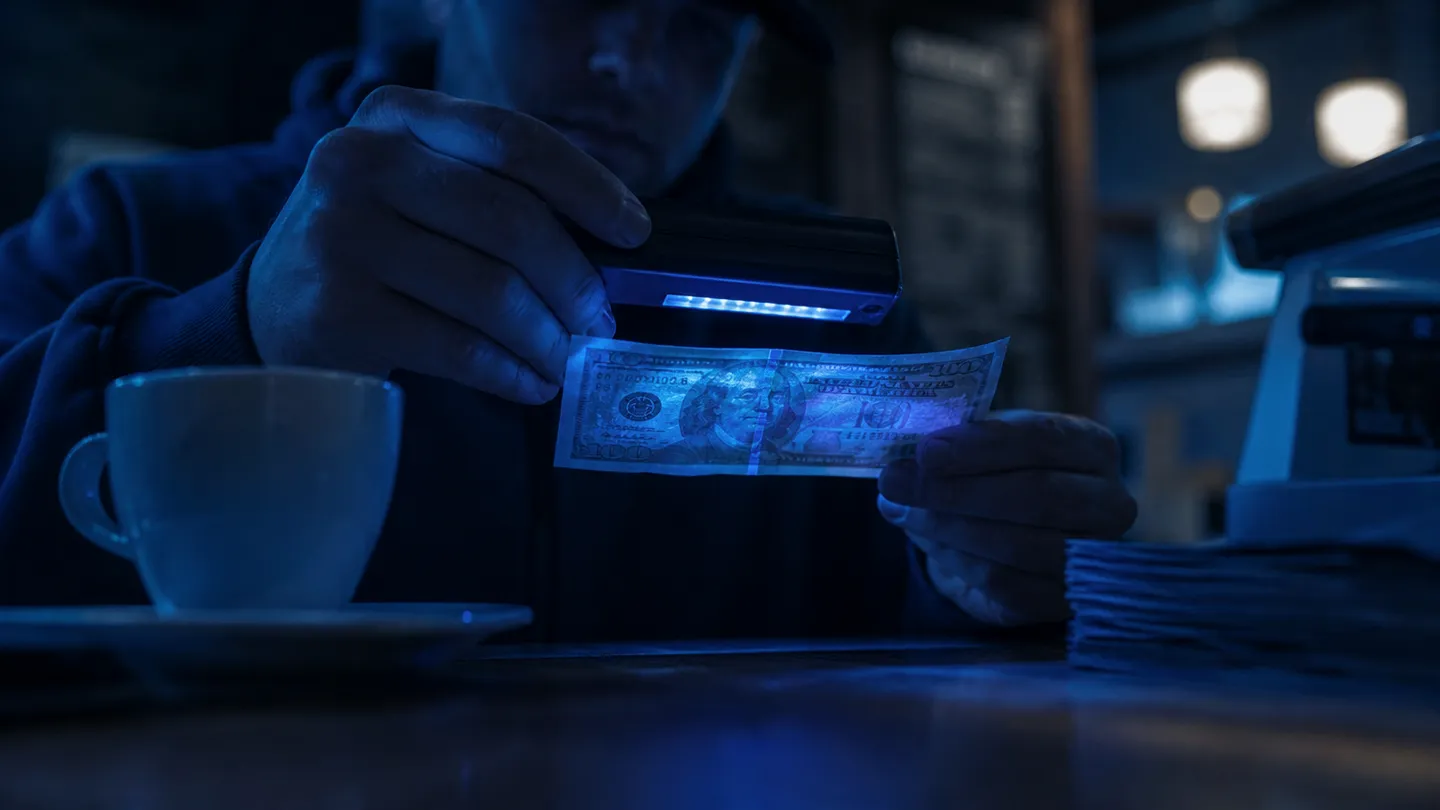
Then, hold the bill to light. A genuine $20 note has a faint watermark of Andrew Jackson located to the right of the printed portrait, which should be visible from both sides when illuminated[2]. Additionally, look for a vertical security thread that reads “USA TWENTY” and glows green under ultraviolet light[2].
Finally, compare your note with a known genuine bill of the same series. This is crucial, as it allows you to observe any discrepancies in colour, texture, and overall appearance. Relying on a single feature can lead to incorrect conclusions, so using multiple indicators is essential.
Here’s a quick checklist to guide your verification process:
- Feel for the raised printing and unique texture.
- Tilt the note to check the colour-shifting numeral "20".
- Hold the bill to light to find the Andrew Jackson watermark.
- Look for the vertical security thread that says “USA TWENTY”.
- Compare with a genuine bill from the same series.
By following these steps, we can more confidently determine the authenticity of a $20 bill, reducing the risk of accepting counterfeit currency. If you suspect that a bill is counterfeit, keep it separate from genuine cash and notify local authorities immediately[4].
Security Features on the Current U.S. $20 Bill
Security Features on the Current U.S. $20 Bill
The current design of the U.S. $20 bill, introduced in 2003, incorporates several distinctive security features that help to prevent counterfeiting. Recognising these features is essential for anyone handling cash, especially if you suspect that a bill may be counterfeit.
One of the most prominent features is the watermark of Andrew Jackson, which is located to the right of the printed portrait. When held up to the light, this watermark should be faintly visible from both sides of the bill, confirming its authenticity[2].
Another critical element is the embedded security thread, which is positioned vertically to the left of Andrew Jackson's portrait. This thread reads “USA TWENTY” and includes a small flag. It is visible when the bill is held up to light and glows green under ultraviolet light, making it an effective tool for verification[2].
Additionally, the colour-shifting ink used for the numeral "20" in the lower-right corner is a reliable indicator of a genuine note. When you tilt the bill, this numeral should shift from copper to green. In contrast, older designs from 1998 to 2003 display a different colour shift, changing from green to black[2].
To help you check these features effectively, here’s a quick checklist:
- Watermark: Look for the faint Andrew Jackson watermark on the right side when held to light.
- Security Thread: Ensure the thread reading “USA TWENTY” is visible from both sides and glows green under UV light.
- Colour-Shifting Ink: Tilt the note to see the numeral "20" change from copper to green.
By familiarising ourselves with these specific security features, we can better protect ourselves from counterfeit bills. Remember, if you suspect a note is counterfeit, keep it separate from genuine cash and inform local authorities immediately[4].
Paper, Raised Printing, Microprinting, and Fine Details
Paper, Raised Printing, Microprinting, and Fine Details
To identify a counterfeit $20 bill, we must closely examine its physical characteristics, particularly the paper, raised printing, microprinting, and fine details. Genuine U.S. $20 Federal Reserve notes are crafted from a unique cotton-linen blend, consisting of 75% cotton and 25% linen. This material is distinctly different from standard office paper, not only in texture but also in durability. Embedded within this paper are red and blue security fibers, which can be seen when held up to the light, further confirming the bill's authenticity[2].
The raised printing on a genuine $20 bill is a hallmark of intaglio printing, which creates a tactile texture that can be felt with a finger. This raised quality is especially noticeable on the portrait of Andrew Jackson and the borders of the bill. It's important to note that while wear and tear can diminish the tactile experience over time, genuine bills will never lose their defining details to the point of becoming indistinct or blurry[2].
Microprinting is another critical feature to inspect. For current-design $20 bills, we should look for the microprinted text “USA20” located along the first three letters of the blue “TWENTY USA” ribbon as well as “THE UNITED STATES OF AMERICA 20 USA 20” beneath the Treasurer's signature. This microprinting should remain clear and legible under magnification; any blurriness may indicate counterfeiting[2].
Here’s a checklist to guide our examination of a $20 bill:
- Feel the Paper: Ensure it has the unique texture of cotton-linen paper, not the smoothness of regular paper.
- Check Raised Printing: Confirm that the portrait and borders feel raised and distinct.
- Inspect Microprinting: Use a magnifying glass to check for clear microprinted text.
By familiarising ourselves with these tactile and print details, we can effectively distinguish genuine $20 bills from counterfeits. If we suspect that a bill is counterfeit, it is vital to keep it separate from genuine cash and report it to local authorities[4].
Counterfeit $20 vs. Real $20: Side-by-Side Checklist
Counterfeit $20 vs. Real $20: Side-by-Side Checklist
To effectively identify a counterfeit $20 bill, we can use a detailed checklist that compares the security features of genuine notes against potential warning signs. This side-by-side examination will help us spot discrepancies that may indicate a counterfeit.
| Feature | Genuine $20 | Warning Sign |
|---|---|---|
| Paper | Made from 75% cotton and 25% linen, with red and blue security fibers embedded[2]. | Feels like regular paper; lacks the distinct texture of cotton-linen. |
| Watermark | Faint Andrew Jackson watermark visible on the right when held to light[2]. | Watermark does not match Andrew Jackson; is absent or unclear when illuminated. |
| Security Thread | Embedded thread runs vertically to the left of the portrait, reads “USA TWENTY” and glows green under UV light[2]. | Thread is printed on the surface; does not glow under UV light or is missing entirely. |
| Colour-Shifting Ink | The numeral "20" in the lower-right corner shifts from copper to green when tilted[2]. | Colour does not shift or changes differently than expected; may appear flat. |
| Microprinting | Clear microprinting includes “USA20” and “THE UNITED STATES OF AMERICA 20 USA 20”[2]. | Microprinting is blurry or illegible under magnification; missing key text. |
| Serial Numbers | Two serial numbers present; they should match and be printed clearly[5]. | Both serial numbers do not match; one or both appear faded or unclear. |
| Quality of Printing | Raised printing can be felt; distinct intaglio texture on the portrait and borders[2]. | Printing feels flat or indistinct; lacks the tactile quality of genuine notes. |
By using this checklist, we can systematically evaluate a $20 bill for its authenticity. If we notice any warning signs, it's essential to keep the suspected counterfeit separate from genuine cash and notify local authorities immediately[4]. Remember, the consequences of passing counterfeit notes can be severe, including fines and imprisonment[6].
The Washed-Bill Trap: When a Real $5 Becomes a Fake $20
The Washed-Bill Trap: When a Real $5 Becomes a Fake $20
Criminals sometimes employ a method known as "washing" to transform genuine lower-denomination bills into counterfeit higher-denomination notes. This process involves removing the denomination from a real $5 bill and replacing it with a $20 image, creating a counterfeit that can appear convincingly authentic at first glance. While the paper and printing may look legitimate, there are critical checks we can perform to identify these fraudulent notes.
To determine if a note is truly a $20 bill, we should focus on two essential security features: the watermark and the security thread. A genuine $20 note displays a faint watermark of Andrew Jackson to the right of the printed portrait when held up to light. This watermark must be visible from both sides of the bill[2]. If we see a Lincoln watermark instead, it indicates that the bill has been altered from a $5 note, revealing its counterfeit nature.
In addition to the watermark, we should inspect the vertical security thread embedded in the note. On a genuine $20 bill, this thread runs alongside the portrait and reads “USA TWENTY” with a small flag. It should glow green under ultraviolet light and be visible from both sides of the bill[2]. If the thread indicates a different denomination or fails to glow under UV light, it suggests that the bill has been tampered with.
Here’s a quick checklist to help identify a washed bill:
- Watermark: Look for the Andrew Jackson watermark on the right side when held up to light.
- Security Thread: Check that the thread reads “USA TWENTY” and glows green under UV light.
By being vigilant and checking these specific features, we can protect ourselves from inadvertently accepting a counterfeit $20 bill that started as a legitimate $5 note. If we suspect a bill is counterfeit, it’s crucial to keep it separate from genuine cash and notify local authorities immediately[4].
Old $20 Bills: Which Security Features Should Be Present?
Older $20 bills can still be legal tender, even if they lack some features found in the current design. It's important to understand that not all security features need to be present on older bills, as they were designed at different times and may vary based on the series year. Instead of relying solely on a checklist for the latest $20 bill, we should verify the bill's series and design to determine its authenticity.
The U.S. $20 Federal Reserve notes have undergone several redesigns over the years. The current design, introduced in 2003, includes notable features such as an embedded security thread and a colour-shifting numeral. However, prior to this, there were large portrait series notes, including those issued from 1998 to 2003, which have some different features. For example, on the 1998–2003 series, the colour-shifting ink changes from green to black, unlike the current design that shifts from copper to green[2].
Older notes, such as those issued between 1990 and 1998, feature a green-glowing thread marked “USA” and “TWENTY” to the left of the Federal Reserve Bank seal, along with microprinting around the portrait frame[7]. Even older notes, issued from 1914 to 1990, will exhibit distinct characteristics, including cotton-linen paper with embedded red and blue fibers, raised printing, and two serial numbers[8].
It's worth noting that some bills may display "Series 1996," as the design from 1998 through 2003 includes this series designation. If you encounter a bill marked as Series 1998, it may be misleading. Bills can be misread, leading to confusion about their authenticity[2].
Here’s a quick reference for identifying features based on their series:
- Current Design (2003): Look for the security thread, colour-shifting ink, and watermark.
- 1998–2003 Series: Check for the green-glowing thread and different colour-shifting ink.
- 1990–1998 Notes: Confirm the presence of the green-glowing thread and microprinting.
- Pre-1990 Notes: Ensure the bill features cotton-linen paper, raised printing, and dual serial numbers.
Understanding these differences allows us to accurately assess the legitimacy of older $20 bills. If we suspect a note is counterfeit, it’s essential to keep it separate from genuine cash and report it to local authorities immediately[4].
Counterfeit-Detection Myths and Unreliable Tests
Many people believe that using a counterfeit detection pen, ultraviolet light, or cash register guarantees the authenticity of a $20 bill. However, these tools only verify specific features and can sometimes lead to erroneous conclusions. For instance, a counterfeit detection pen tests primarily for starch, which means it can produce false results. Coated counterfeits or notes printed on bleached genuine currency paper can easily defeat this method, rendering it unreliable[3].
Similarly, while ultraviolet light can reveal certain features, such as the glowing security thread, it does not account for other critical aspects like the texture of the paper or the presence of microprinting. A genuine $20 note should feel distinct with its raised printing and should exhibit a faint Andrew Jackson watermark when held up to light[1][2]. Therefore, relying solely on a single method can be misleading.
Another common myth is that if a cash register accepts or rejects a bill, it must be genuine or counterfeit, respectively. This is not always the case. Machines can malfunction or be programmed incorrectly, leading to inaccurate assessments. A bill may pass through a register yet still be counterfeit, particularly if it has been altered from a lower denomination[9].
To reduce the risk of accepting counterfeit notes, we recommend performing at least two to three independent checks. For example, we can combine tactile inspection of the raised printing with a visual check for the security thread and watermark. Here’s a brief checklist to guide our verification process:
- Feel the Paper: Ensure it has the texture of cotton-linen, not regular paper.
- Check the Watermark: Look for the faint Andrew Jackson watermark on the right side when held to light.
- Inspect the Security Thread: Verify that it reads “USA TWENTY” and glows green under UV light.
By combining these different methods, we can enhance our ability to accurately identify counterfeit $20 bills. If we suspect a bill is counterfeit, it’s essential to keep it separate from genuine cash and notify local authorities immediately[4].
What to Do If You Receive a Counterfeit $20
If you find yourself in possession of a counterfeit $20 bill, there are several important steps to follow to ensure your safety and comply with legal guidelines. First and foremost, do not attempt to spend or use the counterfeit bill again. This can lead to serious legal consequences, as knowingly passing counterfeit currency is a federal crime punishable by fines and imprisonment[6].
Minimise your handling of the counterfeit note. Place it in a separate envelope or container to avoid mixing it with genuine cash. It's vital to record the circumstances under which you received the bill, including the time, location, and any details about the person who gave it to you or their vehicle. This information can be crucial for law enforcement.
Next, contact your local police department, bank, or the U.S. Secret Service. Each of these authorities can provide guidance on how to proceed. The Federal Reserve recommends notifying local police immediately and keeping the suspect note separate from genuine cash[4].
It's important to understand that banks typically do not reimburse individuals for counterfeit currency. Therefore, the likelihood of recovering your loss is minimal. If you received the bill in a transaction, try to recall any details that could assist law enforcement in identifying the passer.
Legally, simply receiving a counterfeit note without knowledge of its status does not constitute a crime. The law primarily addresses cases of knowingly possessing or attempting to pass counterfeit money with the intent to defraud[6]. This distinction is crucial; it means that if you unknowingly accept a counterfeit bill, you are not liable for the same legal consequences as someone who knowingly circulates counterfeit currency.
By following these steps, we can protect ourselves and assist in the effort to combat counterfeiting. Always remain vigilant when handling cash and utilise the resources available to verify the authenticity of currency. If you want to learn more about identifying counterfeit bills, check out our guide on Fake 20 Dollar Bill: Identifying Counterfeits.
Genuine Feature vs. Warning Sign for $20 Bills
| Feature | Genuine Note | Warning Sign |
|---|---|---|
| Watermark | Faint Andrew Jackson on right | Lincoln watermark or absent |
| Security Thread | Reads 'USA TWENTY', glows green | Different denomination or no glow |
| Colour-Shifting Ink | Copper to green shift (current) | Green to black shift (1998-2003) |
| Microprinting | Clear 'USA20' and 'THE UNITED STATES OF AMERICA' | Blurred or missing microprinting |
| Paper Texture | Cotton-linen with embedded fibres | Regular paper texture |
| Raised Printing | Distinct texture felt by touch | Flat or smooth surface |
Common Mistakes and Misconceptions
Most mistakes are preventable.
Checking features in a random order
A rushed inspection often jumps between details and misses contradictions. We suggest using the Federal Reserve's rapid authentication sequence[1]:
- Feel the paper and raised printing.
- Tilt the note and watch for changing features.
- Check the note with visible or ultraviolet light.
If one result conflicts with another, set the note aside for further examination rather than trusting the easiest test.
Treating familiar paper or a pen result as proof
Washed bills can retain genuine currency paper, so they may feel convincing and produce a reassuring counterfeit-pen result. Pens primarily react to starch and can be defeated by coated counterfeits or notes made from bleached genuine currency[3]. We should check that embedded denomination features agree with the printed $20 design, not merely confirm that the paper appears authentic.
Reading the series year as the printing year
People may assume "Series 1996" means the note was physically printed during that year. The series identifies a design approval or a change involving Treasury officials' signatures, while a following capital letter indicates a significant design change[5]. We should use the series to identify the correct design family, then compare features belonging to that design.
Expecting every genuine $20 to match the current design
A genuine older note may lack features shown on a current-design checklist yet remain legal tender. Notes issued during earlier design periods require checks appropriate to their layouts, rather than automatic rejection for missing a modern feature[7][8]. The redesigned $20 is currently listed for approximately 2030, subject to changes, so the existing design remains the current standard for now[10].
Trying to pass the note after noticing warning signs
Accidentally receiving a counterfeit is different from knowingly passing or possessing it with intent to defraud. Under 18 U.S.C. § 472, that knowing conduct can lead to a fine, imprisonment for up to 20 years, or both[6]. Whether we notice the problem at a Seattle till or later at home, we should separate the note from genuine cash, record details about the passer or vehicle, and notify local police immediately[4]. A suspected counterfeit cannot be exchanged for genuine money[4].
Conclusions
Stay methodical.
- We should begin by setting the suspicious $20 aside, rather than returning it to the till or spending it.
- Check several independent details: paper texture, raised printing, watermark, security thread, and colour-changing ink.
- Match each feature to the note’s design period; an older genuine bill may differ from the current version[7][8].
- Never treat a pen, ultraviolet lamp, or cash register result as decisive, because each tests only part of the note[3].
- If warning signs remain, we should record where the bill came from and contact Seattle police; knowingly passing counterfeit currency can carry serious federal penalties[4][6].
For a broader checking routine across denominations, read Fake US Dollars: How to Spot Them.
Straight answers
Is passing a counterfeit $20 bill a felony?
Yes, if we knowingly pass or attempt to pass it with intent to defraud, the conduct can be prosecuted under 18 U.S.C. § 472[6]. The offence is punishable by a fine, imprisonment for up to 20 years, or both; unknowingly accepting the note is different from deliberately recirculating it[6].
What is the difference between a counterfeit $20 dollar bill and a real one?
A genuine current-design note has security features that agree with its denomination: an Andrew Jackson watermark, a thread reading "USA TWENTY", and colour-shifting ink that changes from copper to green[2]. We should look for agreement rather than one convincing feature, because a counterfeit made from a bleached genuine $5 bill may retain real currency paper but show a Lincoln watermark that conflicts with the printed denomination[9].
Can a counterfeit pen confirm that a $20 bill is real?
No; the pen mainly tests for starch, so coated counterfeits and notes printed on bleached genuine currency paper may produce misleading results[3]. We advise treating it only as a preliminary check, then feeling the raised printing, tilting the note, and examining it with visible or ultraviolet light[1].
Links and references
- 1. Training Course - Security | U.S. Currency Education Program
- 2. $20 Note | U.S. Currency Education Program
- 3. How To Check Your Money Training Presentation
- 4. How do I determine if a banknote is genuine? What should I do if I think I have a counterfeit note? | Federal Reserve Board
- 5. Banknote Identifiers and Symbols | U.S. Currency Education Program
- 6. 18 U.S.C. § 472 — Uttering Counterfeit Obligations or Securities
- 7. $20 Note Issued 1990 to 1998
- 8. $20 Note Issued 1914 to 1990
- 9. United States Secret Service FY 2012 Annual Report
- 10. FAQs | Bureau of Engraving and Printing