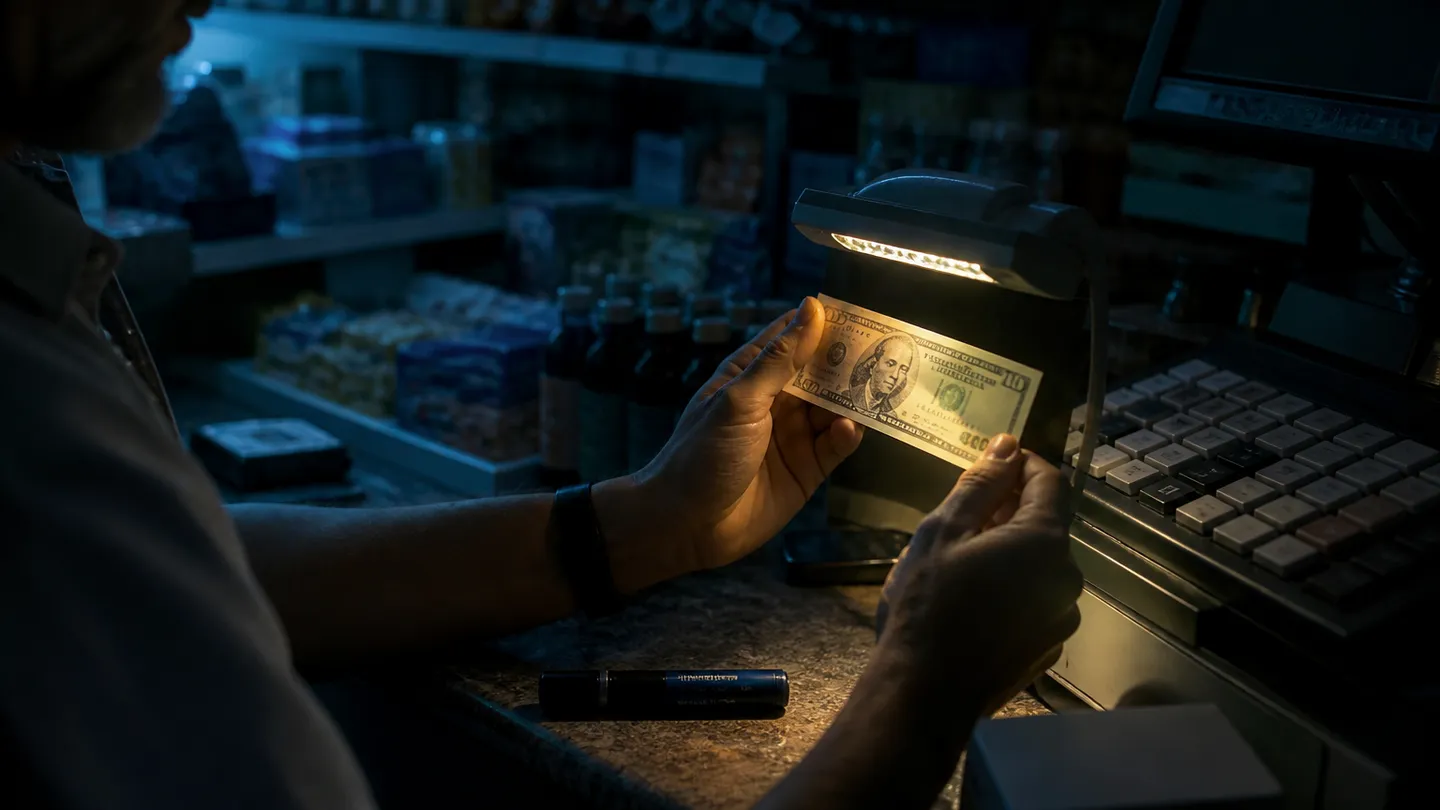
Counterfeit means an unauthorised imitation of money, goods, documents, or other items made or presented to deceive people into believing it is genuine. We advise treating suspected counterfeits as potentially illegal or unsafe: do not use, sell, or pass them on, preserve any evidence, and report the item to the relevant business or authorities.
What Does “Counterfeit” Mean?
Counterfeit refers to an imitation that is presented, marked, or used with the intent to deceive. This term can function as a noun, adjective, or verb, pronounced as /ˈkaʊntəfɪt/. As a noun, it describes the imitation itself, such as counterfeit money or counterfeit goods. As an adjective, it characterises items that are fake, like counterfeit designer handbags. As a verb, it refers to the act of making or using such imitations.
Counterfeiting can take various forms, including currency, identity documents, branded goods, and digital certificates. For instance, counterfeit money is often produced to resemble genuine currency closely enough to be mistaken for it. Identity documents, like passports or driver's licenses, can be forged to enable identity fraud. In the realm of branded goods, counterfeit products might mimic the appearance of well-known brands, undermining trademark protections and intellectual property rights. Digital certificates, which authenticate online identities, can also be counterfeited, posing security risks in online transactions.
Legal definitions of counterfeiting can vary by jurisdiction. For example, the U.S. Secret Service focuses on counterfeit currency, while other agencies may address counterfeit goods or document fraud differently. It's essential to understand these nuances, as the implications for counterfeiting can differ significantly depending on local laws.
When encountering potential counterfeits, we recommend taking caution. Always verify the authenticity of items, especially when purchasing high-value goods or critical documents. In cases of suspected forgery, preserving evidence and reporting to the relevant authorities is crucial to combat counterfeiting effectively. For a more detailed exploration of counterfeit money, see our guide on Counterfeiting Money: An Overview.
Counterfeit vs. Fake, Forgery, Replica, Knockoff, and Prop
Understanding the distinctions between counterfeit items and other similar terms is essential for recognising the legal implications and the intent behind each category. While many people use these terms interchangeably, they hold specific meanings that reflect their differences in intent to deceive, authorisation, trademark use, and legal consequences.
| Term | Intent to Deceive | Authorisation | Trademark Use | Legal Implications |
|---|---|---|---|---|
| Counterfeit | Yes | No | Misuse of registered trademarks | Criminal charges, fines, imprisonment |
| Fake | May or may not | No | Often mimics but does not infringe | Generally less severe, may involve civil suits |
| Forgery | Yes | No | Not applicable | Criminal charges, serious penalties |
| Replica | No | Yes | May use trademarks with permission | Usually legal if properly labelled |
| Knockoff | Yes | No | Imitates branding without permission | Can lead to trademark infringement claims |
| Prop | No | Yes | Not applicable | Typically legal, used for entertainment |
Counterfeiting specifically involves the intent to deceive, meaning counterfeits are created to imitate genuine articles with the aim of tricking someone into believing they are authentic. In contrast, a "fake" may not necessarily have the intent to defraud. For example, a fake watch might simply be a poor imitation without the intention of being sold as a genuine item.
It's important to note that not every fake, replica, or prop is classified as counterfeit. Many replicas are produced with the rightful permission of the trademark owner and are clearly labelled as replicas, which legally protects them from being classified as counterfeit. The common myth that an item becomes lawful merely because it is labelled a "replica" is misleading; the legality depends on the context in which it is used and whether it infringes on trademarks or intellectual property rights.
In the case of props, these are typically used in films or theatre and do not aim to deceive the consumer into believing they are authentic items. Understanding these differences helps in navigating the complex landscape of counterfeiting and related legal issues. Always exercise caution and verify the authenticity of items, especially in high-stakes transactions.
A Brief History of Counterfeiting
Counterfeiting has a long and complex history, spanning from ancient times to the modern digital age. The earliest forms of counterfeiting involved clipped or debased coins, where individuals would shave off precious metal from coins to create more currency than what was genuinely produced. This practice can be traced back to ancient Greece and Rome, where the minting of coins was heavily regulated to prevent such fraud.
The introduction of paper money in China during the Tang Dynasty in the 7th century marked a significant milestone in counterfeiting. As paper currency became more prevalent, the potential for forgery increased. In the 17th century, European nations began to adopt paper money, which led to the development of more sophisticated counterfeiting techniques.
Timeline of Key Events in Counterfeiting
- 600s AD: Introduction of paper money in China during the Tang Dynasty.
- 1661: Sweden issues the first European banknotes, paving the way for widespread use of paper currency.
- 1861: The U.S. introduces paper currency during the Civil War, leading to a surge in counterfeit money production.
- 1929: The U.S. begins issuing modern banknotes with advanced security features to combat counterfeiting.
- 1990s: The rise of industrial-scale counterfeit goods, including luxury items and electronics, emerges as a major global issue.
- 2000s: Digital technology enables the creation of counterfeit documents and currency, leading to new challenges for law enforcement.
As counterfeiting techniques evolved, so did the measures to combat them. The U.S. Secret Service was established in 1865 specifically to combat counterfeiting, and today, various security features such as watermarks, holograms, and colour-shifting inks are integrated into currency to ensure authenticity. The Organisation for Economic Co-operation and Development (OECD) and the European Union Intellectual Property Office (EUIPO) have also been instrumental in addressing counterfeit goods and protecting intellectual property rights.
Understanding the history of counterfeiting helps highlight the ongoing battle between counterfeiters and authorities. As technology advances, new methods of counterfeiting continue to emerge, necessitating continuous innovation in security features and enforcement strategies. For more insights into counterfeit money specifically, see our guide on Counterfeiting Money: An Overview.
The Main Types of Counterfeiting Today
Counterfeiting manifests in various forms, each with distinct characteristics and implications. Understanding these types helps us recognise the breadth of counterfeiting and its impact on society.
Counterfeit Money and Securities
Counterfeit money is perhaps the most well-known type of counterfeiting, with counterfeiters attempting to replicate currency closely enough to deceive individuals and businesses. The U.S. Secret Service, established in 1865, primarily focuses on combating this crime. An example includes counterfeit U.S. dollar bills that may appear authentic but lack the necessary security features such as watermarks and colour-shifting ink. Counterfeit securities, like fake stock certificates, also fall under this category, posing risks to investors and the economy.
Forged or Altered Documents
Document fraud involves the forgery or alteration of official documents, such as passports, driver's licenses, and identity cards. A notable example is the production of fake passports, which can facilitate identity theft or illegal activities. Forged documents are created with the intent to deceive authorities and individuals, leading to severe legal consequences if discovered. It’s crucial to verify the authenticity of documents, especially in high-stakes situations.
Trademarked Consumer Goods
Counterfeit goods often include trademarked items such as designer handbags, watches, and electronics. These products are designed to mimic the appearance of genuine brands, undermining intellectual property rights. For instance, a counterfeit Louis Vuitton handbag may look similar to the original but is made from inferior materials and lacks the craftsmanship associated with the brand. Purchasing such goods not only supports illegal activities but can also lead to financial loss for consumers.
Medicines and Safety-Critical Products
Counterfeiting extends into the pharmaceutical industry, where fake medicines can pose serious health risks. An example includes counterfeit medications that may contain harmful substances or incorrect dosages. The World Health Organization has highlighted that counterfeit drugs account for a significant percentage of medicines in some regions, endangering public health. Always ensure medications are purchased from reputable sources to avoid these risks.
Digital Counterfeits
In the digital realm, counterfeiting takes the form of forged digital certificates and counterfeit software. These items can lead to security breaches, identity theft, and financial fraud. For example, counterfeit software might be sold at a lower price but may contain malware that compromises users' personal information. Protecting against digital counterfeits requires vigilance and the use of trusted platforms.
Understanding the differences between counterfeiting and related offenses is essential. While piracy often refers to the unauthorized reproduction of copyrighted materials, fraud encompasses a broader range of deceptive practices that may not involve imitation. Document alteration specifically targets the modification of existing documents rather than creating entirely new forgeries. Recognising these distinctions can aid in effectively addressing and combating counterfeiting.
By being informed about these various types of counterfeiting, we can better protect ourselves and our communities from the associated risks.
When Is Counterfeiting a Crime?
Counterfeiting becomes a crime when individuals engage in specific actions with fraudulent intent. This includes making, possessing, importing, distributing, or knowingly passing counterfeit items. In the United States, laws such as 18 U.S.C. §§ 471–473 outline various forms of counterfeiting, particularly concerning currency and securities. The Trademark Counterfeiting Act further addresses the illegal reproduction of trademarked goods, reinforcing the protection of intellectual property.
To be charged with counterfeiting, there typically must be proof of intent to deceive. For instance, if someone creates counterfeit money intending to use it as if it were real, they are committing a crime. Similarly, possessing counterfeit goods with knowledge of their fraudulent nature can lead to legal consequences. It’s essential to understand that proof requirements and penalties can vary significantly by country. In some jurisdictions, the mere possession of counterfeit items may constitute a crime, while in others, intent must be clearly established.
In 2022, the U.S. Sentencing Commission reported that the average sentence for counterfeit-related offenses was approximately 12 months, highlighting the seriousness with which these crimes are treated. Penalties can escalate depending on the scale of the counterfeiting operation and the specific laws violated. For example, large-scale counterfeit operations may attract harsher penalties, including substantial fines and longer prison sentences.
Common Legal Elements of Counterfeiting
When examining the legal framework surrounding counterfeiting, several key elements are consistently present:
- Making: The creation of counterfeit items, such as forging currency or documents.
- Possessing: Having counterfeit items in possession, especially with knowledge of their fraudulent nature.
- Importing: Bringing counterfeit goods into a country, which can violate both local and international laws.
- Distributing: Selling or distributing counterfeit items, which can lead to significant legal repercussions.
- Knowingly Passing: Using counterfeit items with the intent to deceive, such as attempting to spend fake money at a store.
Awareness of these elements can help individuals understand the risks involved in counterfeiting. Engaging in any of these activities, even unknowingly, can result in severe legal repercussions. We recommend being vigilant and educated about the authenticity of items, especially in transactions involving money or significant purchases. For a deeper understanding of counterfeit money, see our guide on Counterfeiting Money: An Overview.
Why Counterfeiting Matters
Counterfeiting has significant implications that extend beyond mere financial loss. It affects consumer safety, impacts businesses and tax revenues, facilitates identity fraud, and diminishes trust in payment systems and official documents. Understanding these aspects is crucial for recognising the broader consequences of counterfeiting.
Financial losses due to counterfeiting are staggering. The Organisation for Economic Co-operation and Development (OECD) and the European Union Intellectual Property Office (EUIPO) estimated that counterfeit and pirated goods accounted for nearly USD 509 billion in international trade in 2016. This figure only scratches the surface, as it does not include all domestic and online activity, meaning the actual losses could be much higher. The financial ramifications are felt not only by businesses but also by government tax revenues, as counterfeit goods often evade taxation, leading to a reduction in public funding.
Consumer safety is another critical concern. Counterfeit goods, especially in sectors like pharmaceuticals and electronics, can pose severe health risks or lead to product malfunctions. For instance, counterfeit medicines may contain harmful substances or incorrect dosages, endangering lives. The prevalence of counterfeit products can diminish consumer trust in legitimate brands and the systems that support them, such as payment methods and identification documents.
Identity fraud is an additional risk associated with counterfeiting. Forged documents, such as passports or driver's licenses, can facilitate illegal activities and identity theft. This not only harms individuals but also places a burden on law enforcement and legal systems as they struggle to combat these crimes.
Finally, the erosion of trust in payment systems and document authenticity can have far-reaching effects on the economy. Consumers may become wary of transactions, leading to decreased spending and economic stagnation. We must remain vigilant and informed to mitigate these risks, ensuring we verify the authenticity of items and documents we encounter. For insights into counterfeit money specifically, please see our guide on Counterfeiting Money: An Overview.
How Counterfeits Are Detected and Authenticated
Detecting and authenticating counterfeits involves several high-level methods. Security features are one of the primary tools used to differentiate genuine items from counterfeit ones. These features may include watermarks, holograms, and unique inks that change colour under certain conditions. Serial-number checks are also common; by verifying the unique number against official databases, we can confirm the legitimacy of a product. Material analysis looks into the composition of the item, identifying whether the materials used match those of authentic products. Packaging verification examines the quality and details of packaging, as counterfeit goods often skimp on these aspects. Finally, examination by authorised institutions, such as the U.S. Secret Service for currency, provides an additional layer of assurance.
When assessing authenticity, it’s essential to understand the difference between reliable evidence and weak signals. The following table outlines some common indicators:
| Indicator | Reliable Evidence | Weak Signals |
|---|---|---|
| Security Features | Presence of genuine holograms, watermarks | Inconsistent or missing features |
| Serial Number Checks | Matches official records | Discrepancies or lack of records |
| Material Analysis | Matches known authentic materials | Inferior or different materials |
| Packaging Verification | High-quality, consistent branding | Poor quality or generic packaging |
| Examination by Authorities | Certification by recognised bodies | Claims without formal verification |
Relying solely on price or appearance is insufficient to prove authenticity. Counterfeiters often price their goods attractively to lure consumers, and many counterfeit items can closely mimic genuine ones. Therefore, we should always conduct thorough checks, especially for high-value items. Engaging with authorised institutions for authentication is advisable, particularly when dealing with significant purchases or legal documents. By being diligent and informed, we can better navigate the risks of counterfeiting and protect ourselves from fraud.
What to Do If You Suspect Something Is Counterfeit
If you suspect that an item you've encountered is counterfeit, it's crucial to act carefully and responsibly. Here’s a checklist of actions we recommend:
Currency and Financial Transactions
- Do not knowingly spend suspected currency: If you believe you have counterfeit money, do not attempt to use it. This could lead to legal repercussions.
- Preserve any receipts or packaging: Keeping documentation can be vital for reporting and resolving issues related to counterfeit goods.
Identity Documents and Safety-Critical Products
- Avoid using questionable identity documents: Counterfeit identification can lead to serious legal consequences, including identity fraud charges.
- Do not use safety-critical products: Items like medications or electronics that you suspect are counterfeit can pose significant health risks or safety hazards.
Reporting and Contacting Authorities
- Contact the appropriate authority: If you suspect counterfeit currency, reach out to your bank or the U.S. Secret Service, which investigates counterfeit money cases. For counterfeit goods, consider contacting the brand owner or local law enforcement.
- Report to your local marketplace: If you purchased a suspicious item online, report it to the marketplace to prevent others from falling victim to the same counterfeit.
Handling Prop Money
- Keep prop money clearly marked: If you are using prop money for films or theatre, ensure it is clearly labelled as fake. Passing prop money as genuine is illegal and could lead to serious consequences.
Additional Reporting Options
For suspected counterfeit goods or currency, we can report to various authorities. In the U.S., the U.S. Secret Service is a key agency for currency-related issues. Internationally, similar bodies exist in various countries, often through customs or consumer protection agencies.
Staying informed and vigilant can help us protect ourselves and others from the risks associated with counterfeiting. By following these guidelines, we can ensure that we do not inadvertently contribute to the problem.
Counterfeit Comparison Matrix and Response Checklist
| Type | Authorization | Deceptive Intent | Branding | Legal Treatment |
|---|---|---|---|---|
| Counterfeit | None | Yes | Imitates brand | Serious penalties, varies by jurisdiction |
| Fake | None | Yes | Imitates brand | Legal consequences depend on intent |
| Forgery | None | Yes | Imitates official documents | Severe penalties, often criminal |
| Replica | May be authorised | No | Similar but not identical | Generally legal if not misleading |
| Knockoff | None | Yes | Similar branding | Legal consequences vary, often civil |
| Prop Money | Clearly marked | No | Not intended for sale | Legal if used correctly, must be marked |
Common Mistakes and Misconceptions
Several shortcuts cause confusion.
Treating "counterfeit", "fake", and "replica" as interchangeable
These labels are not synonyms. "Fake" is a broad everyday term, while counterfeits imitate protected money, branding, or products deceptively; forgery usually concerns altered or fabricated documents, signatures, or records. A replica or knockoff may resemble an original without claiming authenticity, and legally produced prop items remain distinct when their design, marking, sale, and use comply with applicable rules.
Assuming a low price proves something is counterfeit
Price alone proves little. Sellers may discount genuine goods, while counterfeiters can charge full market prices to appear credible, leaving buyers with financial loss and limited recourse. Before purchasing, we suggest checking the seller, provenance, payment protections, product details, and return terms together rather than treating price as a verdict.
Trusting appearance as final proof
A convincing appearance does not establish authenticity. Counterfeits may copy packaging, logos, colours, serial-number formats, and visible security features, while genuine items can look unusual because of wear, regional packaging, or production changes. We should compare several independent features and seek assessment from the issuer, brand owner, authorised seller, or another appropriate institution when uncertainty remains.
Believing a counterfeit-detection pen settles the question
A detection pen provides only a limited screening result. It tests a material characteristic and cannot confirm every security feature, establish a note's denomination, or replace examination of the complete item. We advise treating the result as one signal and following the receiving bank's or relevant currency authority's process instead of declaring the note genuine or counterfeit ourselves.
Using the same response for every suspicious item
The safest response depends on the category. Suspected currency, identity documents, medicines, branded goods, and prop money involve different risks and reporting routes, so sending everything to a marketplace or confronting the seller may mishandle evidence or create unnecessary danger. Before acting in Seattle or elsewhere in the USA, use this category check:
- Currency: stop the transaction and follow the receiving financial institution's procedure.
- Identity documents: avoid copying, sharing, or using them; contact the issuing authority or local law enforcement where appropriate.
- Medicines or safety-sensitive goods: stop using them and consult the relevant seller, manufacturer, regulator, or healthcare professional.
- Consumer goods: retain the listing, receipt, messages, packaging, and payment record before contacting the marketplace or brand owner.
- Prop items: keep them separated from genuine currency or documents and retain evidence of their legitimate production purpose.
Repeating scale estimates without context
A large estimate is not self-explanatory. Figures may cover international trade, selected product categories, reported seizures, or modelled losses, and presenting them without their year, geography, scope, and method can make unlike measures appear comparable. Before relying on any scale claim, we should confirm four points: when it was produced, what it measured, which locations and categories it covered, and what it excluded.
Conclusions
The essentials are simple.
- Pause before acting: we should set aside any questionable item and avoid spending, using, selling, or altering it.
- Identify the category: currency, documents, branded goods, medicines, and props require different checks and reporting channels.
- Build an evidence trail: save receipts, seller messages, photographs, payment records, and packaging without confronting the seller.
- Seek qualified confirmation: appearance, price, and detection tools are clues, not final decisions about authenticity or legality.
- Choose the proper recipient: depending on the item, this may be a bank, issuer, marketplace, manufacturer, regulator, or police department.
For the next step, learn the practical warning signs in Fake US Dollars: How to Spot Them.
Straight answers
What does the term counterfeit mean?
"Counterfeit" describes an unauthorised imitation made or presented to be mistaken for something genuine, such as currency, branded goods, or documents. We can use the word as an adjective, a noun for the imitation itself, or a verb meaning to produce that imitation.
Is counterfeit the same as fake?
Not exactly: "fake" is a broad everyday label for anything inauthentic, while "counterfeit" usually implies copying something genuine to deceive others. A fictional film document may be fake without being counterfeit if it is clearly marked and cannot reasonably pass as authentic.
What are the synonyms of counterfeit?
Possible alternatives include "fake", "bogus", "fraudulent", "imitation", and "spurious", but their meanings depend on context. We would use "forged" for fabricated or altered documents and signatures, while "replica" does not necessarily imply deception.
What is a counterfeit crime?
A counterfeit crime generally involves knowingly making, possessing, distributing, selling, or using an imitation with deceptive intent. Accidentally receiving a suspicious banknote or product is different from deliberately passing or marketing it as genuine, although the precise offence depends on the item and applicable law.
Can counterfeit products be dangerous?
Yes, particularly when counterfeit medicines, cosmetics, batteries, electrical parts, or vehicle components contain unknown materials or fail expected safety controls. We advise stopping use, retaining the packaging and purchase record, and contacting the manufacturer, marketplace, or relevant US regulator rather than testing a suspect item ourselves.