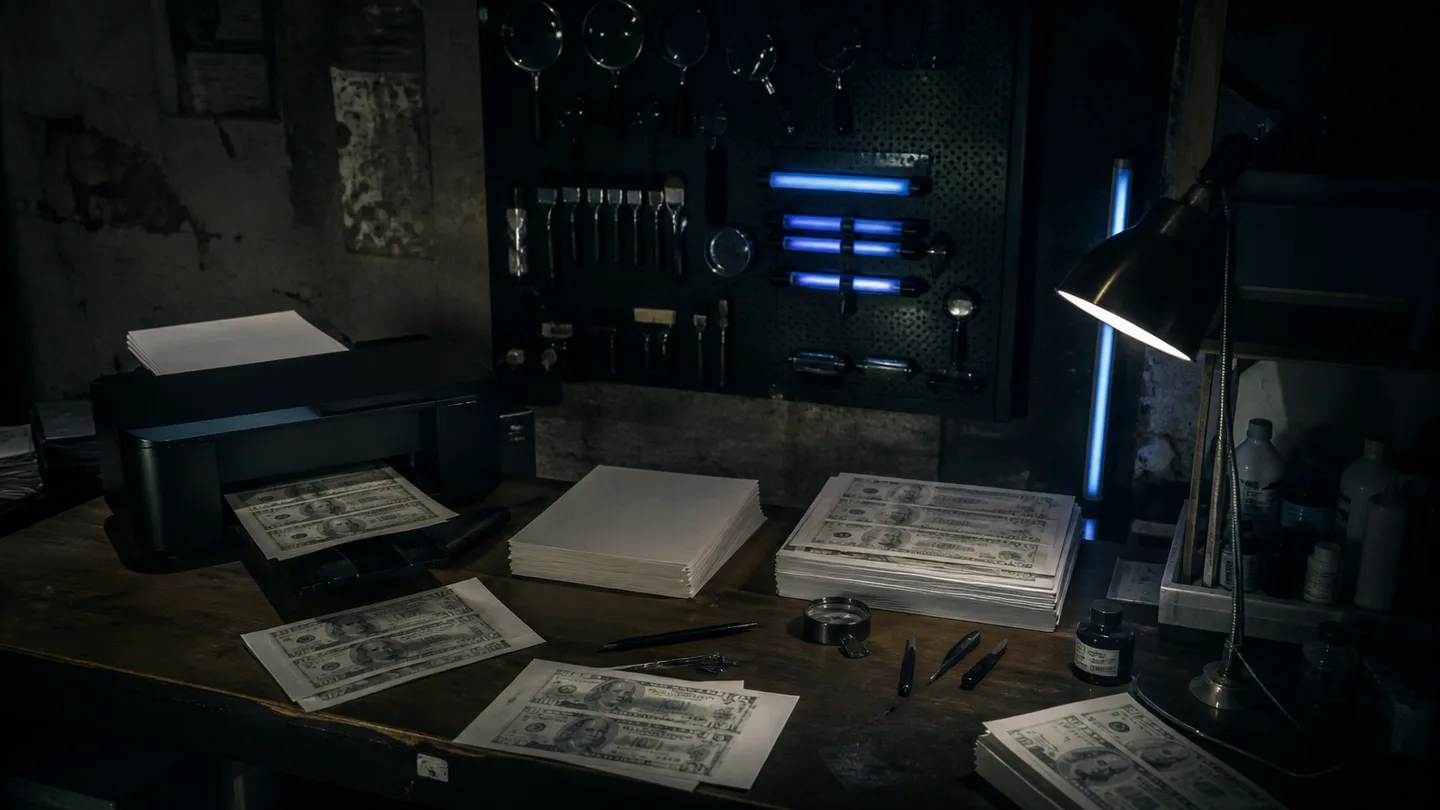
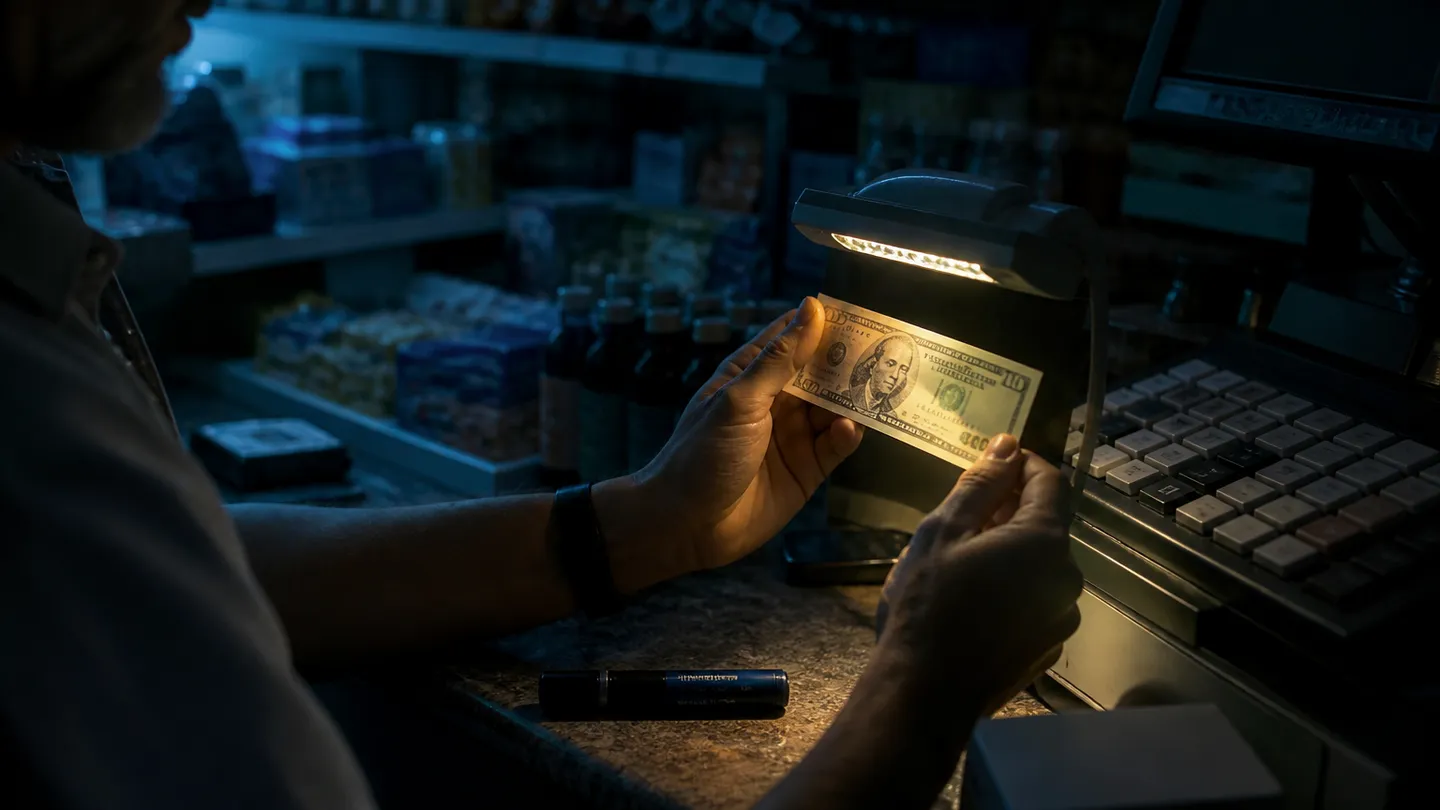
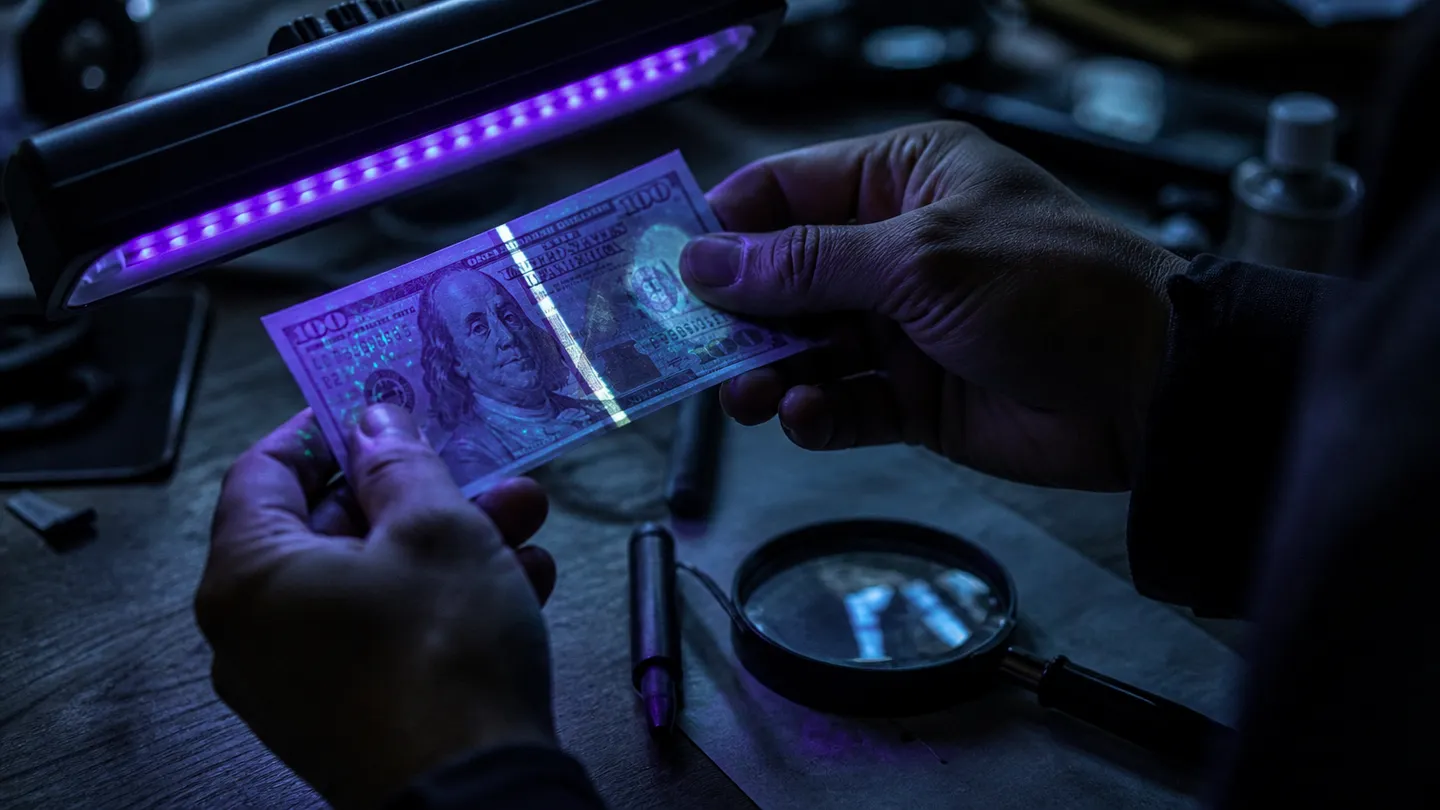
A counterfeit dollar is a fake or altered U.S. banknote intended to deceive.[1] Check several built-in features—not only a detection pen—including paper texture, raised printing, the watermark, and security thread; if the note remains suspicious, separate it from genuine cash, do not pass it on, record relevant details, and notify local police promptly.[2][3][4]
What Is a Counterfeit Dollar?
Counterfeit US currency refers to fake or altered banknotes that are designed to deceive individuals and businesses into accepting them as genuine. Unlike altered genuine notes, which are original bills modified to appear different, counterfeit dollars are entirely fabricated. Novelty bills and legally produced prop money are distinct categories as well; novelty bills often display phrases like “For Motion Picture Use Only,” while prop money is created for film and theatre, adhering to specific legal guidelines regarding its appearance and use.
Counterfeit bills present a significant risk, leading to direct financial losses for both individuals and businesses. When a counterfeit note is accepted, the recipient cannot exchange it for genuine currency, meaning they bear the loss entirely. According to a Federal Reserve study, the estimated amount of counterfeit currency in circulation ranges from $15 million to $30 million, translating to about one counterfeit note for every 40,000 to 80,000 genuine notes in circulation[5]. This small percentage may seem insignificant, but it highlights the potential for unsuspecting individuals to encounter fake money.
The US Secret Service is the federal agency tasked with investigating counterfeiting. This agency plays a crucial role in protecting the integrity of US currency and ensuring that counterfeiters are held accountable. Engaging in counterfeiting is a serious crime that can result in severe penalties, including fines and imprisonment for up to 20 years for those knowingly passing counterfeit notes[1][2]. Understanding what constitutes counterfeit currency is essential for anyone handling cash, as it equips them to identify and respond appropriately to potential threats.
How to Tell a Real Dollar From a Counterfeit
Identifying a genuine dollar bill involves several key checks that focus on its look, feel, and specific security features. To effectively authenticate a note, we recommend a systematic approach using the following criteria: paper texture, print quality, portrait details, colour-shifting ink, watermarks, security threads, and microprinting. It's essential to remember that these features can vary by denomination, design series, and issue year. Therefore, always compare a suspect note with a known genuine bill of the same denomination and series.
Key Features to Check
Paper Texture: Genuine Federal Reserve note paper is made from a blend of 75 percent cotton and 25 percent linen, giving it a slightly rough texture compared to ordinary paper[3].
Print Quality: Authentic bills have sharp, clear printing. Check for any blurriness or smudging, which can indicate a counterfeit.
Portrait Details: The portraits on genuine bills are intricately detailed. Look closely at the face and hair to ensure clarity and precision.
Colour-Shifting Ink: On certain denominations, like the $100 note, the lower right corner changes colour from green to black when tilted[3].
Watermarks: Genuine notes feature a watermark that can be seen from both sides. For example, the Franklin watermark is present on the $100 bill[3].
Security Threads: Embedded security threads are visible when held up to the light. The thread on the $100 bill reads "USA 100" and glows pink under ultraviolet light[3].
Microprinting: This involves tiny text that is usually difficult to replicate. Check areas around the portrait for this feature.
Denomination Comparison Table
Here’s a quick reference for the key security features by denomination:
| Denomination | Key Features to Check |
|---|---|
| $1 | No special features; check for correct paper texture and print quality. |
| $5 | Security thread visible when held up to light; blue and red fibers throughout. |
| $10 | Portrait details are sharp; security thread reads "USA 10". |
| $20 | Security thread visible; microprinting in the border areas. |
| $50 | Security thread is embedded; check for colour-shifting ink in the lower right corner. |
| $100 | 3-D Security Ribbon; Franklin watermark; embedded security thread[3][6]. |
Using these methods, we can significantly reduce the chance of accepting counterfeit currency. Always remember that if a note appears suspicious after these checks, do not pass it on. Instead, separate it from genuine currency, record relevant details, and notify local authorities promptly[4].
Fake $100 Bill vs. Real $100 Bill
Understanding the differences between a genuine $100 bill and a counterfeit is essential for anyone handling cash. The current-design $100 note, which entered circulation on October 8, 2013, features several advanced security elements designed to deter counterfeiting. Some of the most notable features include the blue 3-D Security Ribbon, the Bell in the Inkwell, a colour-shifting numeral, a watermark, and an embedded security thread.
The blue 3-D Security Ribbon is woven into the paper, and when tilted, the bells and 100s appear to move, creating a dynamic visual effect. The security thread is embedded in the note and reads "USA 100," glowing pink under ultraviolet light. Additionally, the Franklin watermark is visible from both sides of the bill, providing another layer of verification[3]. These features make the current $100 bill distinctly different from older versions, which may lack the blue ribbon but still remain legal tender.
For those checking older genuine $100 designs, it is important to know what to look for. Bills issued between 1996 and 2013 include a raised printing texture, a lower-right numeral that shifts from green to black, a Franklin watermark, and an embedded security thread. They also feature red and blue fibres and clear microprinting[6]. This means that while a lack of a blue ribbon may lead some to assume a bill is counterfeit, it may simply be an older, yet still valid, note.
We should also be aware of altered lower-denomination notes that might retain genuine paper but display incorrect watermarks or security threads. For example, a $5 bill could be altered to resemble a $100 bill by changing its appearance, yet still maintain the original paper quality. Such alterations can be deceptive and require careful inspection to identify.
By familiarising ourselves with these security features and knowing how to differentiate between genuine and counterfeit bills, we can significantly reduce the risk of accepting fake currency. Always remember to verify multiple features before making any assumptions about a bill's authenticity. If a note seems suspicious, do not pass it on; instead, separate it from genuine currency and notify local authorities immediately[4].
What to Do If You Receive a Suspected Counterfeit Bill
If you suspect that a bill you have received is counterfeit, it is crucial to act carefully and responsibly. First and foremost, do not attempt to spend or return the note. Handling a suspected counterfeit can lead to legal issues, especially if it is determined that you knowingly passed it on[1][2].
To ensure your safety and the integrity of the situation, follow these steps:
Minimise Handling: Limit your contact with the suspected counterfeit note. Place it in an envelope or a separate location to avoid mixing it with genuine currency.
Keep It Separate: Store the note away from your other cash. This reduces the risk of inadvertently passing it on to someone else.
Record Relevant Details: Take note of any important information, such as the description of the person who gave you the bill and any vehicle details if applicable. This information could be useful for law enforcement.
Contact Local Authorities: Notify your local police department about the suspected counterfeit. The Federal Reserve also advises reporting it promptly to law enforcement[4]. Avoid confronting or detaining the person who gave you the bill, as this could pose a risk to your safety.
Follow Reporting Guidance: Should you require more detailed guidance, consider the current reporting procedures from the US Secret Service, which may involve contacting a local field office or using specific forms for suspected counterfeit cases[7].
It is essential to understand that banks and Federal Reserve Banks do not credit counterfeit currency as valid money. This means that if you accept a counterfeit bill, you are likely to bear the financial loss without reimbursement[4]. By adhering to these safety measures, we can protect ourselves and assist in combating the circulation of counterfeit currency.
What Happens If You Accidentally Use Counterfeit Money?
Accidentally using counterfeit money can lead to serious consequences, but the legal implications depend on whether the individual knowingly passed the fake bill or did so without intent to defraud. Under federal law, 18 U.S.C. § 472 specifies that knowingly passing or possessing counterfeit currency can result in severe penalties, including fines and imprisonment for up to 20 years[2]. In contrast, if someone unknowingly uses a counterfeit bill, they may not meet the intent requirement necessary for prosecution under this statute[2].
If you discover that you have used a counterfeit bill, it is essential to act swiftly. Imagine this scenario: you visit a local shop in Seattle, and the cashier informs you that a $20 bill you just handed over appears to be fake. In this situation, it is crucial to cooperate with the merchant. Attempting to spend the bill elsewhere could be viewed as knowingly passing counterfeit currency, which could lead to legal trouble[1]. Instead, follow these steps:
- Remain Calm: Acknowledge the cashier's concern without becoming defensive.
- Separate the Bill: Keep the counterfeit bill separate from your other cash to avoid further complications.
- Provide Information: Be prepared to give details about where you received the bill, as this information may aid in the investigation.
- Notify Authorities: The shopkeeper might contact local law enforcement to report the counterfeit, which is the right course of action. You should also consider doing so yourself to ensure you are protected.
It is important to remember that counterfeit notes cannot be exchanged or redeemed for genuine currency. If you receive a suspected counterfeit bill, the Federal Reserve advises notifying local police immediately and following their guidance[4]. By cooperating with the merchant and law enforcement, we can navigate this situation responsibly and help mitigate the risks associated with counterfeit currency.
The Financial and Legal Risks of Counterfeit Currency
Accepting counterfeit currency can lead to significant financial and legal consequences. When a counterfeit note is discovered, the individual or business that accepted it typically incurs a loss equal to the bill's face value. This is crucial to understand, as banks and Federal Reserve Banks do not reimburse businesses for counterfeit notes they inadvertently receive[4]. For example, if a cashier unknowingly accepts a counterfeit $100 bill, that amount is lost, impacting the business's cash flow.
In addition to financial losses, there are legal implications. Federal law treats knowingly passing counterfeit currency as a serious crime, punishable by fines and imprisonment for up to 20 years[1]. If a person unknowingly accepts or uses counterfeit money, they may not face the same legal penalties, as intent to defraud is a critical element of the offense[2]. However, the situation can be complicated. For instance, if someone tries to spend a counterfeit bill after being informed of its status, they could be charged with knowingly passing counterfeit currency.
Businesses may also face chargebacks or cash shortages as a result of accepting counterfeit currency. If customers pay with counterfeit notes, merchants may find themselves short on cash, leading to complications in daily operations. Additionally, the reputational damage can be considerable. Customers may lose trust in a business that has been associated with counterfeit currency, potentially affecting sales and customer loyalty.
Investigative consequences can arise as well. If a business is found to have accepted counterfeit notes, it may attract the attention of law enforcement. This could lead to investigations that disrupt operations and divert resources away from core business activities. It is essential to handle suspected counterfeit currency with care and notify local authorities to mitigate these risks. Following the Federal Reserve's guidance can help ensure proper procedures are followed when encountering counterfeit bills[4].
Counterfeit-Detection Myths and Unreliable Tests
Counterfeit detection is often clouded by myths and misconceptions. One common belief is that a counterfeit-detection pen can definitively prove a bill is real. However, the Federal Reserve warns that these pens are not always accurate and can yield false results[4]. They may fail to identify bleached or chemically altered notes, which can easily slip through this basic test. This highlights the importance of using multiple verification methods rather than relying on a single tool.
Another misconception is that all genuine $100 bills have a blue 3-D Security Ribbon. While the current-design $100 note, which entered circulation on October 8, 2013, does feature this ribbon, older designs do not[6]. Bills issued before this date remain legal tender, and their authenticity must be verified through other security features. For instance, a note from 1996 to 2013 can be authenticated by checking for raised printing, a colour-shifting numeral, and a Franklin watermark, among other features[6].
Additionally, some might assume that if a bill feels like genuine paper, it must be a legitimate note. Genuine Federal Reserve note paper is a blend of 75 percent cotton and 25 percent linen, giving it a unique texture[3]. However, counterfeiters have become adept at mimicking this texture, so relying solely on the feel of the paper is insufficient.
To effectively authenticate a bill, we recommend checking multiple security features. For example, verify the watermark, security thread, and colour-shifting ink. Using an official reference for the denomination and series can also help ensure accuracy. The Cash Assist app, while useful for identifying a bill's denomination, does not identify counterfeits, so we should not rely solely on it[8].
When handling currency, it is vital to remain vigilant and informed about the various security features and limitations of common detection methods. By doing so, we can better protect ourselves and our businesses from the risks posed by counterfeit currency.
Official Tools for Checking and Reporting US Currency
Official Tools for Checking and Reporting US Currency
To effectively check and report counterfeit US currency, we recommend utilising the resources provided by the US Currency Education Program. This programme offers denomination-specific visual guides that detail the security features found on genuine bills. These guides can help us identify characteristics such as the security thread, watermark, and colour-shifting ink that differentiate real currency from counterfeit notes. Additionally, the US Secret Service and local law enforcement agencies are the appropriate channels for reporting suspected counterfeit currency. If we encounter a counterfeit bill, it is crucial to notify local police immediately and provide as much detail as possible about the individual who passed the note[4].
Banks are also equipped to inspect notes, but this typically occurs when a customer brings in a suspicious bill. It is important to understand that banks do not reimburse individuals for counterfeit currency, meaning the financial loss falls on the person or business that accepted it[4]. While authentication equipment can be a helpful tool in our efforts to identify counterfeit bills, it should not replace comprehensive training for cash-handling staff. We should always verify multiple security features before making a determination about a bill's authenticity, as reliance on a single method can lead to errors[4].
To assist in this process, we have compiled a compact checklist for both consumers and cash-handling businesses:
Printable Checklist for Identifying Counterfeit Currency
For Consumers:
- Check for the watermark by holding the bill up to the light.
- Inspect the security thread; it should be embedded in the paper.
- Look for colour-shifting ink on the numerals.
- Feel for raised printing; genuine notes have a slightly rough texture.
For Cash-Handling Businesses:
- Train staff to recognise and verify multiple security features.
- Use authentication equipment as a supplementary tool, not a replacement for training.
- Establish a protocol for reporting suspected counterfeit notes to local authorities.
- Regularly review and update security feature information from the US Currency Education Program.
By using these tools and resources, we can better safeguard ourselves and our businesses against the risks associated with counterfeit currency.
Dollar Denomination and Series Verification Table
| Denomination | Series | Security Features | Older Design Exception |
|---|---|---|---|
| $1 | 2017 | Security thread, watermark | N/A |
| $5 | 2013 | Security thread, watermark, colour-shifting ink | N/A |
| $10 | 2014 | Security thread, watermark, colour-shifting ink | N/A |
| $20 | 2013 | Security thread, watermark, colour-shifting ink | N/A |
| $50 | 2014 | Security thread, watermark, colour-shifting ink | N/A |
| $100 | 2013 | 3-D Security Ribbon, security thread, watermark | Older designs lack blue ribbon |
Common Mistakes and Misconceptions
These errors are preventable.
Applying the newest design checklist to every bill
People often compare every note with the latest design, which can cause genuine older currency to be rejected. Security features vary by denomination and design series, while older Federal Reserve note designs remain legal tender[6]. We advise identifying the denomination and approximate design first, then using the matching official feature guide.
Treating one matching feature as sufficient proof
Finding a watermark, security thread, or familiar paper texture does not complete the check, particularly when a genuine note may have been altered. We should confirm that visible features correspond to the printed denomination rather than merely confirming that they exist. Counterfeit-detection pens can also return false results, so decisions should rest on several built-in features[4].
Assuming obvious replica wording is the only warning sign
Cashiers may look only for phrases such as "For Motion Picture Use Only" or "Replica" because these fakes are easy to recognise. Less obvious suspicious notes require the same denomination-specific inspection of their watermark, security thread, printing, and other applicable features[9]. We advise checking the note itself rather than judging authenticity solely from conspicuous wording or its absence.
Accusing the person who presents a suspicious note
A rejected bill does not establish that the customer knew it was counterfeit or intended to deceive the business. Federal law distinguishes accidental use from knowingly passing or possessing counterfeit currency with intent to defraud[2]. We should keep the interaction calm, avoid accusations, and allow law enforcement to investigate intent.
Using the same response for consumers and cash-handling staff
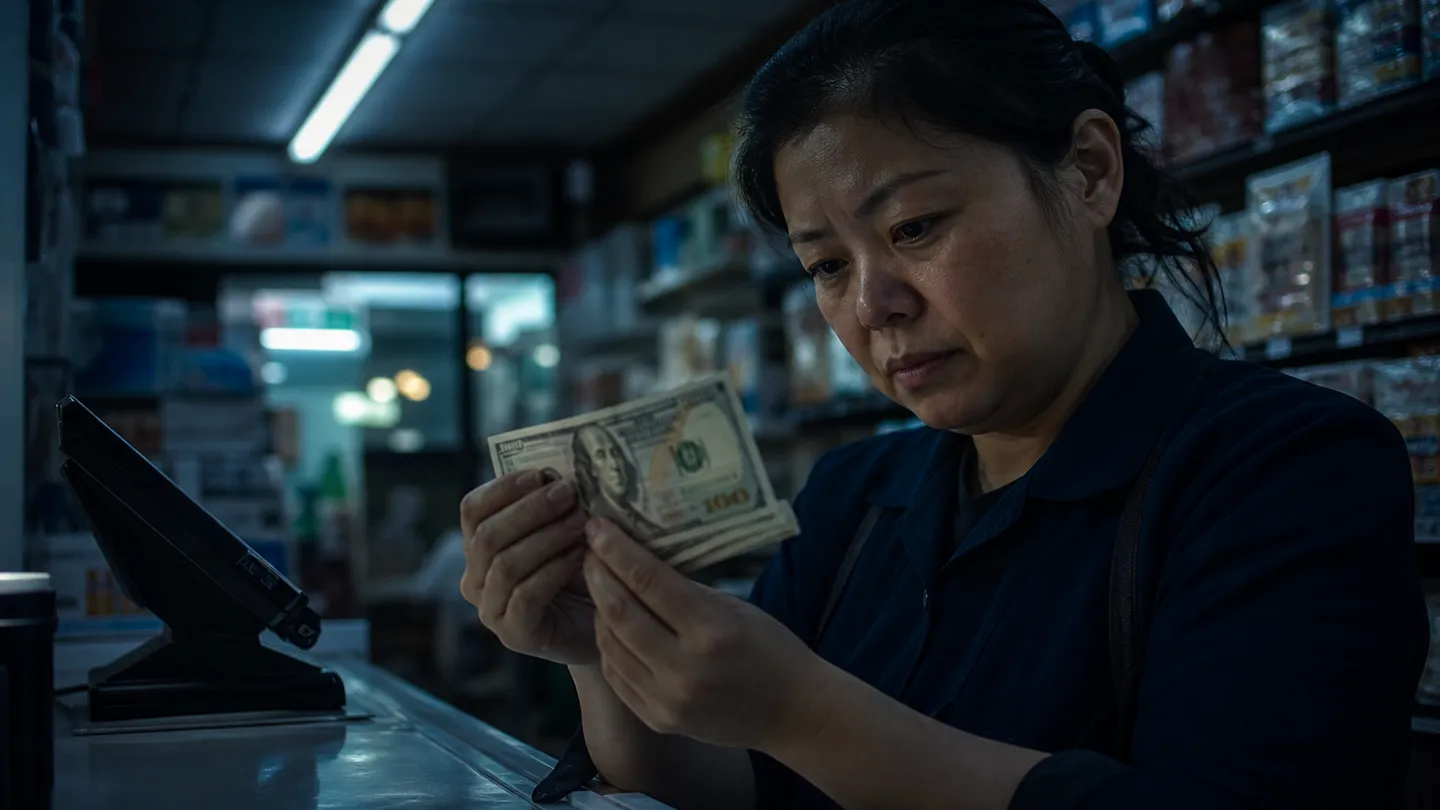
Consumers and businesses share reporting duties, but their immediate actions differ. A consumer should stop trying to use the note, while a cashier should pause the transaction and follow the workplace escalation procedure. Before responding in a Seattle shop or elsewhere, we suggest using this safety-first checklist based on Federal Reserve guidance[4]:
- Consumers: Keep the suspected note separate and notify local police.
- Cashiers: Alert a supervisor, avoid confrontation, and record the passer’s description or vehicle details only when safe.
- Both: Preserve the note separately from genuine cash and surrender it promptly to law enforcement.
Conclusions
Stay calm.
- We should begin by comparing the note’s denomination and design series with the correct official reference, since older designs remain valid currency[6].
- Confirm several built-in features, including the watermark, embedded thread, raised printing, and colour-changing details; a detection pen alone is not decisive[4].
- If doubts remain, consumers should stop using the bill, while cashiers should pause the sale and follow their workplace procedure.
- Keep the note apart from genuine cash, avoid accusing the customer, and contact local police; record identifying details only when it is safe[4].
- Businesses should organise regular staff refreshers so that each cashier knows both the inspection process and escalation steps.
Next, review Fake US Dollars: How to Spot Them for a focused recognition guide.
Straight answers
How can I tell the difference between a fake dollar and a real dollar?
We suggest checking the note by touch, tilt, and light rather than trusting one feature. Genuine note paper contains 75 percent cotton and 25 percent linen, while raised printing creates a slightly rough texture; the watermark and embedded security thread should also match the denomination[3][4].
What happens if you accidentally pay with counterfeit money?
Accidentally passing a counterfeit note does not by itself meet the federal offence's intent requirement, but knowingly using or possessing one can carry up to 20 years in prison[2]. Stop using the note, keep it separate from genuine cash, and notify local police; you may still bear the financial loss because counterfeit currency cannot be exchanged for genuine money[4].
What's the best fake money?
There is no safe "best" counterfeit money, because making or altering US currency with intent to defraud is a federal crime[1]. For filming or display, we advise using unmistakable prop money marked "For Motion Picture Use Only" or "Replica" rather than anything designed to pass as genuine currency[9].
How can I compare a fake $100 dollar bill vs real?
For a current-design $100 note, tilt it and watch the bells and 100s on the woven blue ribbon appear to move; then hold it to light to find the Franklin watermark and a thread reading "USA 100"[3]. Under ultraviolet light, that embedded thread should glow pink, and all features should correspond to the $100 denomination[3].
Links and references
- 1. Currency Image Use | U.S. Currency Education Program
- 2. 18 U.S. Code § 472 - Uttering counterfeit obligations or securities
- 3. Decoding Dollars: The $100
- 4. How do I determine if a banknote is genuine? What should I do if I think I have a counterfeit note? | Federal Reserve Board
- 5. Estimating the Volume of Counterfeit U.S. Currency in Circulation
- 6. Acceptance and Use of Older-Design Federal Reserve Notes
- 7. Reporting Suspected Counterfeit Currency to the United States Secret Service
- 8. Cash Assist Mobile App | U.S. Currency Education Program
- 9. Cashier Toolkit | U.S. Currency Education Program