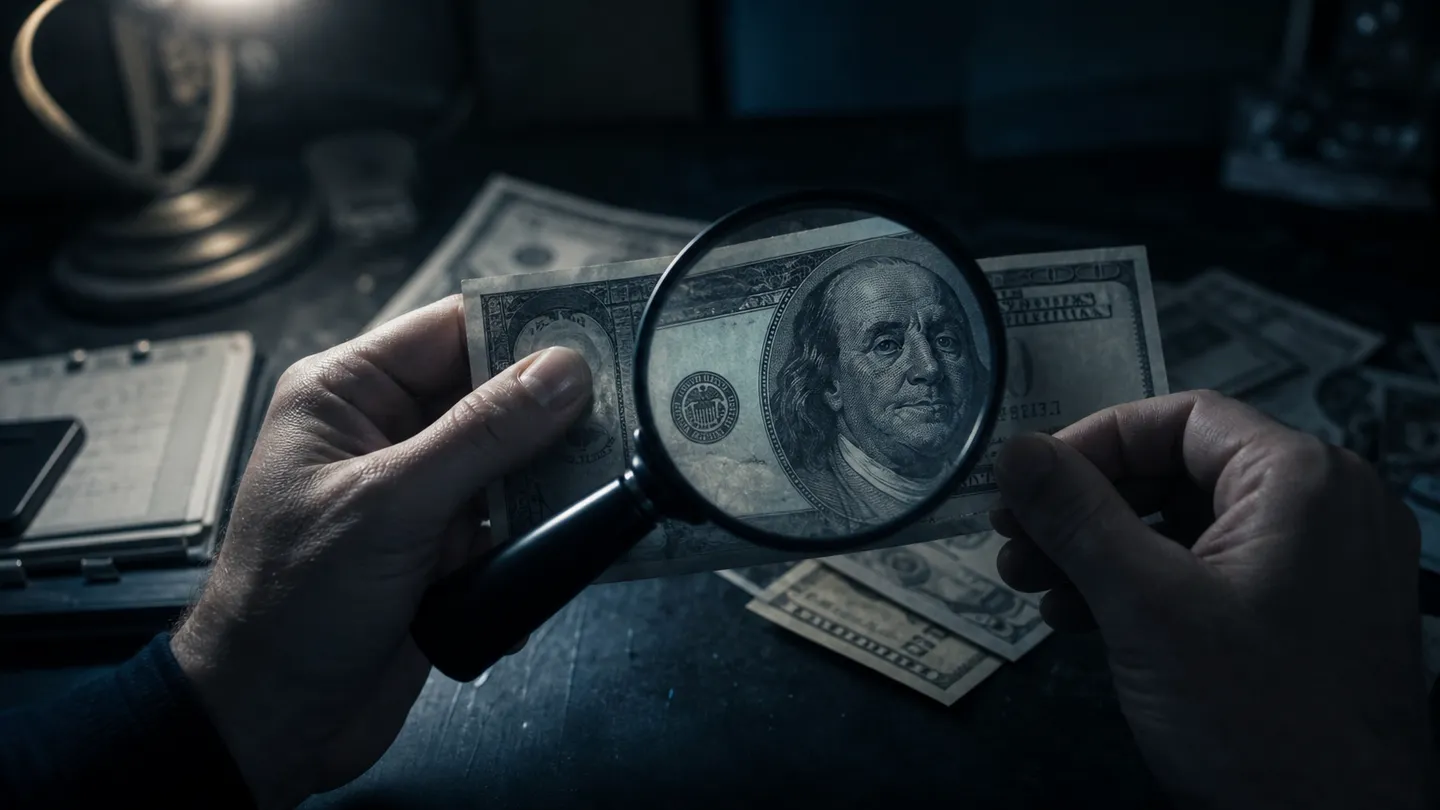
Do not look for counterfeit money: buying, receiving, selling, possessing, or passing it with intent to use it as genuine can carry up to 20 years in prison.[1][2] For filming or education, we advise using a reputable theatrical supplier and choosing one-sided reproductions that meet federal size restrictions rather than realistic counterfeit notes.[3]
Where Can You Find Counterfeit Money? The Direct Answer
There is no safe or lawful source for spendable counterfeit currency. Any offers for counterfeit money are typically linked to criminal operations or scams. Engaging in such activities can result in severe legal consequences, including fines and imprisonment of up to 20 years under 18 U.S.C. § 472 and § 473 for passing or selling counterfeit currency[1][2].
It is important to distinguish between counterfeit money and legitimate situations where one might accidentally receive a fake note during a cash transaction. In these cases, the recipient should keep the note separate from genuine cash, notify local authorities, and understand that a confirmed counterfeit cannot be exchanged for real currency[4].
Another scenario involves the use of prop money, which is designed for film, theatre, photography, or educational purposes. We advise sourcing prop money from reputable suppliers who provide one-sided reproductions that comply with federal regulations. For instance, these reproductions must be less than three-fourths or more than one-and-one-half times the size of actual notes and should not be used in a manner that could lead to confusion with genuine currency[3].
| Goal | Options Available |
|---|---|
| Avoiding legal issues | Do not seek counterfeit money |
| Using realistic-looking money safely | Purchase compliant prop money from reputable suppliers |
| Identifying counterfeit notes | Learn about security features of genuine currency |
Understanding these distinctions can help you navigate the complexities surrounding money usage without falling into unlawful practices.
Counterfeit Currency vs. Prop Money, Replicas, and Genuine Notes
Counterfeit currency refers to fake money that is made to resemble real U.S. notes with the intent to defraud. Engaging with counterfeit currency can lead to severe legal consequences, including fines and imprisonment of up to 20 years for knowingly passing or selling it[1][2]. It is crucial to understand the differences between counterfeit currency and other forms of money, such as prop money, replicas, and genuine notes.
Prop money is specifically designed for use in films, theatre, photography, or educational settings. This type of money is often clearly marked and should comply with federal regulations. For instance, prop money must be one-sided, less than three-fourths or more than one-and-one-half times the size of actual notes, and the production materials must be destroyed after use[3]. Labels like “For Motion Picture Use Only” do not guarantee that a note is lawful; they may still be mistaken for real currency, which is why cash handlers must be cautious[5].
Replicas and novelty bills may also be available on the market but do not automatically comply with legal standards. In the U.S., all designs of Federal Reserve notes issued from 1914 to the present remain legal tender, meaning that older designs are not necessarily counterfeit simply because they look different from current bills[6]. However, the authenticity of any note should be verified through specific security features, such as watermarks and security threads, rather than relying solely on serial numbers[4].
When dealing with money, understanding the legal reproduction rules outlined in 18 U.S.C. §§ 471–473 and 504 is essential. These laws specify what constitutes lawful reproduction and the penalties for violating these regulations. For example, creating a color reproduction of U.S. currency is only federally authorised under strict conditions, which include the destruction of image-making materials after use[3].
In summary, while counterfeit currency is illegal and punishable by law, prop money and replicas can serve legitimate purposes if used correctly. Always ensure that you are sourcing these items from reputable suppliers and understand the legal implications of their use.
Where to Find Legal Prop Money for Film, Theater, or Photography
Finding legal prop money for use in film, theatre, or photography involves sourcing from established suppliers who comply with federal regulations. We recommend looking for theatrical prop suppliers and film-production suppliers that specialise in creating realistic-looking money that cannot be confused with genuine currency. This prop money must meet specific criteria, such as being one-sided and sized appropriately — less than three-fourths or more than one-and-one-half times the dimensions of actual notes[3].
When searching for prop money, we advise creating a vendor checklist to ensure you are dealing with reputable sources. Here are some key points to consider:
- Visible Markings: Ensure the prop money is clearly marked as "prop" or "replica" to avoid any confusion with real currency.
- Product Photos: Look for detailed images that show the quality and design of the prop money.
- Dimensions: Confirm that the size of the prop money adheres to federal guidelines.
- Return Policy: A solid return policy indicates a trustworthy seller; you should be able to return the product if it does not meet your expectations.
- Seller Identity: Research the seller's reputation and customer reviews to gauge their reliability.
- Intended Use Disclosures: The seller should provide information on how the prop money can be used legally, emphasising that it should not be passed as genuine currency.
Be cautious of any products advertised as "passable," "spendable," "1:1," or those claiming to defeat detection methods. These descriptors are often associated with counterfeit money and engaging with such items can lead to severe legal consequences under 18 U.S.C. § 472 and § 473[1][2]. Always prioritise sourcing from vendors who explicitly state that their products are for theatrical or educational use only, ensuring compliance with federal law[5].
By following these guidelines, we can help ensure that your use of prop money remains legal and safe while achieving the realistic look needed for your projects.
Why “Realistic Counterfeit Money for Sale” Offers Are High-Risk
Why “Realistic Counterfeit Money for Sale” Offers Are High-Risk
Engaging with offers for “realistic counterfeit money for sale” exposes individuals to significant legal risks. Under U.S. law, knowingly buying, receiving, or possessing counterfeit currency with the intent to use it as genuine can lead to severe penalties, including fines and imprisonment for up to 20 years as set out in 18 U.S.C. § 472 and § 473[1][2]. The U.S. Secret Service actively investigates and prosecutes such crimes, making it crucial for individuals to understand the implications of handling counterfeit currency.
Several red flags can indicate a high-risk transaction. For example, sellers who only accept cryptocurrency payments often operate outside of regulated financial systems, making it difficult to pursue legal recourse if the transaction goes awry. Similarly, offers made through encrypted chat platforms may suggest an intent to evade law enforcement scrutiny. Claims that counterfeit notes can be accepted at ATMs or other machines are misleading; acceptance by such devices does not guarantee the authenticity of the currency, as Federal Reserve Banks verify currency through sophisticated equipment[7]. Requests for identity documents can also signal fraudulent activity, as legitimate sellers typically do not require such information.
Moreover, many listings for counterfeit money deliver poor-quality paper or legal prop notes instead of genuine-looking currency. Buyers may end up with items that do not meet their expectations or, worse, receive nothing at all. The U.S. Currency Education Program warns that labels like “For Motion Picture Use Only” or “Replica” do not ensure the legality of a note; they could still be counterfeit[5].
To avoid falling victim to scams, it is essential to recognise these warning signs and understand the legal consequences associated with counterfeit currency. Always prioritise sourcing prop money from reputable suppliers who provide compliant products intended for theatrical or educational use. By doing so, we can mitigate the risks associated with counterfeit money offers and ensure legal compliance.
How to Check Whether a U.S. Bill Is Genuine
To determine if a U.S. bill is genuine, we recommend using the official Look–Feel–Tilt method, which focuses on several key security features. First, examine the printing quality and the details of the portrait on the bill. Genuine notes have sharp, clear printing, while counterfeits often exhibit blurred images. Next, feel the texture of the bill; genuine currency is printed on a unique blend of 75 percent cotton and 25 percent linen, giving it a slightly rough texture due to the raised intaglio printing[8].
Tilt the bill to check for colour-shifting ink, particularly on the current $100 note, where the lower right corner shifts from copper to green when tilted[8]. Additionally, ensure that the security thread is present; it should be embedded in the paper and visible when held up to the light. The thread will read "USA 100" for the $100 note and glow pink under UV light[8].
Another critical feature is the watermark, which should be visible from both sides of the bill. For the $100 note, the Franklin watermark is an essential element to look for[8]. Remember that different denominations have varying features; for instance, the current $1 and $2 notes do not include a watermark or security thread, which are found on higher denominations[9].
For a thorough understanding of the specific security features applicable to each denomination, we suggest consulting the Federal Reserve and U.S. Currency Education Program guides. These resources provide detailed information on how to authenticate each type of bill, ensuring that you are well-informed when handling currency.
Engaging with counterfeit currency can lead to severe legal consequences, including fines and imprisonment of up to 20 years for knowingly passing or selling counterfeit notes[1][2]. Therefore, it's crucial to familiarise ourselves with these features and verify the authenticity of any currency we receive.
What Detection Tools Can—and Cannot—Tell You
When it comes to detecting counterfeit currency, various tools and methods can assist us, but they each have their limitations. Visual inspection is often the first line of defence. We can look for key security features such as watermarks, security threads, and colour-shifting ink. However, this method relies heavily on our knowledge and familiarity with genuine notes.
Counterfeit-detection pens are commonly used, but they are not foolproof. These pens test for certain characteristics, such as the presence of starch, which can yield false positives or negatives. They should never replace a thorough examination of a note's security features[4]. UV lights can reveal certain elements invisible under normal light, but again, they only provide partial verification. For example, while the security thread of a $100 note glows pink under UV light, not all counterfeit notes will exhibit this feature[8].
ATMs and bank equipment can accept notes but should not be regarded as definitive authentication tools. Federal Reserve Banks employ sophisticated machinery to verify currency, and just because a note is accepted by an ATM does not guarantee its authenticity[7].
The Federal Reserve’s Cash Assist app offers a practical option for identifying denominations, but it is essential to note that it does not authenticate the notes as genuine or counterfeit[10]. Instead, it provides reference information that can help guide our understanding of currency.
Myth vs. Fact: Serial Numbers and One-Test Claims
| Myth | Fact |
|---|---|
| A serial number guarantees authenticity. | A serial number alone is not a recommended method for verifying genuineness; security features are key[4]. |
| One test is sufficient for detection. | No single test can definitively determine if a note is genuine; a combination of checks is necessary. |
Understanding these limitations can help us better navigate the complexities of currency verification. Always be cautious and rely on multiple methods to ensure the authenticity of any currency we encounter.
What to Do If You Receive a Suspected Counterfeit Note
If you find yourself in the unfortunate situation of receiving a suspected counterfeit note, it is crucial to handle it correctly to avoid legal repercussions. First and foremost, do not attempt to spend, return, or knowingly pass the note. Engaging in such actions can lead to severe penalties, including fines and imprisonment for up to 20 years, as outlined in 18 U.S.C. § 472 and § 473[1][2].
Instead, we advise you to take careful steps to document the situation. Record the details of where and when you received the note, including any information about the person who passed it to you or their vehicle, if possible. Avoid confronting anyone about the note; this could escalate the situation unnecessarily.
Minimise handling of the suspected counterfeit note to preserve any evidence. Place it in a protective envelope or a similar container to prevent it from coming into contact with other currency. This action helps to maintain the integrity of the note for examination.
Next, contact your local police department, a bank, or the U.S. Secret Service for guidance on the next steps. Each of these entities has protocols for handling counterfeit currency. Be aware that once a note is confirmed as counterfeit, it cannot be exchanged for genuine currency, and reimbursement is not guaranteed[4].
Should the note be retained for examination, it may be forwarded to the Secret Service for further investigation. The Bureau of Engraving and Printing notes that while suspected counterfeit notes may be examined, this process does not assure that you will receive any compensation for the loss[4].
By following these steps, we can help ensure that we act responsibly and legally when faced with suspected counterfeit currency.
Common Questions About Finding and Buying Fake Money
Buying fake money can lead to serious legal consequences. Under U.S. law, engaging in activities such as buying, receiving, or selling counterfeit currency with the intent to use it as genuine can result in fines and imprisonment for up to 20 years according to 18 U.S.C. § 472 and § 473[1][2]. It's crucial to understand that even if someone claims that a note is for novelty or theatrical use, this does not guarantee it is lawful or harmless[5].
Many people wonder whether ATMs can detect counterfeit notes. While ATMs do have mechanisms to identify suspicious currency, acceptance by these machines is not a definitive authentication method. Federal Reserve Banks utilise advanced equipment to verify currency, and a note being accepted by an ATM should not be treated as conclusive proof of its authenticity[7].
Another common misconception is that the presence of a serial number on a note guarantees its authenticity. However, the U.S. Currency Education Program advises that a serial number alone is not a reliable method for verifying genuineness. Instead, one should check for multiple security features such as watermarks and security threads[4].
When searching for "realest fake money," listings often refer to high-quality prop money that mimics genuine currency closely. However, the term is subjective and can vary widely in quality. We recommend sourcing prop money from reputable suppliers who specifically indicate their products are for theatrical use. This ensures compliance with federal regulations and avoids the legal risks associated with counterfeit currency[5].
Detection of counterfeit currency should involve a combination of features rather than relying on a single test. We advise familiarising ourselves with the various security elements present in different denominations, such as raised printing, embedded threads, and colour-shifting ink. By employing a thorough approach, we can better safeguard ourselves against counterfeit currency and ensure our activities remain within legal boundaries.
Counterfeit Money Decision and Myth vs. Fact Table
| Goal | Action | Legal Status | Detection Method |
|---|---|---|---|
| Find Legal Prop Money | Source from reputable suppliers | Legal for theatrical use | Check for compliance with 31 CFR § 411.1 |
| Collectible Currency | Consult with currency dealers | Legal if genuine | Verify authenticity with security features |
| Official Authentication Guidance | Refer to U.S. Currency Education Program | Legal | Use Look–Feel–Tilt method |
| Report Suspected Counterfeit | Notify local police or Secret Service | Legal obligation | Document details before reporting |
Common Mistakes and Misconceptions
The wording matters.
Searching for Counterfeit Currency When You Need Props
People often search "counterfeit money where to find" when they actually need lawful stage or photographic money. That wording can lead towards illegal sellers rather than Seattle prop houses, theatre suppliers, or established vendors offering clearly non-spendable products. We suggest searching for "legal US prop money", "stage currency", or "photographic money props" and avoiding anyone who claims their notes will pass as genuine.
Treating a "Replica" Label as Proof of Legality
A printed disclaimer can look reassuring. Yet labels such as "For Motion Picture Use Only" and "Replica" do not establish that a note is lawful or harmless, because official cash-handler guidance warns that fake notes may carry those words[5]. We should assess the product’s design, dimensions, seller documentation, and intended use rather than relying on one printed phrase.
Buying Before Screening the Vendor
Buyers sometimes focus on price and delivery speed while overlooking what the seller actually supplies. Before paying, we advise using this checklist:
- Request clear images of the front and reverse, plus exact physical dimensions.
- Ask for an invoice describing the items as theatrical, educational, or photographic props.
- Check for identifiable contact details, shipping terms, and a written returns policy.
- If the item reproduces US currency in colour, ask how it meets the federal conditions: it must be one-sided, smaller than three-fourths or larger than one-and-one-half times the note’s linear dimensions, with image-making materials and files erased after final use[3].
These checks cannot certify a vendor, but unanswered questions or claims that the notes are "ATM-safe" are strong reasons to leave the listing.
Choosing the Most Realistic Product Available
People often assume that a close-up scene requires money that is indistinguishable from genuine cash. In practice, excessively convincing props can be mixed with real takings, carried away from the set, or presented outside their intended context. We advise choosing props that work at the planned camera distance while remaining readily identifiable, then storing and counting them separately from genuine dollars.
Rejecting an Older Note Because It Looks Unfamiliar
An unfamiliar design is not automatically counterfeit. Every Federal Reserve note design issued from 1914 onwards remains legal tender, so an older appearance alone is not a valid reason to reject a bill[6]. We should identify the note’s design series and consult the corresponding official security guidance instead of comparing it only with current cash.
Using Shopping Listings to Authenticate a Suspect Bill
Marketplace photographs are sales material, not authentication references. If we receive an unfamiliar note, comparing it with prop listings can create confusion because the pictured products may be altered, incomplete, or unlawful. We should use official denomination-specific guidance and, if concerns remain, follow the reporting process rather than trying to find a matching note for sale.
Conclusions
- Start by defining the legitimate purpose: filming, theatre, photography, education, or collecting. Counterfeit currency intended to circulate as genuine is not a lawful purchase[1][2].
- For productions, choose clearly distinguishable prop notes that suit the camera distance rather than products advertised as spendable, scannable, or "ATM-safe".
- Before ordering, confirm the note’s dimensions, front-and-reverse design, seller identity, invoice wording, returns policy, and compliance information[3].
- If a dollar bill seems suspicious, compare several security features using official guidance; do not rely solely on a serial number, pen, app, or machine acceptance.
- Keep props separate from genuine dollars, control access on set, and account for every piece after use.
Next, review Realistic Fake Money for Sale: Where to Find It before comparing lawful suppliers.
Straight answers
How to find counterfeit money?
We suggest checking several built-in features rather than trying to locate counterfeit notes deliberately. Feel for slightly rough, raised printing and cotton-linen paper, then compare the watermark, security thread and colour-shifting elements with official guidance for that denomination[8][4].
Can you go to jail for buying fake money?
Yes, if you buy or receive counterfeit US currency intending to pass or use it as genuine, you could face a fine, imprisonment for up to 20 years, or both[1]. Knowingly possessing counterfeit currency with intent to defraud can also carry up to 20 years in prison[2].
How to detect counterfeit money $100?
On a current $100 note, check that the blue security ribbon is woven into the paper and that the bell and lower-right numeral change from copper to green when tilted[8]. Hold it to light for a Franklin watermark visible from both sides and a thread marked "USA 100"; under ultraviolet light, that thread should glow pink[8].
How to check if money is real at home?
We recommend comparing the note’s feel, watermark, security thread and colour-shifting features with official guidance for its denomination[4]. Do not rely on a counterfeit-detection pen because it can give false results, and remember that the EyeNote app identifies denominations but does not authenticate currency[4][10].
How to tell if a one dollar bill is real with light?
A genuine $1 note does not have the watermark or embedded security thread used on denominations of $5 and above, so holding it to light cannot confirm authenticity through those features[9]. Instead, inspect the embedded red and blue fibres, feel for raised printing and check that the paper has the characteristic cotton-linen texture[8][9].
Links and references
- 1. 18 USC 473: Dealing in counterfeit obligations or securities
- 2. 18 USC 472: Uttering counterfeit obligations or securities
- 3. 31 CFR § 411.1 - Color illustrations authorized
- 4. How do I determine if a banknote is genuine? What should I do if I think I have a counterfeit note?
- 5. Cashier Toolkit | U.S. Currency Education Program
- 6. Use of Older-Design Notes | U.S. Currency Education Program
- 7. Federal Reserve Board - Currency and Coin Services
- 8. Decoding Dollars: The $100 | U.S. Currency Education Program
- 9. $1 Note | U.S. Currency Education Program
- 10. Mobile Applications | Bureau of Engraving and Printing