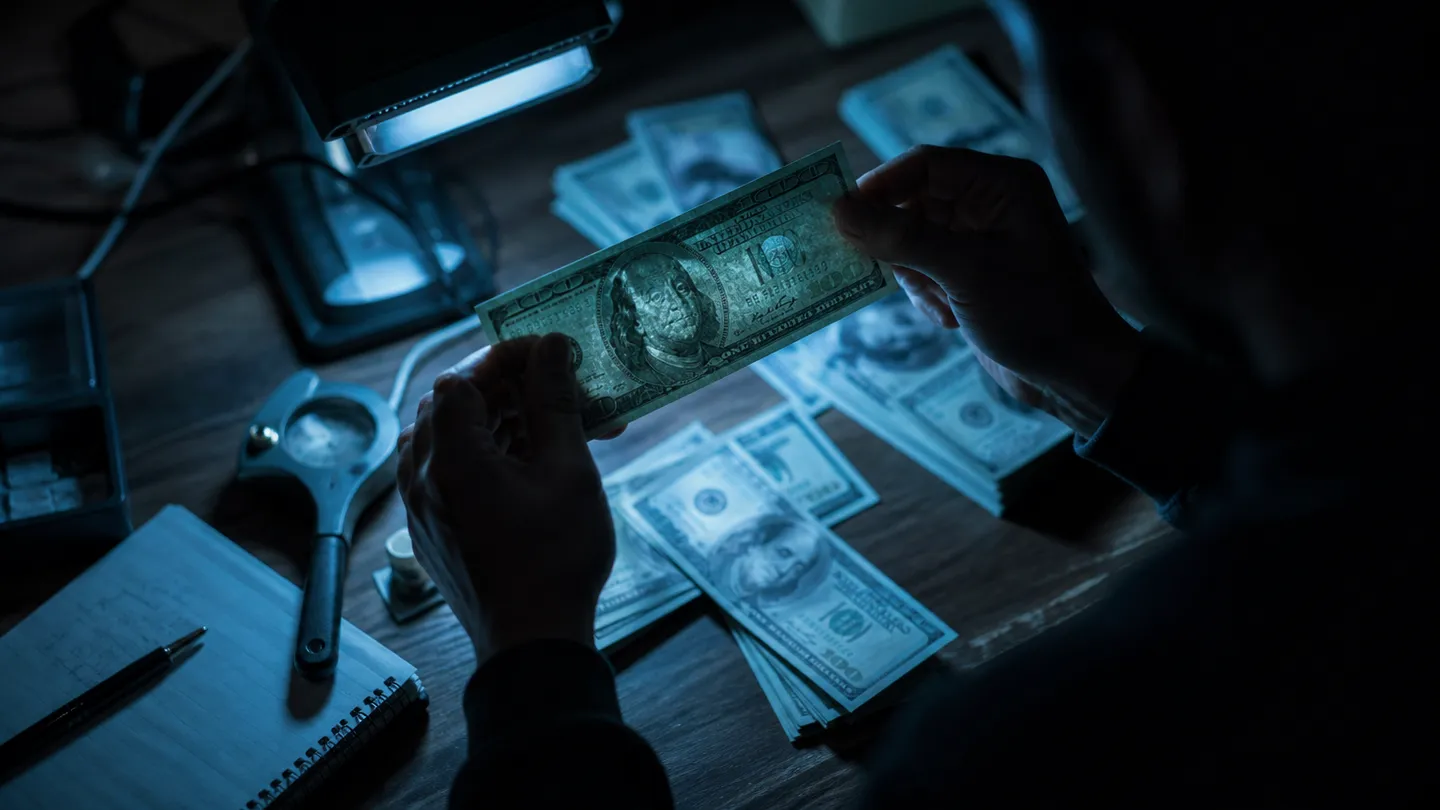
Knowingly using counterfeit U.S. money with intent to defraud is a federal felony, not a misdemeanour.[1][2] "Using" includes passing, selling, importing, attempting those acts, or possessing or concealing counterfeit currency with fraudulent intent; however, someone who genuinely believed a note was real does not commit the federal passing offence merely by spending it.[1][3]
What Counts as “Using Fake Money”?
"Using" fake money encompasses several actions, including passing, attempting to pass, spending, exchanging, depositing, selling, and possessing counterfeit currency. For instance, presenting a fake $100 bill at a store qualifies as passing counterfeit money. Similarly, if someone deposits a counterfeit note at a bank, they are also engaging in illegal activity. The law under 18 U.S.C. § 472 specifically outlines these actions, making it clear that intent to defraud is a crucial factor in these definitions[1].
It's important to differentiate between counterfeit notes and other types of fake currency. Counterfeit notes are illicit reproductions of genuine currency intended to deceive, while prop money is designed for theatrical use and is often marked "For Motion Picture Use Only"[4]. Altered genuine bills, on the other hand, are real notes that have been modified to change their value, which also falls under illegal activity. Lawful reproductions exist, but they must adhere to strict guidelines, such as being one-sided and not exceeding certain size limits[5].
Possessing counterfeit currency is also illegal, even if one has not attempted to use it. For example, if someone finds a counterfeit note and keeps it, they could still face legal repercussions under federal law. The knowledge of the currency being counterfeit plays a significant role in determining legal liability. A person who honestly believes a note is real may not be charged with passing counterfeit money[3]. However, repeated attempts to use counterfeit notes can imply knowledge and intent to defraud, leading to more severe legal consequences[6].
Understanding these definitions and distinctions is crucial for anyone who may encounter counterfeit money. If you suspect you have received a counterfeit note, the U.S. Currency Education Program advises submitting it to the nearest U.S. Secret Service field office along with a completed counterfeit-note report form[7].
When Using Fake Money Becomes a Crime
Prosecutors must typically demonstrate that a person knew the money was counterfeit and intended to defraud. Simple possession or an innocent mistake does not automatically result in a conviction. For example, if someone unknowingly receives counterfeit currency as change, they may not be charged unless there is evidence of intent to defraud. However, even an unsuccessful attempt to use counterfeit money can still lead to charges under federal law, making the legal landscape complex.
Different Scenarios of Use
Accidental Use: In this scenario, a person unknowingly spends a counterfeit bill. If they genuinely believed the note was real, they may not face charges for passing counterfeit money, as established by the U.S. Supreme Court in United States v. Carll[3]. However, if evidence suggests they repeatedly attempted to use counterfeit notes, it could indicate knowledge of the currency's status.
Suspicious Circumstances: If someone is found with a counterfeit note but claims they did not know it was fake, the situation becomes more complicated. Law enforcement may consider factors such as the person's history with counterfeit currency or the context in which the note was received. A single act of passing a counterfeit note may not be enough to prove guilty knowledge, but multiple instances can lead to legal implications[6].
Deliberate Passing: When a person knowingly attempts to use counterfeit money with the intent to defraud, they are committing a federal felony. Under 18 U.S.C. § 472, actions like passing, uttering, or selling counterfeit currency can result in penalties of up to 20 years in prison. The law is clear that intent to defraud is essential for a conviction[1][8].
Understanding these scenarios can help clarify the legal risks associated with counterfeit currency. If you suspect you have encountered counterfeit money, it is advisable to report it to the U.S. Secret Service, following the guidelines laid out by the U.S. Currency Education Program[7].
Federal Counterfeit-Money Laws and Penalties
Under 18 U.S.C. § 472, knowingly using counterfeit U.S. money can lead to serious legal consequences. This statute covers a range of actions, including passing, uttering, publishing, selling, attempting any of these acts, and possessing or concealing counterfeit currency with the intent to defraud[1]. A conviction under this law can result in a federal prison sentence of up to 20 years and substantial fines; however, the actual sentence varies based on specific case details and federal sentencing guidelines[1]. It's crucial to understand that while the maximum penalty is severe, there is no mandatory minimum sentence, which means outcomes can differ significantly depending on the circumstances surrounding each case[1].
It's also important to differentiate between using counterfeit money and manufacturing it. Under 18 U.S.C. § 471, the act of creating, forging, or altering U.S. obligations with intent to defraud carries similar penalties, including imprisonment for up to 20 years and fines[8]. While both offenses are serious federal felonies, the key distinction lies in the nature of the crime. Using counterfeit money involves the act of passing or attempting to use already produced counterfeit notes, whereas manufacturing refers to the creation of those notes.
Knowledge of the currency's counterfeit status is essential for establishing guilt. The U.S. Supreme Court has ruled that if a person genuinely believes a note to be real, they cannot be convicted of passing counterfeit money[3]. However, repeated attempts to use counterfeit currency can imply knowledge and intent, leading to more severe penalties[6]. Thus, individuals should exercise caution and remain informed about the legal implications of engaging with counterfeit currency.
If you suspect that you have encountered counterfeit money, it is advisable to report it to the nearest U.S. Secret Service field office, following the guidance provided by the U.S. Currency Education Program[7].
Is Using Counterfeit Money a Felony or a Misdemeanor?
Using counterfeit money is classified as a federal felony under 18 U.S.C. § 472. This statute includes a range of activities such as passing, uttering, selling, attempting to do any of these acts, importing, or possessing counterfeit currency with the intent to defraud[1]. The serious nature of this offense carries a maximum prison sentence of up to 20 years and significant fines[8]. However, it is essential to note that there is no universal minimum sentence for a first-time offense; the actual punishment will depend on various factors, including the specifics of the case and federal sentencing guidelines[1].
State laws also play a role in determining the legal repercussions of using counterfeit money. Each state has its own classification and penalties, which can vary significantly based on the jurisdiction, the amount of money involved, the specific conduct of the individual, and their criminal history. For example, some states may treat the possession of counterfeit currency as a misdemeanor, while others may classify it as a felony, depending on the circumstances[2].
Federal Versus State Comparison
Federal Law: Under federal law, the penalties for using counterfeit money are severe, with up to 20 years in prison. There are no mandatory minimum sentences, so outcomes can differ based on the case specifics[1].
State Law: State laws can vary widely. Some states may impose lighter penalties for first-time offenders, while others may have stricter guidelines that mirror federal law. The classification as a felony or misdemeanor may depend on the amount of counterfeit currency involved and the individual's prior criminal record.
Understanding these distinctions is crucial for anyone who may encounter counterfeit currency. If you find yourself in a situation involving counterfeit money, it is advisable to consult legal resources or seek professional guidance to navigate the complexities of both federal and state laws.
What If You Used Counterfeit Money by Accident?
Accidentally using counterfeit money can lead to serious legal consequences, even if there was no intent to defraud. Under federal law, specifically 18 U.S.C. § 472, “using” counterfeit currency includes passing, uttering, or possessing it with the intent to defraud[1]. However, the absence of knowledge about the note being counterfeit can be a significant factor in determining criminal liability. If someone genuinely believed they were using real currency, they may not be charged with passing counterfeit money. The U.S. Supreme Court has established that genuine belief in a note's authenticity is crucial for exoneration[3].
When an individual is questioned by law enforcement or merchants about counterfeit money, they may still face scrutiny. Investigators often consider various factors to assess intent. These include what the person said during the encounter, where they obtained the note, any history of repeated attempts to use counterfeit currency, and whether they possess additional fake notes. For example, if someone has only one counterfeit bill and claims ignorance, it may be viewed differently than if they are found with multiple counterfeit notes, which could suggest knowledge of their status[6].
It is vital not to make false statements if questioned. Providing inaccurate information can complicate legal proceedings and may lead to additional charges. If you find yourself in a situation where you are being investigated as a suspect, it is advisable to seek legal counsel from a criminal-defense lawyer. They can guide you through the complexities of the law and help protect your rights.
In summary, while accidental use of counterfeit money can impact legal liability, it is not a guaranteed defence. Understanding your situation and seeking professional assistance can make a significant difference in navigating potential legal repercussions.
What to Do If You Receive or Suspect Fake Money
If you find yourself in a situation where you receive or suspect that you have counterfeit money, it is crucial to act quickly and responsibly. Here’s a safe checklist to guide you through the necessary steps:
Stop Using the Note: Cease any attempts to spend or circulate the note immediately. Continuing to use it can expose you to legal repercussions under federal law, as defined in 18 U.S.C. § 472, which includes passing or attempting to use counterfeit currency with the intent to defraud[1].
Do Not Return It to Circulation: Returning a counterfeit note to circulation, even unknowingly, can lead to serious legal consequences. Under federal law, knowingly passing counterfeit money can result in penalties of up to 20 years in prison[8].
Preserve Information About How It Was Received: Document any details surrounding the receipt of the counterfeit note. This includes where and how you obtained it, as this information may be important for authorities.
Contact Local Authorities: Reach out to your local police department, bank, or a U.S. Secret Service field office. The U.S. Currency Education Program advises submitting the suspected counterfeit note along with a completed counterfeit-note report form to the nearest U.S. Secret Service field office[7]. Each note requires a separate submission form (SSF 1604), which treats the submitted note as counterfeit unless proven otherwise[9].
Check Security Features: Genuine-looking notes can have security features that should be checked. The Federal Reserve provides resources to help identify these features, such as watermarks, security threads, and colour-shifting ink[10]. If your note has markings like "For Motion Picture Use Only" or "Replica," it is likely fake[4].
It is important to remember that knowingly passing a note to recover a loss can create legal exposure. The law requires proof of knowledge of the currency's counterfeit status for prosecution; however, repeated attempts to use counterfeit notes may imply intent to defraud[3]. Therefore, if you suspect you have received counterfeit money, it is advisable to follow these steps carefully to protect yourself legally.
Prop Money, Novelty Bills, and Legal Reproductions
Labels such as "prop," "copy," or "not legal tender" do not exempt individuals from legal repercussions when offering a note as real payment. The mere presence of these labels does not alter the fact that using these notes in a transaction can be considered illegal under federal law. For instance, under 18 U.S.C. § 504, the passing of any currency that resembles genuine U.S. money, regardless of its designation, can lead to serious legal consequences if done with the intent to defraud.
The legal landscape surrounding prop money and novelty bills is complex. While these items are often used in film and theatrical productions, the law is strict about their use in any financial transaction. Federal regulations permit the reproduction of U.S. currency only under specific conditions, such as ensuring that the reproductions are less than 75% or more than 150% of the original size and that they are one-sided[5]. These rules are in place to prevent confusion between real and fake currency, which is crucial for maintaining public trust in the monetary system.
A common misconception is that simply stating a note is for "motion picture use only" protects individuals from legal action. This is not the case. For example, using a prop bill in a cash transaction can be treated as passing counterfeit money, which carries penalties of up to 20 years in prison under 18 U.S.C. § 472[1]. The distinction lies in the intent and context of use; slipping a prop bill into a real cash exchange is illegal, while using it solely for film purposes, without any intention to defraud, is permissible.
In conclusion, while prop money and novelty bills can have legitimate uses, it is essential to understand the legal boundaries. Engaging in any activity that involves using these notes as real currency can lead to severe legal repercussions, including federal felonies and lengthy prison sentences. Always ensure that you are informed and compliant with the law to avoid unintended consequences.
Common Myths About Using Fake Money
Several myths surround the use of fake money, leading many to misunderstand the legal implications involved. One common belief is that "one fake bill is not a felony." This is false; under 18 U.S.C. § 472, any act of passing or using counterfeit money, regardless of the amount, is illegal and classified as a federal felony, carrying a maximum penalty of up to 20 years in prison[1][8].
Another misconception is that "poor-quality counterfeits are always legal." While the quality of a counterfeit note may influence whether it legally resembles currency or the ability to prove intent, it does not provide a blanket defence against prosecution. The law does not distinguish between high-quality and low-quality counterfeits when assessing intent to defraud[1].
The idea that "returning counterfeit money as change is harmless" is also misleading. This act can be considered passing counterfeit money, which is punishable under federal law[1][8]. Even unintentional actions can lead to serious consequences, as the law applies to anyone who knowingly uses counterfeit currency, regardless of their intent.
Finally, the belief that "a first offense cannot lead to prison" is inaccurate. Although the law does not impose a mandatory minimum sentence for first-time offenders, the actual punishment can be severe and depends on various factors, including the specifics of the case and federal sentencing guidelines[1].
To clarify these myths, we can consider the following scenarios and their key legal issues:
| Scenario | Key Legal Issue |
|---|---|
| Accidental receipt | Lack of knowledge may mitigate liability, but not guarantee it[3] |
| Attempted purchase | Intent to defraud can be inferred from the act of attempting to use counterfeit money[1] |
| Bank deposit | Attempting to deposit counterfeit money is illegal and can lead to charges[11] |
| Prop use | Using prop money in transactions can be treated as passing counterfeit currency[1] |
| Repeated passing | Multiple attempts to use counterfeit money imply knowledge and intent, increasing penalties[6] |
Understanding these myths and their realities is crucial for anyone who may encounter counterfeit currency. We encourage everyone to stay informed and cautious to navigate the complex legal landscape surrounding fake money.
Using Fake Money: Legal Implications Scenario Matrix
| Scenario | Knowledge | Intent | Likely Legal Issue | Safest Next Step |
|---|---|---|---|---|
| Accidental Receipt | Genuine belief may exonerate | No intent to defraud | Potential scrutiny by authorities | Document details and seek legal advice |
| Attempted Spending | Depends on circumstances | Intent inferred from action | Charged under 18 U.S.C. § 472 | Stop using the note immediately |
| Depositing | Depends on knowledge of note | Intent to defraud likely assumed | Illegal under 18 U.S.C. § 473 | Contact local authorities and report |
| Using Prop Money | Awareness of prop status needed | Intent to defraud if used as real | Considered passing counterfeit currency | Avoid using in transactions |
| Repeated Passing | Possession indicates knowledge | Intent strongly inferred | Increased penalties under federal law | Seek legal counsel immediately |
Common Mistakes and Misconceptions
Treating every non-genuine bill as the same thing
Not every imitation is counterfeit currency. Counterfeit notes, altered genuine bills, film props, play money, and currency illustrations present different legal questions, although any item offered deceptively as payment can create serious exposure. A colour illustration is permitted only when it is one-sided, below 75 per cent or above 150 per cent of genuine size in each linear dimension, with production files and materials erased or destroyed afterwards[5].
Assuming an accidental attempt automatically proves a crime
People often panic when a cashier rejects a note, but an innocent attempt does not by itself establish the federal passing offence. The Supreme Court has held that knowledge of the counterfeit nature is essential, while 18 U.S.C. § 472 also requires intent to defraud[1][3]. Before explaining the incident, we suggest organising the facts rather than guessing:
- where and when the note was received;
- whether a receipt, witness, or transaction record exists;
- what happened before and after someone questioned the note.
Believing a failed payment attempt does not count
A completed purchase is not required. Section 472 covers attempting to pass, sell, or otherwise use counterfeit U.S. money when knowledge and fraudulent intent are present[1]. A declined purchase at a Seattle shop can therefore matter, but an unknowingly tendered note remains legally different from a deliberate attempt[3].
Thinking that selling fake notes is safer than spending them
Some people assume liability begins only when fake currency reaches a checkout. Federal law also covers buying, selling, exchanging, transferring, receiving, or delivering counterfeit U.S. obligations when the person intends them to be used as genuine[11]. Before transferring prop or novelty money, we advise checking that the listing, packaging, and messages accurately describe it and never suggest that it can pass as real currency.
Reading the statutory maximum as the expected sentence
The maximum is not a fixed sentence. Section 472 authorises imprisonment for up to 20 years but contains no mandatory minimum, leaving punishment dependent on the advisory Sentencing Guidelines and case-specific circumstances[1]. Under the 2025 Guidelines, the base offence level is 9, face-value increases begin above $2,500, and producing counterfeit money or possessing counterfeiting equipment triggers a two-level increase with a minimum offence level of 15[12].
Assuming federal law provides the entire answer
Counterfeiting U.S. obligations is a federal matter, but citing a federal statute does not resolve every possible charge arising from a local transaction. Jurisdiction, available evidence, prosecutorial discretion, and the conduct involved can affect whether federal charges, state charges, or both are considered. For a Seattle incident, we would ask counsel to examine the applicable Washington law separately rather than treating the federal maximum as the automatic outcome.
Key Takeaways
Keep the essentials clear.
- Never spend, deposit, exchange, or give away a questionable note once concerns arise; set it aside and record how you received it.
- Knowledge and fraudulent intent are central to federal liability, but repeated conduct can make an innocent explanation harder to support[1][3].
- "Prop," "copy," and similar wording does not make a bill safe for purchases, refunds, tips, or change.
- A rejected note is not proof of guilt, and the statutory maximum is not an automatic sentence; evidence and circumstances shape the outcome[1].
- Before speaking about a Seattle incident, organise receipts, messages, witnesses, and transaction details, then consider advice from a lawyer familiar with federal and Washington law.
As your next step, we recommend checking the note against our guide to Fake US Dollars: How to Spot Them.
Straight answers
Is making fake money a crime?
Yes, if someone makes, forges, counterfeits, or alters a U.S. obligation with intent to defraud. Under 18 U.S.C. § 471, the penalty can include a fine, imprisonment for up to 20 years, or both[8].
How does fake money feel?
Genuine U.S. currency should feel slightly rough because of its raised printing, and its paper is a blend of 75 percent cotton and 25 percent linen[10]. We suggest checking more than texture: feel the paper, tilt the bill, and hold it to light to examine the watermark, security thread, colour-shifting ink, and other denomination-specific features[10].
What do you do if you get fake money?
Do not try to spend or transfer the suspected note. We suggest submitting it with a completed counterfeit-note report form to the nearest U.S. Secret Service field office; Form SSF 1604 requires a separate form for each note, and only notes found genuine are returned[7][9].
Is using counterfeit money a felony or misdemeanor?
Knowingly using counterfeit U.S. money with intent to defraud is a federal felony, not a misdemeanour. Because the offence carries a maximum prison term of 20 years, it is classified as a Class C felony[2][1].
What is the minimum sentence for counterfeit money?
There is no mandatory minimum sentence under 18 U.S.C. § 472. Although the statute allows up to 20 years in prison, the actual sentence depends on the advisory Sentencing Guidelines and the circumstances of the case[1].
Could you go to jail if you accidentally use counterfeit money?
Genuinely spending a note while believing it is real does not, by itself, establish the federal passing offence because knowledge that the note is counterfeit is essential[3]. A single passing attempt provides little evidence of guilty knowledge, while repeated attempts or possession of additional counterfeit notes can support an inference that the person knew[6].

Links and references
- 1. 18 USC 472: Uttering counterfeit obligations or securities
- 2. 18 USC 3559: Sentencing classification of offenses
- 3. United States v. Carll, 105 U.S. 611 (1882)
- 4. Teller Toolkit | U.S. Currency Education Program
- 5. Currency Image Use | Bureau of Engraving and Printing
- 6. United States v. Budd, 144 U.S. 154 (1892)
- 7. Frequently Asked Questions | U.S. Currency Education Program
- 8. 18 USC 471: Obligations or securities of United States
- 9. Suspected Counterfeit Note Submission Form (SSF 1604)
- 10. Decoding Dollars: The $100 | U.S. Currency Education Program
- 11. 18 USC 473: Dealing in counterfeit obligations or securities
- 12. 2025 Guidelines Manual §2B5.1