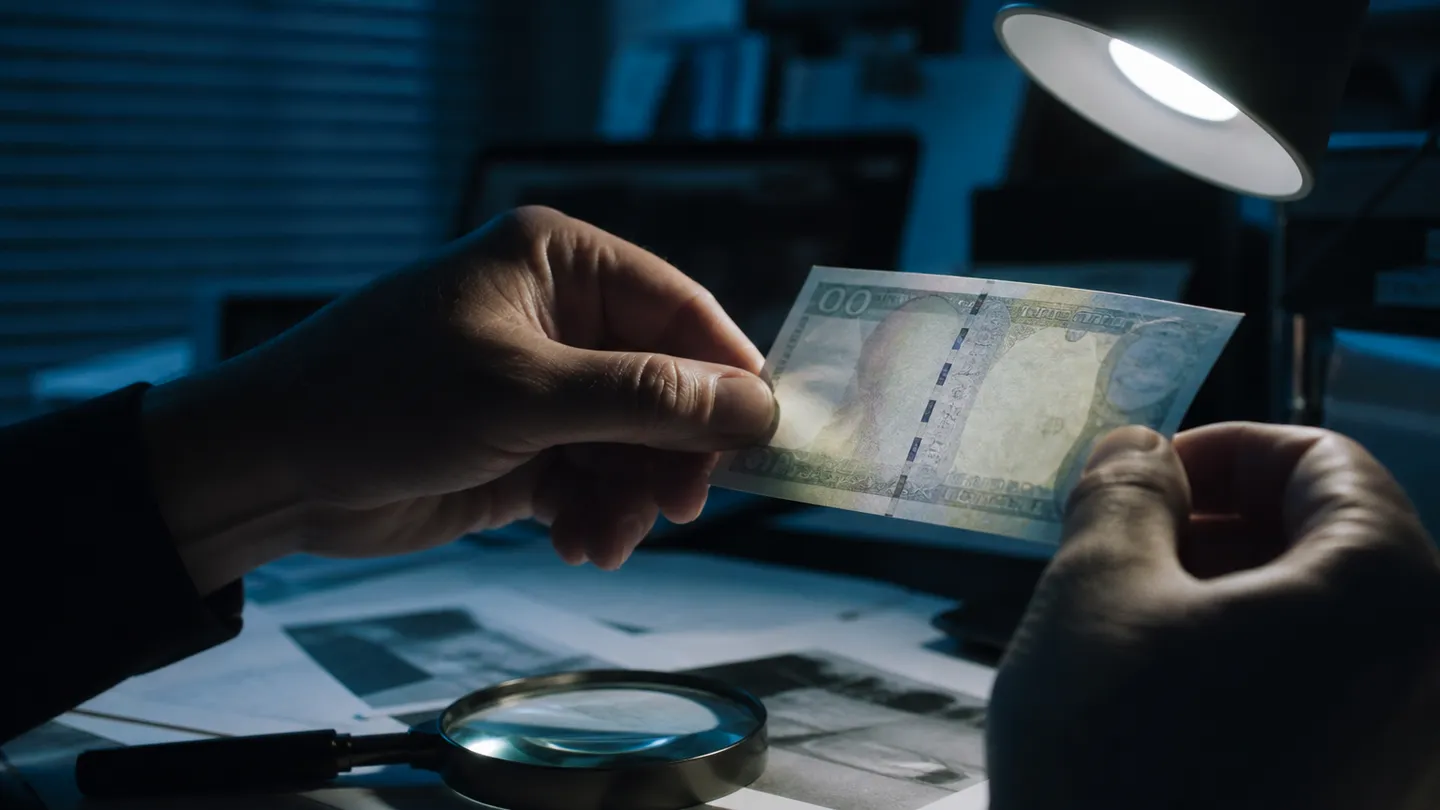
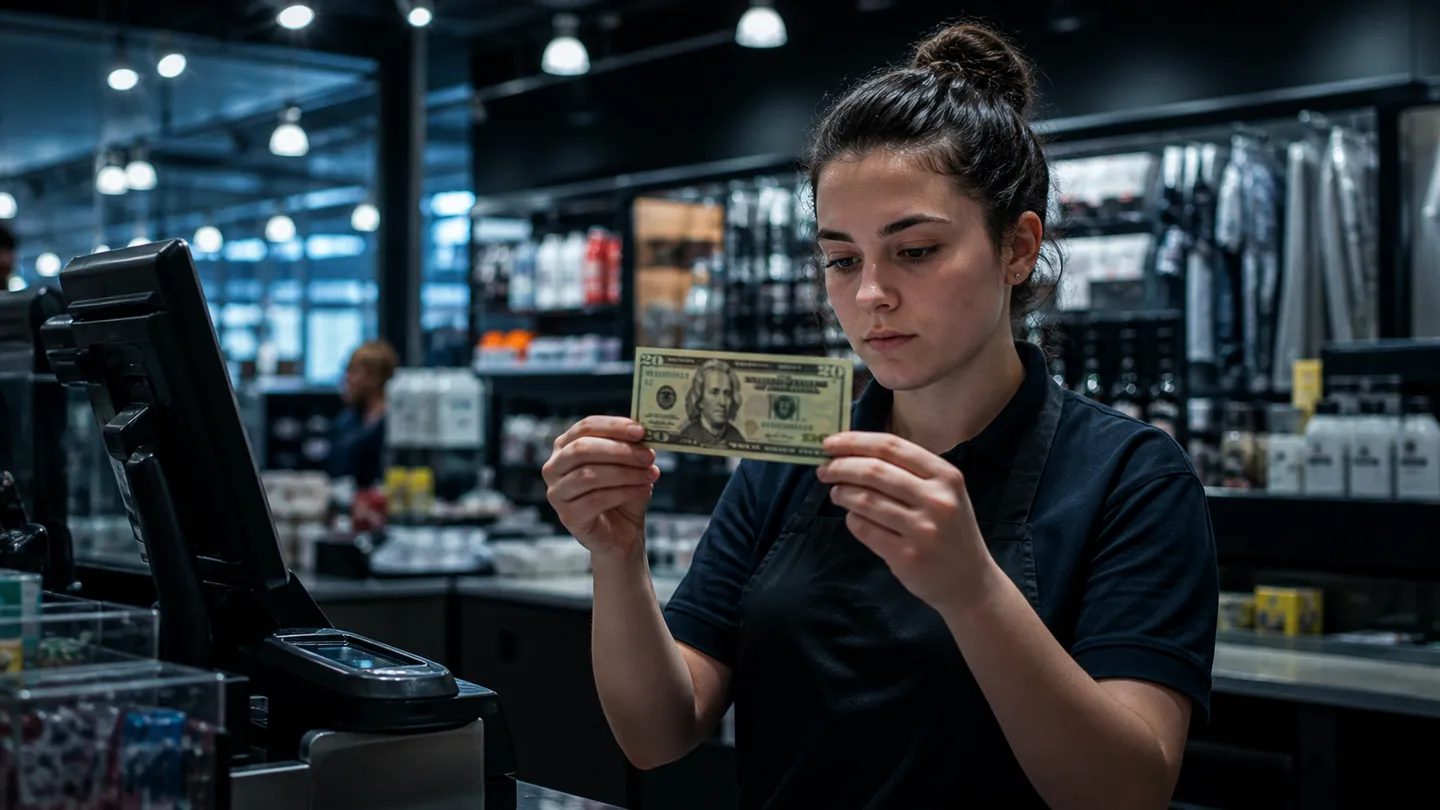
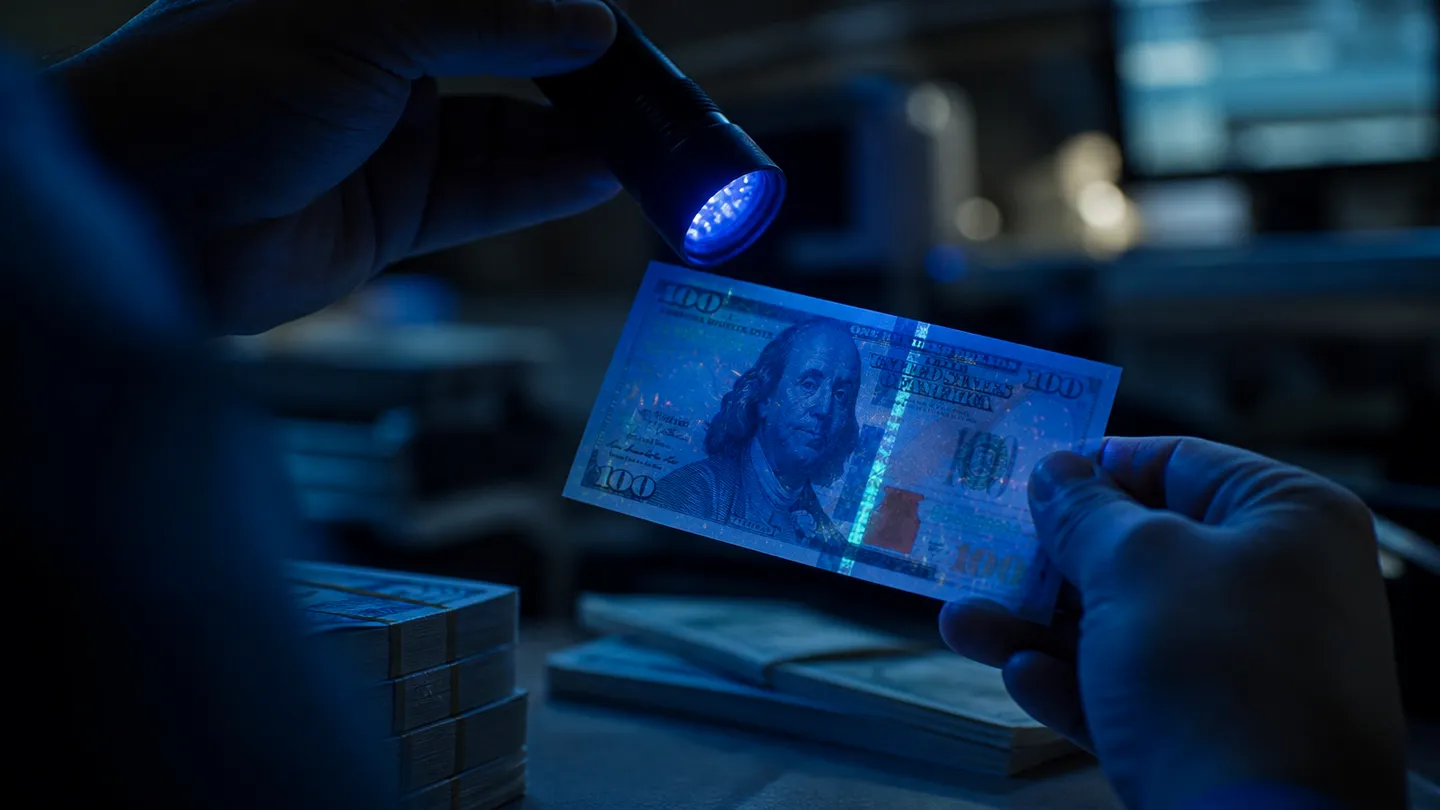
A counterfeit $20 bill is an imitation made to pass as genuine U.S. currency. Compare its paper texture, printing, watermark, security thread, and colour-shifting ink with a known genuine note; if anything seems wrong, do not accept or return it, limit handling, record where it came from, and contact local police or the U.S. Secret Service.
How to Check a $20 Bill in 60 Seconds
To quickly determine if a U.S. twenty-dollar bill is genuine, we recommend a straightforward checklist that utilises multiple security features. Follow these steps for a reliable assessment in just a minute.
First, check the paper. Genuine $20 bills are made from a distinct cotton-linen blend, which feels different from regular paper. Next, examine the raised printing on the note. You should be able to feel the texture of the ink, especially on the portrait and the large "20" in the lower right corner.
Tilt the bill to observe the colour-shifting ink. When tilted, the numeral "20" in the lower right corner should change from green to black. This feature is crucial for verifying authenticity.
Then, hold the bill up to the light. Look for the portrait watermark on the right side, which should be visible from both sides of the bill. Additionally, check for the embedded security thread running vertically through the bill. This thread is inscribed with "USA 20" and glows under ultraviolet light.
Quick Reference Table
| Check Feature | Pass | Questionable | Fail |
|---|---|---|---|
| Paper Texture | Cotton-linen blend | Slightly different | Regular paper |
| Raised Printing | Noticeable texture | Faint texture | No texture |
| Colour-Shifting Ink | Changes from green to black | Faint shift | No shift |
| Watermark | Clear and visible | Faint or blurred | No watermark |
| Security Thread | Present and visible | Faint or missing | No thread |
If any single feature is missing, it may not necessarily mean the bill is counterfeit; it could indicate an older design. However, we advise caution. If you suspect a bill might be fake, avoid accepting it and report your findings to the U.S. Secret Service or local authorities. For more guidance on spotting counterfeit currency, check our resource on identifying fake $20 bills here.
First Identify Which $20 Bill Design You Have
To determine the authenticity of a U.S. twenty-dollar bill, the first step is to identify which design you have. There are three main designs: the current colourized design introduced in 2003, the large-portrait style from 1996, and older small-portrait notes. Each of these designs has different security features, which is crucial for identifying counterfeits.
The current design, which is the most commonly circulated, includes advanced security features such as a portrait watermark, a security thread, and colour-shifting ink. The large-portrait design from 1996 also has some security features but may lack others present in the newer notes. Older small-portrait notes, which were issued before the 1996 redesign, do not include many of the modern security features we rely on today.
Design-Era Security Features Matrix
| Design Era | Watermark | Security Thread | Microprinting | Colour-Shifting Ink |
|---|---|---|---|---|
| Current (2003) | Yes | Yes | Yes | Yes |
| Large-Portrait (1996) | Yes | Yes | Limited | No |
| Small-Portrait (before 1996) | No | No | No | No |
It's important to note that all genuine U.S. currency remains legal tender, regardless of its issue date. If you possess an older design, it may not have all the features of the current version, but that does not necessarily mean it is counterfeit.
When handling any $20 bill, ensure you check for the specific security features based on the design era. If any features are missing or appear suspicious, we recommend not accepting the bill and reporting it to the U.S. Secret Service or local authorities. Understanding these differences can significantly help in identifying counterfeit bills and protecting yourself from fraud.
Check the Paper, Printing, Portrait, and Borders
To identify a genuine U.S. twenty-dollar bill, we should start by examining the paper, printing, portrait, and borders. Authentic notes are crafted from a unique cotton-linen substrate, which feels distinctly different from standard paper. This substrate includes embedded red and blue security fibers, rather than printed fibers, making it crucial to check the texture closely.
Next, we need to feel the raised intaglio printing on the bill. Genuine notes have a slightly raised texture, particularly on the portrait of Andrew Jackson and the large "20" in the lower right corner. This feature is a key indicator of authenticity. The portrait details should be crisp and well-defined, and the fine border lines should be even and clear. The standard dimensions of a U.S. twenty-dollar bill are approximately 6.14 by 2.61 inches, so we can also verify the size against a known genuine note.
Common warning signs of counterfeiting include flat or waxy paper, which lacks the unique texture of real currency. If the printing appears blurry or the ink is smeared, these could be indicators of a counterfeit bill. Additionally, uneven borders or simulated fibers can suggest that a bill is not genuine.
Common Warning Signs
- Flat or Waxy Paper: Lacks the characteristic feel of cotton-linen blend.
- Blurry Lines: Indicates poor printing quality.
- Smeared Ink: Suggests the use of inferior printing methods.
- Uneven Borders: Genuine notes have precise, clean edges.
- Simulated Fibers: Real security fibers are embedded, not printed.
Before accepting a twenty-dollar bill, we recommend carefully checking each of these features. If anything seems off or inconsistent with a genuine note, it’s best to refrain from accepting the bill and report it to the U.S. Secret Service or local authorities. Familiarising ourselves with these elements can significantly enhance our ability to spot counterfeit currency and protect our finances.
Verify the Watermark, Security Thread, and Color-Shifting Ink
To confirm the authenticity of a U.S. twenty-dollar bill, we should closely inspect the watermark, security thread, and colour-shifting ink. Start by holding the bill up to a light source. This will reveal the portrait watermark, which should be clearly visible on the right side of the bill from both sides. The watermark features a subtle image of Andrew Jackson, and its clarity is a key indicator of authenticity.
Next, we look for the embedded security thread. This thread runs vertically through the note and is inscribed with "USA TWENTY." When exposed to ultraviolet light, it will glow green, making it easy to confirm its presence. This is a critical feature that distinguishes genuine notes from counterfeits, as many fake bills fail to replicate the embedded security thread accurately.
Another important characteristic is the colour-shifting ink found on the lower-right corner of the bill. When tilted, the numeral "20" should shift from copper to green. This feature is essential for verifying the authenticity of the current design, which was introduced in 2003. However, it's crucial to remember that the placement and behaviour of these features must match the specific design era of the bill.
Key Features to Inspect
- Watermark: Should be visible from both sides; look for a clear portrait of Andrew Jackson.
- Security Thread: Inscribed with "USA TWENTY" and glows green under ultraviolet light.
- Colour-Shifting Ink: The "20" in the lower-right corner should change from copper to green when tilted.
If any of these features are missing or appear suspicious, it may indicate that the bill is counterfeit. We recommend not accepting the bill in such cases and reporting it to the U.S. Secret Service or local authorities. Understanding these security features can significantly enhance our ability to identify counterfeit currency and protect our finances. For further guidance on identifying fake $20 bills, check our resource here.
Real vs. Fake $20 Bills: Warning Signs and Common Myths
Real vs. Fake $20 Bills: Warning Signs and Common Myths
When evaluating the authenticity of a U.S. twenty-dollar bill, we can compare several key features of genuine and counterfeit notes. Understanding these differences is crucial to avoid accepting fake currency. Below is a side-by-side table that outlines the main characteristics to check:
| Feature | Genuine $20 Bill | Counterfeit $20 Bill |
|---|---|---|
| Texture | Made from cotton-linen blend, feels soft and distinct | Often made from regular paper, feels flat |
| Print Sharpness | Clear, crisp lines and details | Blurry or smeared printing |
| Watermark | Clear portrait of Andrew Jackson visible from both sides | May be faint or missing |
| Security Thread | Embedded thread inscribed with "USA 20," glows under UV light | Often absent or poorly replicated |
| Colour Shift | The numeral "20" changes from green to black when tilted | No colour shift or inconsistent shift |
| Microprinting | Present in various areas, readable under magnification | Often missing or illegible |
| UV Response | Glows under ultraviolet light | No glow or incorrect glowing |
It is a common misconception that a counterfeit-detection pen can reliably confirm authenticity. These pens primarily react to starch, which can lead to false positives on notes that are not counterfeit. Similarly, relying solely on the opinion of a bank teller or the presence of red and blue security fibers is insufficient for verifying a bill’s authenticity, as counterfeiters often replicate these features.
Additionally, it's important to be aware of the altered-note scenario, where genuine lower-denomination paper is reprinted as a $20 bill. In such cases, the watermark and security thread are critical indicators of authenticity. Always ensure these features match the expected characteristics for the specific design of the bill you are examining. If you have any doubts about a bill's authenticity, refrain from accepting it and report it to local authorities or the U.S. Secret Service.
Can a Serial Number Prove a $20 Bill Is Real?
A serial number alone cannot definitively prove that a $20 bill is genuine. There is no public database for checking serial numbers to confirm authenticity. Instead, we should focus on inspecting various features of the bill to determine if it is real.
First, ensure that the serial numbers on the bill match. A common counterfeit technique is to create notes with different serial numbers on the same bill, which is a clear indicator of a fake. We should also check the spacing and colour of the serial numbers; genuine notes have consistent spacing and a specific shade that is difficult to replicate.
Another critical aspect to consider is the series year. Each design of the U.S. twenty-dollar bill has a specific series year, which indicates when it was printed. If the year appears inconsistent with the design of the bill, it could be a sign of counterfeiting. For example, a bill may display a series year that is mistaken for the year it was printed, leading to confusion regarding its authenticity.
Additionally, we should look for Federal Reserve indicators appropriate to the design. Genuine notes contain unique identifiers that correspond to the specific series and design features. If the bill has an impossible mixture of design elements—such as an older series year combined with modern security features—this is a strong indication that it is counterfeit.
In summary, while a serial number is an important part of the bill, it cannot stand alone as proof of authenticity. We recommend closely inspecting matching serial numbers, consistent spacing and colour, a valid series year, and appropriate Federal Reserve indicators to determine if a $20 bill is genuine. If any discrepancies arise during this inspection, avoid accepting the bill and consider reporting it to the U.S. Secret Service or local authorities. For additional guidance on identifying fake $20 bills, check our resource on spotting counterfeit currency here.
Old, Unusual, and Replica $20 Bills
Old, Unusual, and Replica $20 Bills
Older designs, signs of wear, stamps, or writing do not automatically indicate that a $20 bill is counterfeit. The U.S. twenty-dollar bill has undergone various design changes over the years, and it's common to encounter older notes in circulation. For example, bills from the 1996 series still hold face value and are accepted as legal tender, despite their age. It's essential to examine the specific security features associated with each design era to determine authenticity.
However, notes marked with "Replica," "Copy," "For Motion Picture Use Only," or similar phrases are not considered legal tender and must never be passed as real money. These bills are designed for theatrical use and can often resemble genuine currency closely, leading to confusion. The U.S. Secret Service actively investigates the use of such notes in commerce, as attempting to use them can result in legal consequences.
When considering the value of older $20 bills, it's crucial to understand that most circulated genuine notes from the 1996 series are worth their face value. Collectors may place additional value on bills in pristine condition, those that are rare, or "star notes," which are printed as replacements for misprinted bills. The value of these notes is often evaluated by collectors based on factors like condition, rarity, and printing errors. For instance, a well-preserved star note could command a premium in collector circles, but the average consumer should not expect to receive more than face value for a common, circulated bill.
In summary, while older and unusual $20 bills may seem suspicious at first glance, they can still be genuine. Always inspect the specific security features based on the design and avoid accepting notes labelled as replicas. For further information on identifying counterfeit bills, check out our guide on Fake 20 Dollar Bills: Identifying Counterfeits.
What to Do If You Receive a Suspected Counterfeit $20
If you suspect that you have received a counterfeit twenty-dollar bill, the most important step is to avoid spending it or passing it on to someone else. Do not confront the person from whom you received the bill in a way that might create danger. Instead, handle the bill as little as possible to preserve any potential evidence.
Start by recording details about where and how you received the suspicious bill. Note the time, date, and location of the transaction, as well as any descriptions of the person involved. This information will be essential when reporting the incident.
Next, contact your local police department or the nearest U.S. Secret Service field office. The Secret Service is responsible for investigating counterfeiting and can provide guidance on what to do next. It's crucial to understand that if you turn the bill over to authorities, it may be retained for examination. Unfortunately, holders of suspected counterfeit currency typically are not reimbursed for the note, even if it is confirmed as fake.
For businesses, it's vital to follow established cash-handling policies when dealing with suspected counterfeit notes. Training staff on how to identify counterfeit currency and the correct procedures for handling it can help prevent losses.
In summary, remain calm and avoid using the bill. Record relevant details, report the incident to authorities, and adhere to your organisation's cash-handling protocols. Taking these steps can help protect yourself and others while assisting in the fight against counterfeiting. For more information on identifying counterfeit bills, check our guide on Fake 20 Dollar Bills: Identifying Counterfeits.
Counterfeit $20 Bill Security Features Matrix
| Feature | Current Design | Older Design | Notes |
|---|---|---|---|
| Security Thread | Glows green, inscribed 'USA TWENTY' | May vary, often absent | Check for presence and glow under UV light |
| Colour-Shifting Ink | '20' changes from copper to green | Depends on design era | Older designs may lack this feature |
| Watermark | Clear portrait of Andrew Jackson | May differ in clarity | Older bills still valid if features match |
| Microprinting | Present and readable | Varies by design | Check for legibility under magnification |
| UV Response | Glows under UV light | Depends on design | Older notes may not glow |
| Texture | Cotton-linen blend, soft | Regular paper, feels flat | Texture can indicate authenticity |
Common Mistakes and Misconceptions
Shortcuts create confusion.
Before deciding whether to accept a questionable note, we suggest this quick sequence:
- Identify the design family before checking its expected features.
- Use checks based on different properties, such as transmitted light, print quality, and tilt effects.
- Stop the transaction if the results conflict rather than guessing.
Every Genuine Note Must Resemble the Current Design
People often compare every bill with the newest design because it is the version they recognise. Current-style notes, earlier large-portrait notes, and still-earlier small-portrait notes should not be judged using an identical feature list. We should identify the design family from its overall layout, then check only the security features appropriate to that design.
One Convincing Feature Proves the Bill Is Genuine
A convincing watermark, texture, or colour effect can create false confidence. Counterfeiters may imitate individual features, while damage and wear can make a genuine feature harder to assess. We advise combining independent checks involving the paper, printing, transmitted light, and movement; conflicting results deserve closer examination.
A Counterfeit Pen Gives a Final Answer
Counterfeit pens are popular because they produce an immediate and simple-looking result. The mark reflects how the tested material reacts, not who printed the note, whether its denomination is correct, or whether other security features match. We should treat a pen as a screening aid and never as the sole reason for accepting a suspicious bill.
A Serial-Number Website Can Authenticate the Note
Online serial-number tools may identify interesting patterns or help with collector research, but they cannot authenticate the physical note. A counterfeiter can copy a plausible serial number, so a successful search says nothing about the paper, printing, or embedded features. We can treat mismatched or poorly formed serial numbers as warning signs, but a normal-looking number is not proof.
Cashiers Should Confiscate the Bill and Confront the Customer
Employees may feel responsible for stopping a suspicious note immediately, yet an accusation, pursuit, or improvised seizure can escalate the situation. At a Seattle counter, we advise pausing the transaction, involving a supervisor, following the organisation's written cash policy, and prioritising personal safety. If the note has already been accepted, keep it separate, record objective transaction details, and contact local police or the U.S. Secret Service rather than attempting to spend it.
Conclusions
Use a layered check.
- Start by recognising the note’s design generation, since an older twenty-dollar bill may lack features found on newer issues.
- Compare several independent details, including feel, print sharpness, light-visible elements, and changes seen when the bill is tilted.
- Treat detector pens and serial-number searches as supporting tools, not decisive authentication methods.
- Before accepting a doubtful note, pause the sale, involve a supervisor, and follow the business’s cash-handling procedure without confronting the customer.
- If the note is already in hand, keep it separate, document the transaction, and seek guidance from local police or the U.S. Secret Service.
For the next step, use our Fake US Dollars: How to Spot Them guide to build a repeatable cash-checking routine.
Straight answers
How to spot a fake $20?
We recommend comparing the note with a known genuine bill from the same design family. Check the paper feel, raised printing, sharp borders, watermark, embedded security thread and tilt-dependent ink rather than trusting one feature. If the watermark or thread indicates another denomination, reject the note even if a detector pen gives a favourable result.
What bill is counterfeited most?
No single denomination is consistently counterfeited most in every place or period. Without current official data, we should not assume the twenty-dollar bill leads simply because it is commonly handled. Treat every denomination with the same layered checking routine.
What happens if you accidentally pay with counterfeit money?
A cashier may refuse the note, involve a supervisor or report it, and the note may be retained for examination. An honest mistake differs from knowingly passing counterfeit currency, so we advise explaining where you received it and cooperating calmly. Do not try to use the note elsewhere after someone identifies it as suspicious.
Is an old $20 dollar bill real or fake?
Age alone does not make a twenty-dollar bill fake. We should compare its portrait, seals, layout and security elements with a reliable reference for that particular design, not with the newest note. Heavy wear can obscure genuine details, so ask a bank to examine it if the checks remain inconclusive.
Can you check a $20 bill with a serial number lookup?
A lookup can help identify an unusual serial pattern, but it cannot authenticate the physical bill. Counterfeiters can copy a valid number, while genuine notes can have ordinary-looking numbers. We should rely on the note's printing, paper and embedded security elements instead.
Is a counterfeit $20 bill worth anything?
A counterfeit twenty-dollar bill has no face value and cannot legally be spent as money. We advise keeping it separate from genuine cash and contacting local police or the U.S. Secret Service for instructions. Do not sell or give it to someone who might mistake it for legal tender.
What should you do if a bank says your $20 bill is fake?
Ask the bank to explain its procedure and provide a receipt or other record if it retains the note. Write down the branch, employee, transaction details and where you received the bill, then follow any reporting instructions from the bank, local police or the U.S. Secret Service. Do not demand the note back so that you can try spending it elsewhere.